
by Giliann Karon (@gilposting)
Since its inception in 2010, Radiator Hospital has been Sam Cook-Parrott’s go-to artistic persona. His project takes whatever form he’s feeling at the moment, whether it's a stripped-back solo concept or a robust four-piece, all while flying just barely below the radar of mainstream indie success. Late last year he was offered a touring opportunity, prompting him to tinker with the basic mechanics of songwriting. Distorting Time chews up Radiator Hospital’s foundations and sticks its thumb in the eye of an industry that rewards nostalgia over evolution.
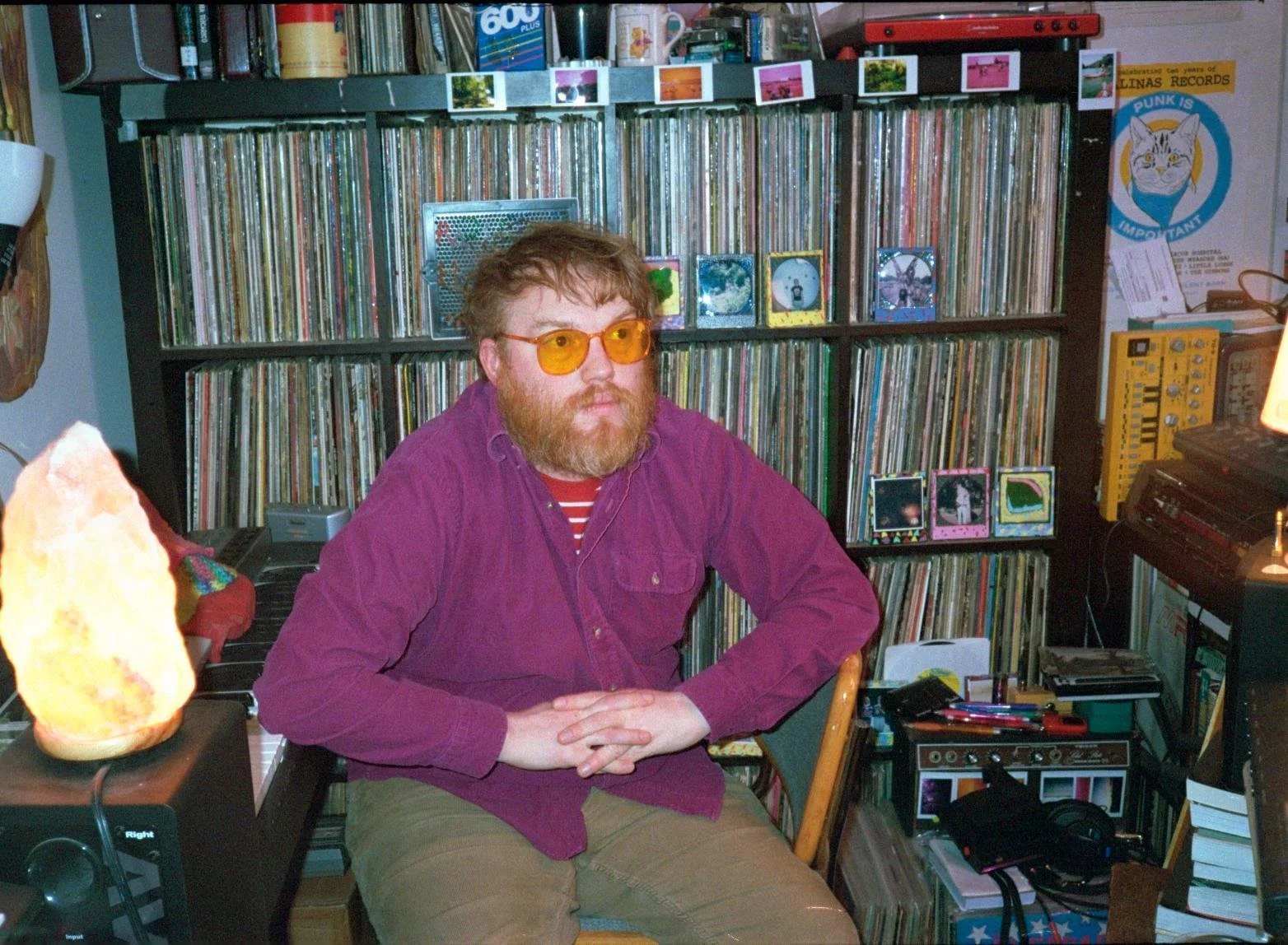
GILIANN KARON: Over the past sixteen years, your lineup has changed so many times. How do you articulate the evolution of your band's sound across all those eras, and what is Radiator Hospital now?
SAM COOK-PARROTT: There's a through line for me, which is that they're my songs. I've tried to do them in many different ways over the years. When I first started, there were three different versions of Radiator Hospital. It could be a home recording project where I made four-track recordings, a solo acoustic act, or a band. The live band felt like an extension of the recordings. Over the course of many years, it shifted.
There were times when it really felt more like a four-piece rock band. It wasn't a solo project at all. It was a band, but even then there was an aspect of it as a solo project. I always wrote the songs on my own, and I always had a couple of songs on each record that I played entirely by myself anyway. The band I played with for many years stopped playing together, but I didn't want to keep doing it solo. But when I started doing this new live act, I decided I wanted to make another record.
Now, when I play live, I have a four-track playing all my backing music, and I just sing over it. If you see me at a show, it sounds loud. It sounds like a band is playing 'cause there's a full backing track. It's kind of this hybrid where it's not quite just a solo acoustic singer-songwriter thing, but it's not really a band either. In a lot of ways, that feels like what Radiator Hospital always was. I haven't done this before, but it's a natural continuation of the project.
GK: When you think about yourself as a touring musician and a career musician, especially in relation to having a day job, how has that understanding shifted over time?
SC: It's definitely changed because I now make my living from music. I haven't had to have a day job, like working at a coffee shop. That's what I did for most of Radiator Hospital's life as a band, but I haven't had to in a little while. It hasn't changed how I make music the way I thought it would.
I never wanted to rely solely on my music for my income. I was afraid of what would happen when I didn't feel like making music, when it felt like it had dried up. I've always liked having a job on the side as a steady source of income, but making it my main income has given me time to focus on my music in a way I didn't have before. It’s fun and exciting, and it's not as stressful as I thought. I have a lot of songs about my struggle with having a job and feeling like all I wanted to do was make music, but I was stuck doing something else. Now, I don't have to write songs about that as much anymore.
GK: Congrats! That’s such an exciting milestone. Do you think that you have more room to play and experiment now that this is your primary source of income?
SC: It'll be interesting because I'm doing something different, but still calling it Radiator Hospital. Whether people continue to follow me down this path remains to be seen, but I feel like I have the freedom to do whatever I want. I’ve always kept overhead low. I have cheap rent and cheap bills, so that's really how I can afford to live without a formal job.
GK: Your album cycle was kicked into gear when you were offered the opportunity to tour. How did that jumpstart your creative process? Had you been thinking about an album for a while, or was it an opportunity you stumbled upon?
SC: I had been making songs, but I didn’t necessarily think of them as Radiator Hospital songs. I was trying to figure out my next move. I got offered this tour as Radiator Hospital, and I asked if I could play solo. They said yes. I've done many tours where I played electric guitar solo and sang.
I could play a 30-minute set of my usual material, but I wanted to do something different, so I used a four track to play my backing music through the house. That’s what inspired me to do the record, because I could see how I could do this live show and present my new songs in this way. It was a path forward for me that allowed me to play my old stuff in a new and exciting way.
GK: At what point did it start to feel like a cohesive collection of songs?
SC: It evolved that way as I was making it. I set out to make the record in a pretty short period of time. I knew when I wanted to be done, so I had to work within this short time frame. Because of that, I poured myself into it every day.
I was doing it like it was my job. Not having to work meant I could treat my music like my job. I could wake up every day and plug away at songs. But the nature of songwriting is that you only ever write one at a time. I’d finish a song and feel excited, but I always knew there was still so much left to figure out.
The record cohered because of that process, and I ended up writing about the passage of time and how to condense or stretch it. I was trying to make the record in a really short period of time, but also make it feel expansive.
GK: Your album touches on nostalgia. We see it as a branding concept in all of these anniversary tours. Everything that’s old is new again. What is your personal relationship with nostalgia, and why is that something that you didn't want to play into on this last album?
SC: I’d see bands that started around the same time as me doing anniversary things. I didn’t want to do that. I don’t want to be an oldies act yet. I’m not there. I don't wanna do nostalgia shit. I don't wanna go on tour and play the songs the way people think they are supposed to be played, just because that's how the record was. I've never been that way.
I've always wanted to make my new music. That's what I was doing back when we made our earliest records. We were already playing new shit by the time the record came out. We had already moved on from it. That's how I think about music. I just wanna get out and make my new stuff.
I understand why people have that nostalgic itch. I’m splitting the difference. I’m doing new versions of my old songs that don't necessarily sound exactly the way they do on the record, but I'm trying to put that same amount of myself into it, that same amount of heart. I wouldn't play a song from twelve or fifteen years ago exactly as it was on the record. I'm not 21 anymore, so it's not gonna be the same. It would feel disingenuous to me, and I think it would be disingenuous to the audience. I’ve always resisted anniversary tours.
I get why people do it. That’s how you sell tickets. If I were doing an anniversary tour of a certain record and playing it note for note, maybe I would sell more tickets than I do now, when I intentionally do something different but still call it Radiator Hospital. I don't wanna just be making songs that sound like my old songs or doing some kind of fan service. I wanna just keep doing my thing, and I hope the people who liked my music before like what I’m doing now.
GK: I think anniversary tours have been run into the ground. Some of them serve a purpose. I saw the Postal Service a couple years ago, and I had never seen them before. But when it's a band that is still kicking, why can't I just see you on a normal tour?
SC: I get why it's a thing that people have to do. I think of it like The Monkees. I'm a huge fan, but they had this comeback in the mid-'80s. If you look at their comeback record and their comeback tour from the mid-'80s, these guys look so corny. They look so '80s-ed out, but they're '60s guys. That's always what I think when people are doing these 15-year anniversary tours.
I don’t wanna try to squeeze into my old shorts and do it the way I did back in the day. I'm trying to do something that's cool to me now. Micky Dolenz from The Monkees is the only one left, and he still tours. If I'm gonna live to be old and I want people to come see my show, then I'm gonna have to do some fan service and play the songs they like. The trade-off is that I can do my new stuff, too.
GK: I think leaning too hard into nostalgia can deny you the opportunity to witness your music evolve over time and take on new meaning.
SC: I get to do the opposite. I get to see how my old music fits into my new thing. Instead of trying to squeeze my new ideas into this form factor that I think people want, I can keep doing my thing and present the songs I know people wanna hear in a new way.
GK: Throughout this album cycle, have there been any songs from your catalog that have taken on new meaning?
SC: I don't know if it's a new meaning. A song that is thirteen years old has a different meaning to me now than it did when I wrote it. When I do something now, I bring a whole lifetime's worth of knowledge and feelings into it.
When you make a song, people take their own meaning from it. Even my newest music might mean something different to me than it will to you or anybody else seeing me live. There are always new meanings coming into my songs.
GK: What did you try on this album that you had never done before?
SC: The biggest difference would be how I approached making songs. For a long time, I would sit with the chords and write a complete song before I started recording. For this record, I often started recording before I had a song made. I made a drum beat, recorded it, then played bass over it, and kept adding instruments until I put words to it.
GK: I love that you used Oblique Strategies on this album. Is that something that you had done before?
SC: I've had a deck of Oblique Strategies for a while, probably ten years. I love to draw a card and let that shape where I'm gonna go next. I love distorting time, and I like that it’s something I’m thinking about. Like I was saying about starting the song from the ground up, beginning with the drum machine and then adding bass, I'm thinking about distorting time before I'm thinking about the words to the song.