
by Aly Eleanor (@purityolympics)
If you prioritize the relationship, the music will follow. After their creative partner moved across the world, Josaleigh Pollett needed to recalibrate. They had just released an album, suddenly faced with touring it solo, which only compounded the looming, uncertain creative future. By taking time and space to stay connected as friends first, Pollett and Jordan Watko (aka Crowd Shy) ended up transforming the turbulence into a new LP, If I Let It Quiet.
Full of what Pollett calls “over-thinkers’ anthems,” If I Let It Quiet is album-as-self-discovery, simultaneously a deeply personal artifact for the people who made it and a compulsively listenable sequence of electronic pop-rock songs for the rest of the world. Post-Trash caught up with Pollett ahead of the album’s release to talk productivity, trans-Pacific musical songwriting partners, loving Ratboys, friendship, and more.
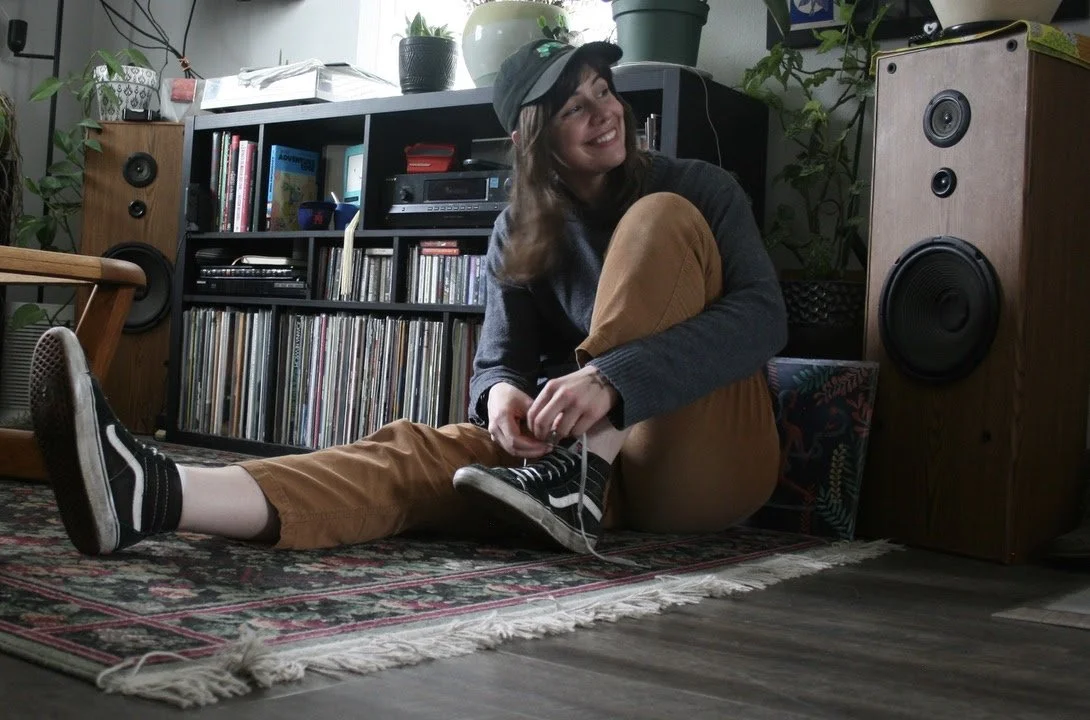
This conversation has been lightly edited for length and clarity.
Josaleigh Pollett: I’ve just got to say it — it helps with the conversation that I can see your face and that you're a person I'm talking to.
Post-Trash: Unless it's an actual technical detriment and it’s not practical. Like, please. It's just so I can see that you're a person and so you can see that I'm a person.
JP: Exactly. It helps the writing process so much.
PT: I'm sure it helps the interviewing process, too. As much as you can recall, what first drew you into making music? Not just caring about it, listening to it, enjoying it. Do you still feel in touch with the person who fell in love with it?
JP: It's hard to pick a specific point. It was a path that I wanted to go down as a young person. I feel lucky to have come from a very musical family. My dad was always in bands and he had practice in the house, at least twice a week. There were always musicians around. For as long as I can remember, a musician was the coolest thing you could be. People are coming over to be loud and play noisy things. It felt so natural to me that it skewed my understanding of people. I figured everybody had band practice at their house every week or had a drum set in the living room. If you had a feeling, you just hit the drums about it. It became a very natural part of being a human being for me. You're making music, that's what people do. That's what the adults in my life do, so that's obviously what I will do as well.
Both of my parents were also big music fans. We were going to a lot of concerts when I was very young, listening to so much music all the time. I remember very few of the camping trips or road trips that we took as a kid, but I always remember what we were listening to in the car. Like, that specific Paul Simon greatest hits or that Tom Waits cassette. I don't know what we were doing or where we were going, but it sounded really good when we got there. This is naturally how I want to exist and how I express myself, which has followed me into adulthood. The part that I've been able to stick to and carry in myself is that music is the main thing. It's the water we're swimming in, it’s the air you're breathing. Everything else you get to figure out. I’m grateful that I've never lost that. It was never a super conscious choice to make music, it just became me.
As I've gotten older, I’ve wondered if this is always going to be consistent. I know so many people my age that I used to play shows with that are like, “Oh, well, I got married and got a job and I don't really play in bands anymore.” And that's sad to me. I was never on a trajectory of thinking that I could [choose to stop making music]. I have to continue doing this because it's who I am.
PT: It's your true north. Even if you go down a different path, it's what you return to.
JP: It's an ever-present force that you can choose to engage with in a lot of different ways, but it's still going to be there no matter what.
PT: It doesn't leave you even if you step away for a bit. Speaking about the almost-heartbreak of your core collaborator, Jordan Watko, moving across the world, you stepped away from working on music together and prioritized your friendship. The relationship was changed, if only by time zones and distance. Even among collaborators and bandmates who really love each other, it's hard to prioritize the relationship over the art that you make together. Does this duality between friendship and music influence how you collaborate, with whom you collaborate?
JP: I noodle on this question a lot. I’m lucky that Jordan and I have such a collaborative and creative friendship. The music that we create is both the reason for the friendship and a result of the friendship. It feeds into itself in this way. I played in bands when I was younger; I would do harmonies with friends. I always enjoyed collaborating with other musicians, but it never felt like this world-opening magical experience until I started working with Jordan. We clicked as friends immediately — we speak such a similar language though we're such different people. We bring so much to our regular conversations, not just when we're working on music. I didn't realize the depth that collaborating could bring you if you had such an incredible friendship.
I've always been such a fanboy of friendship in general. My platonic connections with people have always been where I get the most understanding. I've gotten the most longevity that way, you see this other person changing and growing and you're there because you want to be. This very different type of love has always filled my cup. I already felt that way when Jordan and I started creating music together. It was like a magical world, a cracking open of my heart and my understanding of what my music could be. I can take this beautifully sizzling thing that is friendship and have it feed my art in a way that is so nurturing. I hadn't explored those things together before then.
With his moving, I felt very real grief and heartbreak. It was a meeting of friendship and creativity that I had never experienced with anyone before, so when he moved away, I was like, “This hurts more than any breakup I've ever had.”
PT: And it's a separation by totality.
JP: He was so kind and reassuring through all of it. We put music to the side for a while, because both of us were going through big changes and he’s trying to get settled in this new place. We're just connecting and talking. But because of the nature of how we create together, where our shared creative process and friendship are so deeply intertwined that even if we're not intentionally working on music, we always make our way back to it. Even if we have a FaceTime schedule and we're just going to catch up about the week, we end up showing each other songs or sending demos. Those two things are so intrinsically linked now that it's hard to pick them apart. Our friendship is so creative, and the music is so friend-focused.
When I see a band live… The band that comes to mind is Ratboys, because every time I go see Ratboys, I'm moved to tears by how much you can tell they love each other on stage. They're so thrilled to be onstage and making music together. It comes through in the music. I not only want to feel how much the people making it care about it, but how much they care about the collaboration itself and how they're interacting as people. It's become a priority to make sure everything is built on love and a shared language of understanding, regardless of who I collaborate with. It’s linked to your humanity and who you are as a person. As we bring in new collaborators, we make sure we connect with them on a friendship level first. Then we know that we can get into the weeds of the nitty gritty Ableton file-sharing bullshit with somebody.
PT: Musicians end up friends with a lot of other musicians, which sometimes makes it easier to find collaborators, surrounded by people who you love separately from the music that they may make.
JP: Yeah, absolutely. Especially creating music the way I create music, the way so many people I admire create music, is very DIY. Booking your own tours, setting up your own shows, hand-making merch. You can't do any of it alone. You have to build a community and build friendships inside those spaces, or you just can't do it. Because music is so big and vast — there are so many genres, so many themes, so many cities, so many countries. You can find your people within different sections of it at all times. Who are my people in this giant, crazy thing we're all trying to do?
PT: Between when you released your last record and during the ensuing transitional period, what has been your relationship with productivity as an artist? Not everything is going to be born from a song-a-day project.
JP: I think about my relationship to productivity often. I have to constantly be investigating myself because I am so susceptible to comparing myself with my favorite bands, sometimes putting out an album or two a year. I can hold myself to a standard of, “if I'm not making something and putting it out, am I doing something that's worthy?” I have to rein myself in and remind myself that the act of creating and writing and performing is enough on its own. It’s a value I hold so dear, but one that I can lose so easily. You’re trying to balance between doing it because you love it and needing something to prove that you’ve been doing it. No, you don't. You don't need to do that.
When Jordan first moved away, I was surprised by how insecure and anxious I felt about my music without him. I wish I could return to that point and show them a little snapshot of where we are now. You're still going to make music, you're still going to tour, it's going to be fine. I had no data backing that up at the time. I was worried the friendship would disintegrate and we’d never make music again. I was so uncertain in that and it showed up as insecurity in myself. I’d been a solo artist, playing shows with just me and my guitar, for my whole life before that.
I was faced with the fact that I could keep doing that but it didn’t feel like enough anymore. How do I interrogate that and prove to myself that, even though I have this beautiful collaboration, I'm creating something bigger? How do I make sure I'm taking care of myself? I still value myself as an artist, and what I do is enough on its own. It's just a different world. So right after Jordan moved, I booked my first ever solo tour; I just did shows by myself. I was trying to convince myself, “This is enough and this is important to me.”
PT: It's hard work, even more challenging solo.
JP: I know logically that I'm enough on my own, but I might need to go play some shows and connect with people and hear it from them. Jordan and I could stop making music together tomorrow and I would still have to figure everything out. It was a reminder that I can always count on myself. Knowing that I can [do these things] gave me confidence and greater ability to show up outside of this anxious place.
PT: Ultimately it's an outpouring, even if it is still work. It takes time and effort to write or record a song, to get your ass on the road. Once it becomes only work, forced work, you need to reassess and get back in touch with why you make music.
JP: I run into it so much with people trying to promote their music in the age of the social media grind. PR in general is so much work and there's no guarantee on any of it. You have to be able to reel yourself in and just be like, “I'm not doing this for streaming numbers, I am doing this because I love to create.” It's easy to get lost in the sauce. It's a shit ton of work and it's really easy to be disheartened when you don't have anything to show for it. But if you had a good time, is it really work?
PT: Letting it be enough is a really fucking difficult thing to do, swimming through the ever-thickening fog of modern art-sharing and “content creation,” as they like us to call it.
JP: It's awful. I can't imagine how much better of a world we could have if we didn't have to do any of that stuff. I'm constantly angry that this is the reality that we live in. Like, fuck, this is how I need to engage right now. We live in the moment and it's easy to get lost in that.
PT: If I Let It Quiet draws on feelings of impermanence and transience, which comes across not just in the lyrics but the music as well. Was there a point when you realized, whether simply due to accumulation of songs born out of a similar time and mosaic of feelings, that you had an album on your hands? In your words, what were you pouring into the songs as you were writing them?
JP: Right after he moved, we put music on the backburner. We were only a year or so off the last record [In the Garden, By the Weeds]. It was a ton of work to create because we made it all at home. We knew we didn't want the pressure of anything like that. Jordan was in a new country, he doesn't speak the language yet. I was also experiencing so much change at home. Relationships were changing, I had recently quit drinking. We needed to prioritize our friendship, not to put on any pressure. We don't need to [jump right into] a new album.
We ended up playing Kilby Block Party in spring of 2025, and Jordan came back for a month to play in the band. We had like 3 or 4 songs that were kind of half-baked, some ideas around them, nothing super concrete. I was writing from this very anxious, insecure place — lots of big changes, lots of navigating the impermanence of things. When he was here, we started digging a bit more. Jordan and I can get on a subject and end up yapping for like three hours. We had one of those moments when he was here for that show. We were talking through themes to explore and how to explore them. By the end of the conversation, we had both realized that we're writing an album. It was a meta moment of us navigating our long distance friendship and creative partnership, figuring out how to let each other grow in different places while also learning this new way to grow our relationship, and realizing [all of it] together is the subject matter itself. The act of creating the album is also the act of processing the nature of change and what we're going through.
I’m grateful it comes across as an exploration of a lot of change and impermanence. There was so much anxiousness on my side, lyric-wise. Making an album about distance is too on the nose when you just moved 8000 miles away, but then it became more about emotional distance and relationships with other people. Moving away from your family for the first time creates new dynamics that you have to sift through.
[The move] was impacting us sonically too, because suddenly Jordan was limited by how much he could get to his new apartment in Japan. We had to figure out technological limitations. While he was visiting last year, he got a little Tascam field recorder. I wanted to make sure there were sounds of our environments on the record because those are things we were missing. He recorded a parade going down the street, voices from his partner's family on a road trip dealing with this car rental car beeping, so many sounds from his surroundings, in addition to sounds from me. We had to figure out how to capture this in a way that's sewed together but separate, how to explore trying not to keep things from changing while they’re actively changing. How do we capture those feelings on record? Before he even moved, we had kind of determined that we were working on an album.
If we try to keep our relationship the same, that's where the pain will come in fullness. If you hold on to anything too tightly, too afraid to let it grow into something new, that's where the true distress of being alive comes from. We had to be so intentional to navigate these things, but our relationship grew closer. We were doing a FaceTime call every week just to keep up with each other. We would see each other regularly when he lived here, but it was much more spontaneous and random. Sometimes we’d go several weeks without seeing each other.
PT: A weekly check-in is a beautiful format.
JP: It ended up growing our relationship and musical partnership so much. It became an act of letting [the relationship] change into something else. We know this is going to be a chaotic time, we know there are going to be technological difficulties and timezone issues. It's hard to catch each other and create something when you're on completely different days. As we were deciding to make the record, we needed to lean into how weird shit was feeling, finding a way to express it through collaboration in a way that's representative of how fucking weird this all feels. And so it got to a very strange, fun, weird, beautiful, meta place. We got through the changes by making this album.
PT: The record captures a fragmented-ness, not of any particular thing, but of everything. When you sing the title of the record, it's just about letting things be quiet and fighting solipsism, to fight our tendency to believe our minds and selves are the only things. Especially on the last couple tracks, the record starts to push beyond being trapped in your mind, a prison of your own making. Do you know the drawing of the bird in a cage with only two bars? That's kind of how it feels.
JP: I'm so glad that that comes through, because that definitely feels like the journey of the record. Just like starting in this anxious, confined, and terrible place, and then realizing that you put yourself there.
PT: It's not like it was set out as a narrative. It's how things naturally unfold. Maybe that's just a testament to good sequencing. Was there anything else you wanted to talk about that we missed earlier?
JP: [If I Let It Quiet] is such a friendship album to me, and a processing album. The act of writing is the act of processing of the thing. I always wonder about people who don't express themselves through art — like, how do you navigate anything?
PT: If you aren't pouring out your feelings somewhere, they accumulate. You're going to be full of metaphorical paint that you have to put somewhere.
JP: I'm grateful those feelings are coming through. It’s a very human thing, regardless of what the conflict is, to worry if it comes across in a way that anybody listening can place it into [their own] frame. My favorite thing about being a fan of music is hearing somebody else's experience, however specific, and feeling it resonate with my life.
PT: It's such an oddly pure way of making it about ourselves.
JP: Yeah, it's not selfish.
PT: It's human nature. I mean, I'm sure it can be selfish. I don't want to speak in absolutes, but it's a way to understand things through the prism of other people. I always end interviews with the same question: what is something you love about your creative self?
JP: I love this question. What initially comes to mind is how reliable my creative self feels. Even if I spend several hours playing the same three fucking notes and hitting my head against the wall with lyrics that are not working, there's always a point where something comes out of it, even if it’s just realizing whatever I was doing was not working. I always feel able to grow my creative self if I just allow it to be on all the time.
That was something I appreciated with the songwriting challenge. Even at the end of the most haggard, terrible, busy, stressful day, I have to write a fucking song now. I felt so reliable and no matter what the day looked like or what was going on around me, I could tap into something.
Sometimes I would be pleasantly surprised, like “Damn at the end of a sleepy day, I wrote a song proud of. Or “Of course I wrote a song that fucking sucks ass today, it was a terrible day.” It’s like reliable magic to me. I don't understand how it works or what makes it happen, but I think everybody has it inside of them, and if you just poke at it enough, something will come out.
PT: Reliable magic is a beautiful way of putting it.