
by Brett Abrahamsen
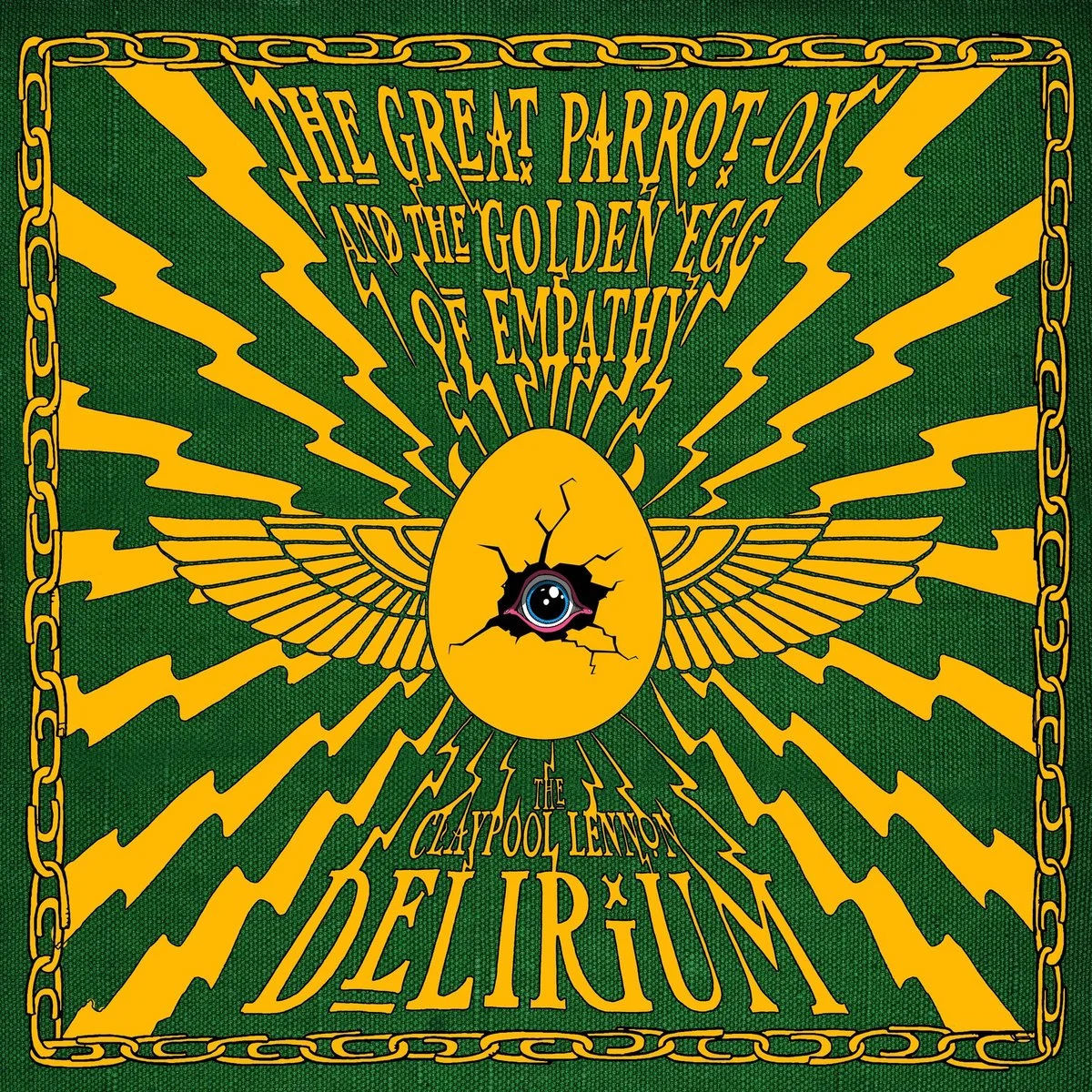
Les Claypool is one of the most creative eccentrics of the modern era, and his latest album under the Claypool Lennon Delirium moniker - The Great Parrot-Ox and The Golden Egg of Empathy - does much to cement that status. It’s arguably the spaciest album of his career, and perhaps the best of his collaborations with Sean Ono Lennon.
After a bonkers “Pro-Log,” the proceedings start in earnest with “W.A.P.” (no relation to Cardi B). Claypool’s melodic bass lines soar over a percussive racket, an impressive and powerful contrast. A spacey organ comes into the mix before Lennon intones his pop lullaby. Lennon’s tune is no more impressive than those written by his father’s overrated band The Beatles, but - thanks to Claypool’s spectacular arsenal of sounds - Lennon’s lame litany gives the whole an appealingly skewed feel, sort of like Jellyfish or an Elephant 6 band. An orchestral outro, ominous synth distortion, and yet another fantastic Claypool bass line provide the coda for the tune.
Claypool sings on “The Wake Up Call,” a bizarre and surreal track. An ominous choir introduces “Meat Machines,” soon annihilated by a bass line that recalls Claypool’s early days in Primus. “Troll Bait” doesn’t quite work, but “Simplest of Deeds” is one of the album’s highlights, as Claypool’s bass merges with a haunting sitar drone. Syd Barrett-like songwriting and some bizarre sound effects contribute to the early Floyd-ian feel of this track. “Heart of Chrome” starts out weak but features some spectacular synth work later on, as well as some poignant guitar lines. Claypool’s bass returns to the fore on “Through the Horizon,” a track which, again, features some elegiac guitar work. The Kinks-like “Mantra of the Manatee” is one of the album’s weaker tracks, though it does briefly incorporate some intriguing psychedelic chaos towards the end of the song. Claypool’s bass effortlessly straddles the line between funky and melodic on the title track, which features Will Smith’s daughter Willow on vocals. Her performance is uninspiring and the synth line seems to steal from Joy Division’s “Day of the Lords,” but Claypool’s bass redeems the track. “Cliptopia” and the (perhaps) thematically related “Cliptron Scuffle” both have interesting elements. “Melody of Entropy” lives up to its title (with a bit too much melody and not enough entropy, though). The album concludes with the 12-minute “It’s A Wrap.” The opening and closing sections are quite beautiful, and the second half of the song in general is intriguing and creative.
All in all, this album proves that Claypool is one of the greatest bassists of all time. He still amuses and amazes, thirty years after his heyday. Lennon, on the other hand, disappoints - he is maybe even more boring than his father, a nearly impossible feat. Nonetheless, the album impresses thanks to Claypool’s stunning performances and demented mind. Anyone who was turned off by Claypool’s more humorous side in Primus (or his rather unoriginal Residents-style vocals) should listen to this album, as it features the same stunning bass work without the gags or (for the most part) the silly vocals. Without Lennon, it could have been a masterpiece.