
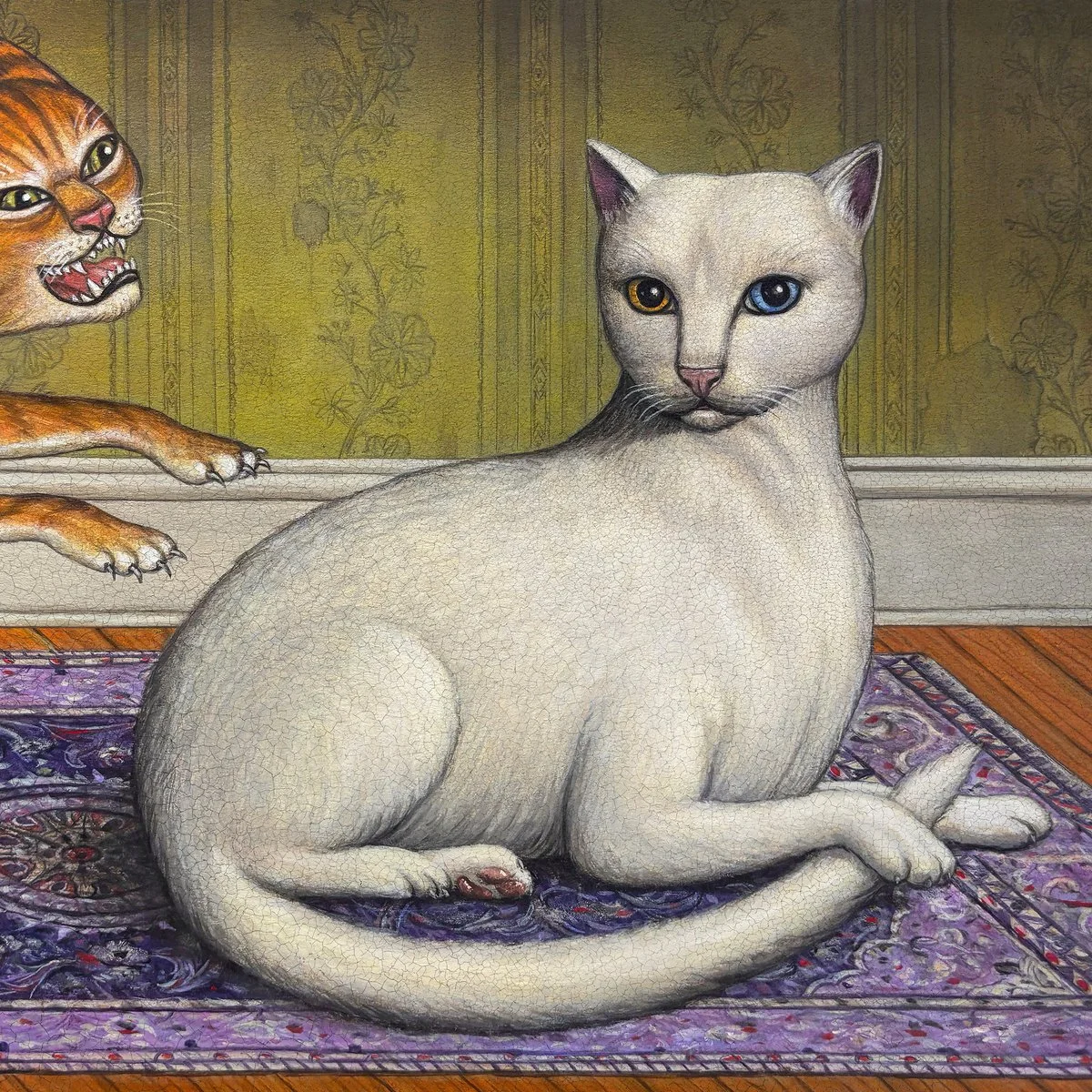
by Emmanuel Castillo (@thebruiseonwe / @emmanuelscastle)
Two things keep Mitski’s varied work in conversation: her songs have always centered on lyric and melody, and her songs have always tried to convey something true. In her early touring days, she would perform by herself with an acoustic guitar, the spitting image of a folk singer, known for playing her songs mostly in drop D, a tuning more readily associated with heavy music. Even this early, the songs were subject to changing forms to suit the needs of her performances, which dovetails nicely with Nothing’s About to Happen to Me, her second recorded collaboration with her touring band. Tasked with reinterpreting her catalog across its disparate sounds over years on the road, Nothing’s About to Happen to Me is the first Mitski album to feel like a culmination of what came before instead of a complete reinvention, as if approaching transformation through consistent action. Old feelings and situations are reinterpreted through complicated new realities accompanied by a relatively stripped down rock band presentation that gives the songs heft and the sense of a collective expression rather than a purely studio construction. The album makes a point of renegotiating a combative relationship with the world, and the live band does the work of teasing out the nuance in the words, the strain, and the effort that underlies whatever sunniness is implied by growth.
The expectations of the world around her have always loomed large, and with them a desire to opt out of those expectations. Whether moving back home after graduation in “Class of 2013” from Retired from Sad, New Career in Business or dreaming of early retirement in “Drunk Walk Home,” from Bury Me at Makeout Creek, failure was often associated with feeling like a child at the whims of others. On Nothing’s About to Happen to Me, fear of failure evolves to include a betrayal of the self. When Mitski sings “you gotta write your book early or it gets written up in your place,” on “In a Lake,” she introduces the recurring theme of finding a reason to continue existing, alluding to the strain with a wonderfully discordant outro. The idea takes its darkest form during “Dead Women,” where Mitski wonders “Would you have liked me better if I'd died/So you could tell my story the way it ought to be?” revealing the bitterness at having to engage with a world determined to misinterpret you and present their version as your truth. Still, there’s a bit of levity—each death fantasy in the verse is contrasted with a wordless “do-do do-do do-do” in the chorus, which comes across a little sardonic, a little resigned.
Many of the climactic moments of songs feature the band imploding around Mitski’s steady melody, one scene disintegrating into the next. There’s an attention grabbing moment in “Rules” where the song seems to dissolve while the beat goes on longer than expected, Mitski counting out a longer pattern as she keeps the song together as the band hammers out the downbeats. It happens at the end of “In a Lake,” as well, but it’s Patrick Hyland’s increasingly distinct guitar playing on “Where’s My Phone” that best exemplifies this tendency towards disintegration, ending with a distorted solo that restates the chorus melody so that it sounds like a frustrated, ghostly wail. Distortion has been deployed judiciously ever since they figured out everyone liked that—no cheap thrills—and on this album, it punctuates some of the most emotional moments, like the bridge on “If I Leave,” an explosion in an otherwise restrained meditation that threads connections between dependency, intimacy, convenience, and cruelty.
The desire to connect is in constant tension with a desire to disconnect from everything. The encroaching world comes most persistently from social pressures presented in naturalistic images: circling dogs, the cats marking your house, the hostile storms that seem less grim than your life. When the pressures take the form of people, the desire to disconnect reaches fever pitch, like on “Instead of Here.” “I’m not here, I’m where nobody can reach,” evolves with each repetition and, coupled with music that manages to be both uplifting and austere, gives the impression of a half-remembered prayer. The natural symbols seem to be the burdens that Mitski is capable of facing, and this uplift has a completely earned quality when it returns on “That White Cat,” the chorus in total opposition to dissociation: “What do you hold on to?” Seeing herself as part of an ecosystem that’s larger than just a set of obligations allows Mitski a slow reengagement with the world, set free by frequent and grounding reminders of things that depend on you but don’t need you.
There’s a heavy alienation that accompanies these songs—there’s growth, but also resignation to a life lived, if not a life desired. The emotional tenor has changed because there’s a longer timeline. For all the talk of death, the final instance is tied to a transient image in “Lightning,” despair fully felt and its temporariness made explicit in the bridge: “If I mourn, all the better / To behold the sunrise.” Nothing’s About to Happen To Me, a statement of fact that acknowledges the prosaic and everyday, comes to the conclusion every recovering depressive has to reckon with: you’re not going to die like you thought, and you can’t get away from people. Figuring out what keeps you going stays hard the entire time, but it’s true that giving up is the only permanent failure. The album suggests it’s enough to stay present through a desire to disconnect, to fully engage even the darkest feeling so you can emerge without having held onto any, and it does so with Mitski’s most urgent, unflinching set of songs since Bury Me at Makeout Creek.