
by Devin Birse (@devvvvi.b)
With a title like My Days of 58 it’s tempting to assume Bill Callahan is in a sentimental mood. Ever since he stopped releasing under his old moniker of Smog, he’s had a habit of shifting away from the universal. Each album sheds a smidge more of the smirking miseries and grim ironies that lined his initial lo-fi home recording days. Of course, Callahan can't stop being wry, but he has stopped being obtuse; the songs that flow off his latest record are often clearly stated. Their thoughts and meanings outlined, on “Empathy,” he even admits that the lines in the middle are the last he wrote.
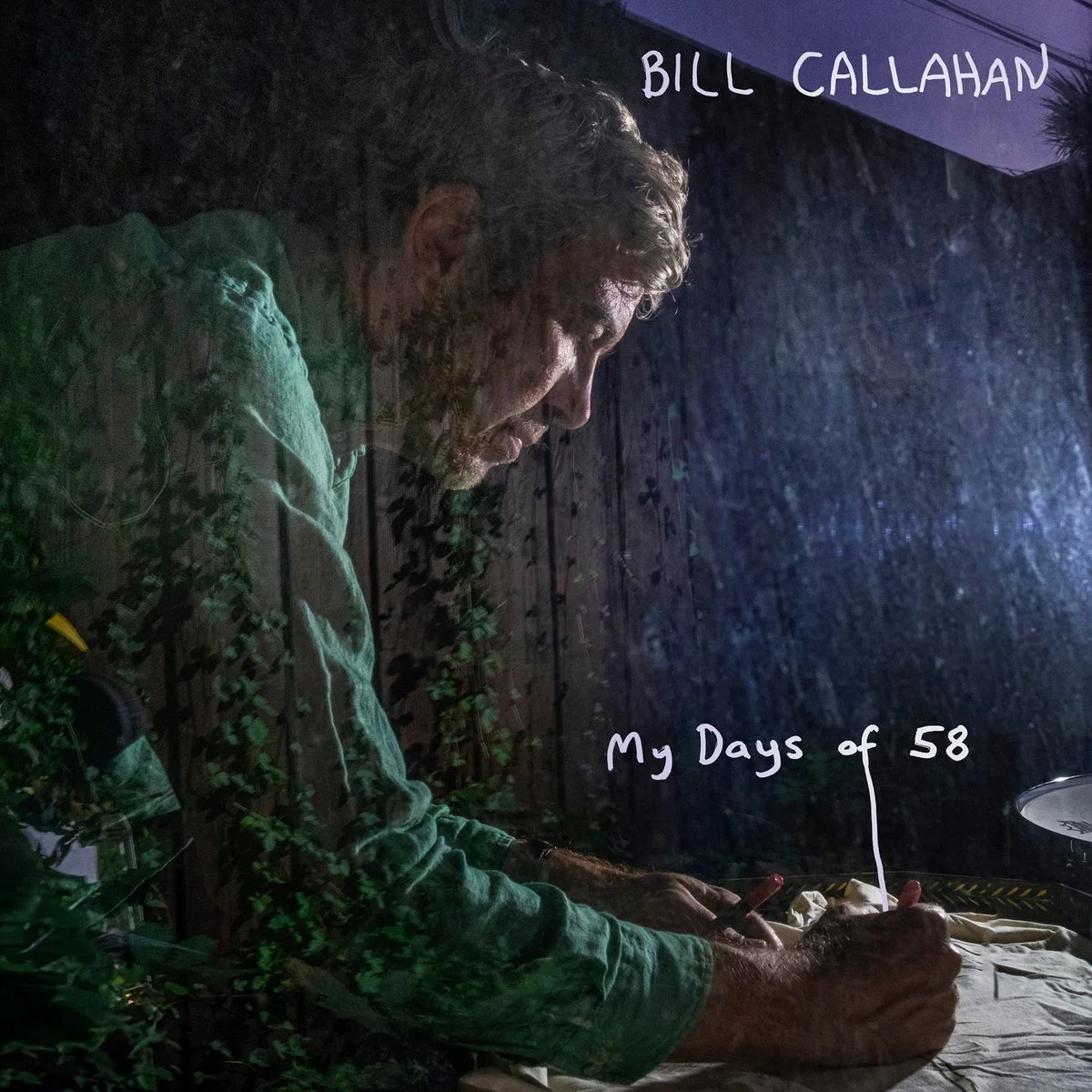
When you look at the cover of My Days of 58, it takes on a memoir-like quality. Callahan is writing out the logs of his late middle-ages in a dark but warm room. Yet there are still things from the Smog days that Callahan hasn’t abandoned: intimacy, emotional immediacy, almost ugly honesty, and the spectre of death. Yes, death hangs heavy here, a subtle creep over the shoulder, not so much cold as simply present. Callahan has stated he wanted this record to be a living room record. The sense of the players being intimate and familiar. Often sounding like they’re in the room with the audience. A sort of slightly chilled folk jam ambience, but one where death is ever-present. One that also happens to be set to some of Callahan and Co’s best arrangements.
On My Days of 58, Callahan is operating closer to band mode than usual. Inspired by a series of excellent live performances, he has moved his collaborators closer to the songwriting process. The result is tracks that move and flow organically, the horns and strings feeling less like additions and more like integral parts of these free-flowing slices of chamber folk. Late career highlight “Stepping Out For Air” moves and beckons like a gust through the trees. The track gradually lets loose to a flowing epiphany as Callahan sings out “Gabriel come blow your horn.” “The Man I’m Supposed to Be” echoes and aches with his guitar. What would take the form as an intimate guitar ballad on previous records is instead a tense piece of folk rock. Callahan’s guitar ricochets against Jim White’s drums as they cut through the lines. While “West Texas” moves at a baroque pace, the strings and horns slowly open the track up to climax in a gorgeous, ethereal outro. It could be easy for these additions to drown out the clear heart of any Callahan album, his lyrics and his voice, but instead they enhance it. Maybe it's because Callahan rehearsed individually with each musician. Maybe it’s a result of the built-in synergy from touring or simply the album's excellent production. Whatever the reason, the result is marvelous, a remarkably full-blooded and complex sound that never forgoes intimacy and immediacy for grandiosity.
But still, the core remains Callahan’s lyricism: sharp and conversational; cut from a similar cloth to his 90s contemporaries in Berman, Oldham, and Chestnut, but unique in its precision. It’s not much of a surprise that My Days of 58 has excellent lyricism; what is new is how biographical they are. While songs like “To Be of Use” and “Back In School” have seen Callahan break into brilliantly discomforting confessionalism, My Days of 58 is remarkable in its frankness and warmth. Death stalks his words; opener “Why Do Men Sing” has Callahan envisioning his trip to the pearly gates to find “Lou Reed was waiting for me/All dressed in white,” a strong image for an artist whose early work resembled a lofi inverse of the shimmering violin drones on “Heroin.” There’s a sense of reflection alongside the mortality. Rather than fearing death, Callahan uses it as an excuse to take stock. “Empathy” is a powerful remembrance of Callahan’s father and a discussion of the struggles of touring life and parenthood. “Pathol O.G.” begins with a retrospective of his career wistfully saying “I don’t want to say it saved my live/but it gave me a life.” Before bursting into the mantra “it’s important to not/treat your lifeboat like a yacht.” While it’s a dull statement to say Callahan has matured from his early days, never has he seemed quite so far removed from the young man screeching, “I’m going to be drunk/So drunk at your wedding.” But it never feels as if Callahan is disregarding his early days; rather, My Days of 58 appears as an incredibly firm chapter in an excellent folio of work.
It’s not all warm reflections, though. “Lonely City” is an excellent slice of moody folk haunted by Matt Kinsey’s smoky guitar lines and Bill McCough’s pedal steel. “And Dream Land” moves like a barnyard jam before switching into a swirl of haunting sax and psychedelic swirls. Closer “The World is Still” moves tranquilly. Its mix of guiding horns and the absence of White’s drumming leaves the album on a near-ambient close. Callahan remains a keenly playful writer, never eager to settle fully into just folk or one mood. Perhaps the album’s biggest outlier is “Computer” with its near spoken-word opening and scattered guitar lines and breezy whistles. The track rises and stops at a steady pace, feeling half-formed till a slacker riff kicks in as Callahan repeats “I am not a robot and I never will be.” It’s the one moment on the album that feels distinctly contemporary, with its anti-AI creed. But through existing within such a personal work, it’s made all the stronger. My Days of 58 is an intimate and human work, one reflective and varied yet full of personality. Not merely a late career highlight but a testament to the importance and brilliance of Callahan and his oeuvre.