
by Benji Heywood (@benjiheywood.bsky.social)
History doesn’t repeat. At the same time, to be alive in 2026 is to heed an echo of the past. There’s no denying this is the age of New American Fascism, a time when governments murder with impunity and xenophobic religious cults have captured the highest echelons of power.
Recall previous state terrorism campaigns that disappeared people for no other reason than who they were: Pol Pot and the Khmer Rouge, Argentina’s “Dirty War,” Bashir Al-Assad’s Syria, Suharto’s Indonesia, Pinochet's Chile—it’s not an honorable list. And while the current U.S. regime does not match these atrocities in scope, it does so in intent.
Despite how bleak this all is, it’s important to remember why these governments are compelled to operate in secrecy—eventually a day of reckoning arrives. Throughout our checkered history of slavery, concentration camps, and genocide, Art has consistently been the morning star blinking on the dawn of judgment.
Consider Mandy, Indiana, a band whose art speaks to living on the brink of collapse. The foursome—vocalist Valentine Caulfield, guitarist and producer Scott Fair, synth player Simon Catling, and drummer Alex Macdougall—make music in the vertiginous region between noise rock and dance music. It is neither one thing nor the other. It does not aspire to transcend or regress or pay homage to what’s come before. Instead, the music of Mandy, Indiana is in a perpetual process of becoming.
The band’s new album, URGH, appropriately titled for the times, almost never was. Against a background of personal turmoil, surgeries, and disparate locales, Mandy, Indiana has put together the first truly great album of 2026. We sat down with Scott Fair and Alex Macdougall to discuss the making of URGH, its challenges, and how existing on the brink means always striving for the good just out of reach.
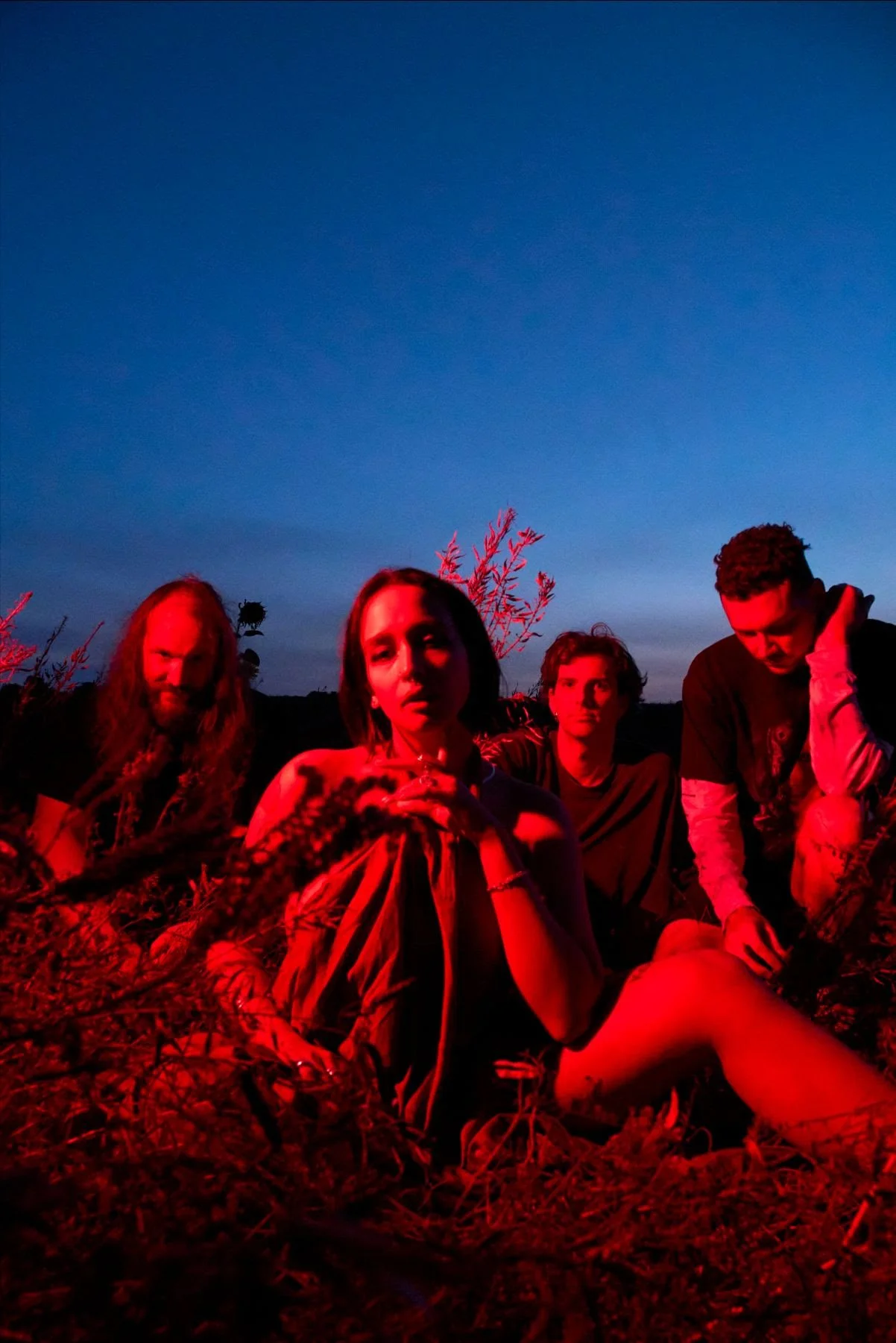
Mandy, Indiana by Charles Gall
This conversation was lightly edited for length and clarity.
Post-Trash: I promise we’ll get to the music, but as a band that seems politically conscious, what are your thoughts about what’s happening in the U.S. right now?
Scott Fair: We’ve been talking about that recently. With the album coming out there’s been discussions around touring the States and I think the consensus is that at the moment, it doesn’t feel like a safe place to go.
PT: I know, a real fun way to start an interview.
Alex Macdougall: But it’s all around us—even in the UK. There’s this constant conveyor belt of crazy shit. It’s hard to ignore. Whereabouts are you located?
PT: Los Angeles. We’ve seen this playbook before.
AM: From an outsider’s perspective the impression is that the U.S. is a nasty and dangerous place for Black and Brown people. Val, our singer, is mixed race and she’s genuinely concerned that she might face some kind of violence, and in turn, we’re concerned, too. It’s a shame because we’ve loved touring the States in the past. It’s such a magical place in so many ways.
PT: It’s also insanely expensive. I went and saw Tropical Fuck Storm the other night and they said their visas cost them 25 grand.
AM: It really is a logistical and financial mountain to climb. We’d love to come over again but it will have to be the right time.
PT: Has the band talked about a time when it would be a political statement to just say “we can't tour the US right now,” even if it were feasible financially?
SF: To be honest, that’s the impression I’ve got from conversations we’ve had as a band. There are certainly artists who are still (touring) and using their voice to draw attention to the horrendous things that are happening. But there’s been a rebellion against doing that from our camp, to not have a physical presence until things change. The last thing we want to do is go to the U.S. and give the impression that everything is fine when it so clearly is not. I don’t want to make assumptions, but it seems the people who seek out music like ours are well-informed enough and open-minded enough to see the injustices that are happening, but we can’t know for sure.
PT: As someone who in no way supports the actions of the U.S. government, what’s happening here gives me a profound sense of shame.
AM: There’s such a diverse range of views and opinions in the U.S. and identity is such a complex thing, but when you live in a country, you’re associated with what it does almost by default. It’s like you feel complicit or responsible, as ludicrous as that may sound. It’s really hard.
PT: There's no good segue here, but let's just jump in and talk about the music. The album is fantastic. Place seems to be an important aspect to the making of your art. I've read stories that you recorded previous bits in caves and crypts and all sorts of seedy places. And for URGH it seems you've gone to a haunted house outside some chilly Northern UK city?
SF: Yeah, we went to this creepy house on the outskirts of Leeds to write. We’re all spread out across the country and Valentine lives in Berlin, so we’re rarely together as a band in the same place. The couple nights we spent at the Leeds house were the only group writing sessions we had (for the album). Then, when it came to recording, it was very disparate. Everybody recorded their parts individually in different places.
PT: Do you find that challenging?
SF: Not necessarily—and sometimes it’s just the opposite. The way we work, we don’t pay a whole lot of respect to making things sound like they’re all occurring at one place at one time. Rather, we like to embrace sounds from different spaces. In the past, we’ve recorded drums in a cave then the guitars in a bedroom somewhere. We’re almost reveling in the fact that everyone has a device in their pocket that can capture high quality enough audio from anywhere that can appear on a commercially-released album. So (on URGH) we’re continuing to embrace that dysfunctional aspect of jamming things together. We did, however, record in studios a lot more this time, but without trying to make things sound too pristine.
PT: Alex, as a drummer, I’m curious how this process works for you? Traditionally, when you think about how a rock record is recorded, often drums are done first and the album is then built on those performances. Obviously, Mandy, Indiana is not a traditional rock band by any stretch of the imagination—which is why I love it—but is it challenging to record drums in such a fractured environment?
AM: Our songs all have a pretty strongly fleshed-out demo, which Scott is the driving force behind, with a skeleton of the track. So, going into the studio, there’s no uncertainty about how the parts will go. For me, it was about laying down the drums like the demo but with my own energy and flair.
SF: I often write parts with Alex’s drumming in mind.
AM: In previous bands the drums have gone down first and if my arms start to fall off, I can hand it over to another band member to start tracking over what I’ve done. But with this session, it was quite intense. We had only three days to do drums and I remember by the third day, Scott and Dan (Fox of Gilla Band, co-producer of both Mandy, Indiana albums) were all jubilant, like, yeah, we’re finished! And I was just in the corner going like, just kill me (laughs). It was really intense.
PT: When I listened to the new album, I definitely wondered on multiple occasions how y’all put a song together. Like, take “Magazine,” one of my favorites—how does something like that get made?
SF: That song is the oldest one on the record. It’s from a period shortly after (i’ve seen a way). I’d seen something online, a 30-sec clip of video from an event, that inspired me to want to make something that sounded like how the clip made me feel. It started with rhythmic, percussive loops, then once the outline of the track was there, Val came in and did her thing, which is always the turning point in the writing process. When her vocals are in, it becomes a lot clearer what the track is, what the structure is. Sometimes I’ll put my editor cap on and move a bit of Val’s vocal around, and sometimes Val will say, no I don’t want it there (laughs). But to go back to what Alex was saying, many of the songs start with his drumming, the performance and personality he brings, his energy. He has a bit of Zach Hill energy.
AM: Yeah, he’s one of my favorite drummers. I remember (when we were writing the album) I would ask you, Scott, who you were vibing on and I would go and listen to some of that stuff. Then I would do a solo session where I just improvised with that inspiration in mind and record it with my phone. This process becomes its own inspiration loop. Scott is inspired by something that I reinterpret, play and record, then send back to Scott. Specifically, with “Magazine,” I remember starting the first beat with that cowbell rhythm after listening to a lot of Liquid Liquid. When we came into the studio to properly record that beat, it didn’t quite do the same thing. So we replaced it with my demo recording, which has a real, like, shitty lo-fi vibe, like, you can hear the fucking pirate studio room I recorded in.
SF: The looseness Alex is mentioning happens a lot with us. So many bands that cross over to the electronic realm seem inclined to make things as tight to the grid as possible. It’s not like we don’t use click tracks, but it’s become a mantra for us to embrace the looseness as well. We like the feeling that the song sounds like it’s on the brink of falling out of time.
AM: We also tend to smash two disparate ideas together. Scott, do you remember what song that was on…was it “ist halt so”?
SF: It might have been that… I think putting two different demo ideas together happened quite a bit on the record. I would send everyone a track and they’d be like, the start of this one (is good) but the end sucks (laughs) so we’d use a section from a different song. There was zero effort on my part to make those disparate parts work.
PT: That’s where having a vocalist as enigmatic and singular as Valentine makes a difference. You can get away with crazy transitions because her voice binds everything together.
AM: That’s a good shout.
SF: 100%. We get away with a lot that perhaps other bands wouldn't because of the consistency of her vocal presence. It's not like she's always doing the same thing. She's a dynamic performer who has an incredibly versatile voice. You know, you hear her on the first track (“Sevastopol”), and it's all crushed up and auto tuned, and then you hear her on “Life Hex”, and she's like shouting with all this delay on—but still, you can tell it's the same person and that gives us a lot of leeway.
AM: I have a lot of admiration for Val’s performance on this record. (During our Leeds writing session) she took quite a risk bringing something new to these songs in front of us. Like her singing for the first time on “A Brighter Tomorrow” and her singing in English for the first time on “I’ll Ask Her.” This album really shows how her voice has developed and her ideas have evolved. (writer’s note: Valentine Caulfield typically sings in her native language, French.)
PT: There were a lot of medical challenges during the recording process, weren’t there? Val’s not here so we won’t talk about what she went through, but Alex, if you feel comfortable, can you tell us what happened with you?
AM: Yeah. I had surgery in September 2024 and there were some complications. Then in January I had another unrelated surgery to remove half of my thyroid gland. I had a growth that could have been cancerous—it ended up being benign, but yeah, it was kind of turbulent and its effects lasted into the recording in April. I thought I had recovered but during the process I realized I hadn’t quite. I’m not very good at recognizing when I need to rest. I hate the prospect of putting my creative pursuits on hold.
PT: How are you doing now?
AM: Fine, yeah. I’m all better.
PT: Scott, I’d imagine, as a bandmate and a friend, it was tough to watch Alex go through that.
SF: Last year was difficult for all of us. It really was a tough time for us on an individual level, but also as a band. We didn't play many shows at all, and as I mentioned previously, we didn't record anything all together. We were separate. We were apart. We weren't nurturing our relationships with one another. Luckily, we're all very conscientious, and so we were all kind of checking in with each other. But there were times when we didn’t know if the album would get finished, not least of all because of the health issues several members of the band were going through. The spirit felt like it was being diminished by the events of the world, our daily lives. Something was being challenged in terms of our relationship with each other. The fact that we finished the album is a real testament to the strength of our relationships and ultimately, the fact that we knew this album was something that needed to be completed.
PT: And this feeling of resilience is markedly different from the first album?
SF: The first album was a pretty breezy experience. This one felt like work. I’d like to think that some of (the difficulty) came from the fact that we’re reaching for something just beyond our reach, which means we were never in our comfort zone. You’re always testing yourself, pushing yourself to try and achieve something just beyond your capabilities. But that’s fucking hard to do. It would have been easy if we’d done another album just like the last one, but as a band, we’re always trying to take a different approach, which requires more mental and emotional effort. It’s a long-winded way of saying, yeah, it was tough. I really love these guys. I love them all. And seeing them struggling and suffering is really, really hard. I feel much more optimistic about this year. Alex is doing better. Val is doing better. And we’re thrilled to finally get to share this thing we’ve been battling with that we’re all so proud of.
PT: You mentioned being in a better place as a band. And this kind of goes full circle to what we were talking about at the start. How do you balance the despair of the moment with a hope for a better tomorrow?
SF: We’re optimistic people and we try to seek out the positive in even the darkest areas of life. But we’re also realists. We don’t shy away from the horrors of the world we live in. A lot of our music is a mirror reflecting these darker areas, but at the same time, the spirit of the music is optimistic. It’s about rhythm and movement and trying to get a response from whoever is engaging with it. We’re not wallowing. This isn’t misery porn. It’s an invitation to people who are experiencing the same crazy thing to recognize the darkness together, so we can face them together and search for the positives together. This band is about not having any limitations. We want the freedom to explore any genre and any emotional content. We could go anywhere.
URGH is out now on Sacred Bones.