
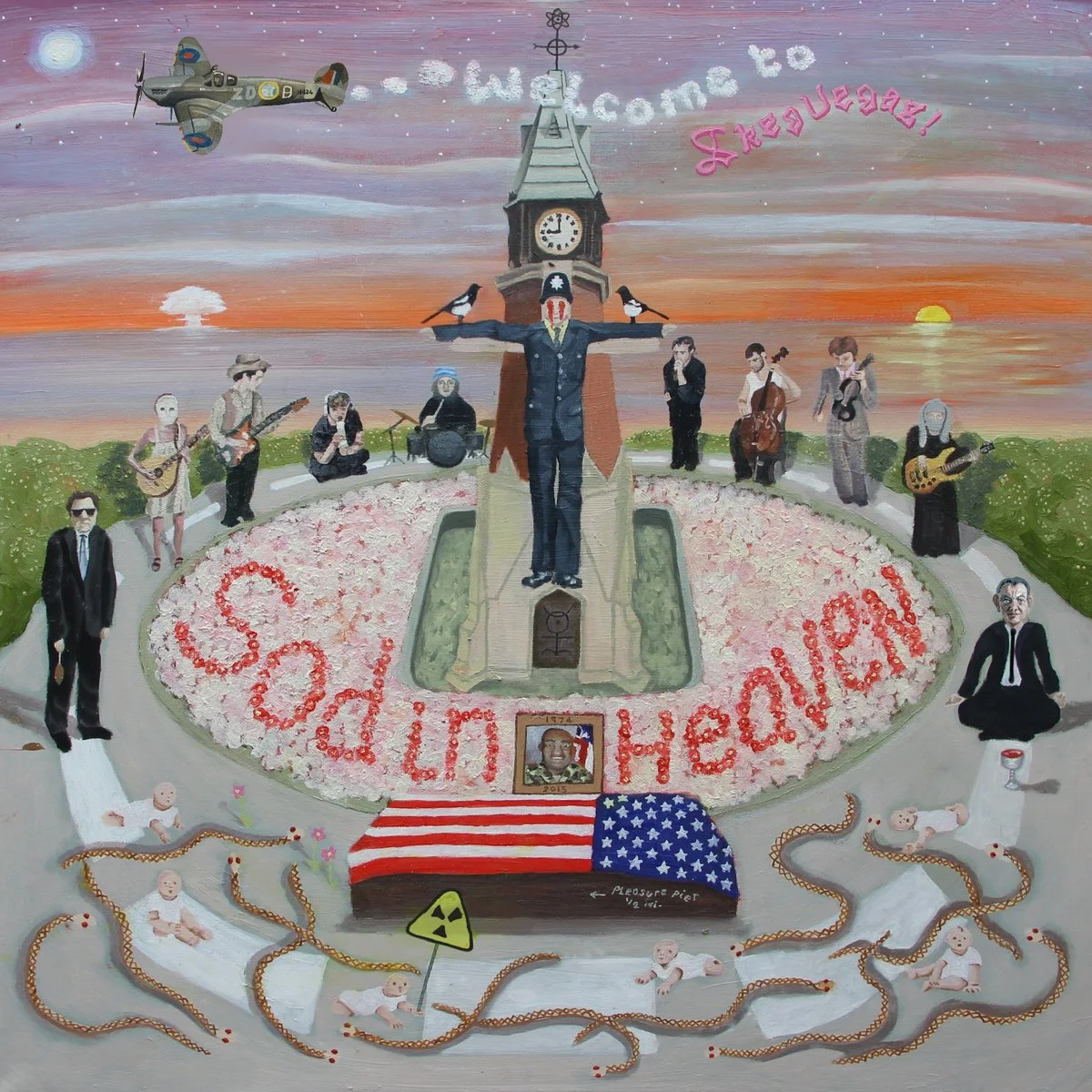
by Devin Birse (@devvvvi.b)
Even in the early days of English folk, there was always something slightly off. The mix of modern production and old songs carried something beguiling. While there’s a long history of the weird lurking within England's bones, the late sixties really let it emerge, the odd psychedelic terror of Syd Barrett and Comus inspiring generations of paganistic folk revivalists. It’s a sound and sensation that echoed out through cult cinema and industrial experimentation. A subtle perversion of the stiff English upper lip into an uncanny gyre. It’s a strategy of uncanniness that endures throughout the ages, the instantly recognisable rustic charms of folk music rendered unnerving. Yet while many modern groups take joy in twisting England's old into something new, Sod In Heaven by MPTL Microplastics presents something that goes deeper. It’s an album that goes past the Cold War paranoia of first-wave post punk, further through the bushes, beyond even the dim electric Albion of psych folk into a realm of unique splendour and terror. Sod In Heaven is an album emerging deep from the mud of the English consciousness. A primordial stew of the odd and uncanny that lies hidden underneath English culture's well-manicured lawn.
In their rapid ascent through London's gig circuit, MPTL Microplastics have never hidden their interest in the English weird. Their first single featured a painting of beloved new queer cinema innovator Derek Jarman watering a blow-up sex doll straight out of Roxy Music's “In Every Dream Home A Heartache.” But what’s so captivating about them is how they’ve forged something new from it. Something that, rather than imitating the pioneers before, recreates their sounds in forms often older than the acts that came before. It shows something new lying under the paintwork; at times terrifying, at others obliquely comforting, but rarely ever fully familiar.
With their first singles, Microplastics seemed to drift between two sonic strands. On tracks like “Sex/Pol” and “No-More Dying,” they channel the proto-noise rock of the English underground, a mix of hypnotic repetition and scrap metal screeches ricocheting off each other. While with “Plastic Princess” and “Wound Nurse,” they offer a unique vision of progressive folk, with martial industrial drums driving forward a mix of scorching strings and clanging guitars. The ghostly vocals of Amelia Blackwell intermix with the manic poetry of Joey Hollis to create an eye of the storm within the sonic vortex. These early works fell nicely within the easily name-droppable framework of references. It’s freak folk by way of Neubauten, David Thomas’ notion of industrial folk fully realised by a band willing to combine cello and mandola with beer keg percussion and vocal synthesizers. These songs are already excellent and clear highlights on the album. “Plastic Princess” particularly benefits from its placement after the frenetic noise of “Sex/Pol” and “No More Dying.” The comparative shift in energy makes its ever-building folk drone march even more apocalyptic.
But while these singles were promising, Sod In Heaven’s most remarkable moments are its newest. The title track opens with a rapturous glam stomp, T-Rex-style guitar, and weepy violins blasting against a surprisingly grooving rhythm section. Hollis’s impish vocals and surreal lyrics almost shouldn’t work as well as they do. His delivery offers a mix of brash confidence and horror movie camp that feels grounded thanks to the strength of his imagery. Images of “future holocausts,” “the charmed school,” and “Britain’s last talk radio victim” appear disparate but unified into a unique, surreal lexicon that feels distinctly British. Hollis’s lyrics rarely offer easy explanations but find strength in their memorability and impact. The excellent “The Swollen Promise” is built around a chorus of “wake up and just swallow promises" which builds upon each repetition. It’s a classic trick and one executed gracefully, but so much is added to it by that line. On each repetition, Hollis’s vocals contort into something more grotesque, screechy, whiney, and oddly beautiful. A sound caught somewhere between a wounded wolf's howl at dusk and the morning weep of birds through the forest at dawn. Its bizarre psych folk tenderness recalls the lo-fi melancholy of Microphones, though if Phil Elverum had leaned more towards Lovecraft and Arthur Machen than Lynch.
In many ways, there’s a strong resemblance between Microplastics and Elverum and the other New Weird America artists of the turn of the millennium. Like early Animal Collective and Joanna Newsom, they are returning to something older and odder to capture a rare essence. But while those bands found whimsy and childhood innocence, Microplastics have embraced the impulses often rejected. In doing so, they’ve crafted something stormy, unique, and brilliant. Far from being for the faint-hearted, Sod In Heaven is a dense and imposing debut. One that crafts a creaking howl out of the ashes of England long past. Like the New Weird America artists of the 2000s, Microplastics are the sound of a New Weird Britain, one that takes from the esotericists who have come before, yet is never indebted to them. A mix of electronic, industrial, and folk that lets loose the ashes of the old into the air, so they may settle into obtuse new forms. While films like “Penda’s Fenn” and “Wickerman” broadcast visions of modern England's discomfort with its wretched folklore, Microplastics are the past and present entwined.
That’s not to say the album is an entirely conceptual affair. “Free Milk” is a genuinely unnerving mix of taught strings and dripping guitars that feels perpetually on the verge of collapse. Blackwell and Hollis’s intertwined vocals feel like two acrobats trembling on a tightwire. Likewise, closer “Arabic Umlaut” is a manic motorik assault with Hollis’s frenetic vocal fight against rupturing drums and screeching nuclear electronic breakdowns. Make no mistake, Microplastics are bearers of doom, their music an ideal soundtrack for the stifled, trembling England of today. While Derek Jarman's cinema screamed through aesthetics and emotions against an oncoming tide of death by cultural conservatism, Microplastics are the glimmers left from the rubble. A screeching rabble of freak folksters who take morbid delight in the sheer grotesque absurdity of the decaying Empire State. Not the last of the English that Jarman predicted, but rather a new generation screeching out through ale-soaked venues into a new apocalypse-glowed dawn.