
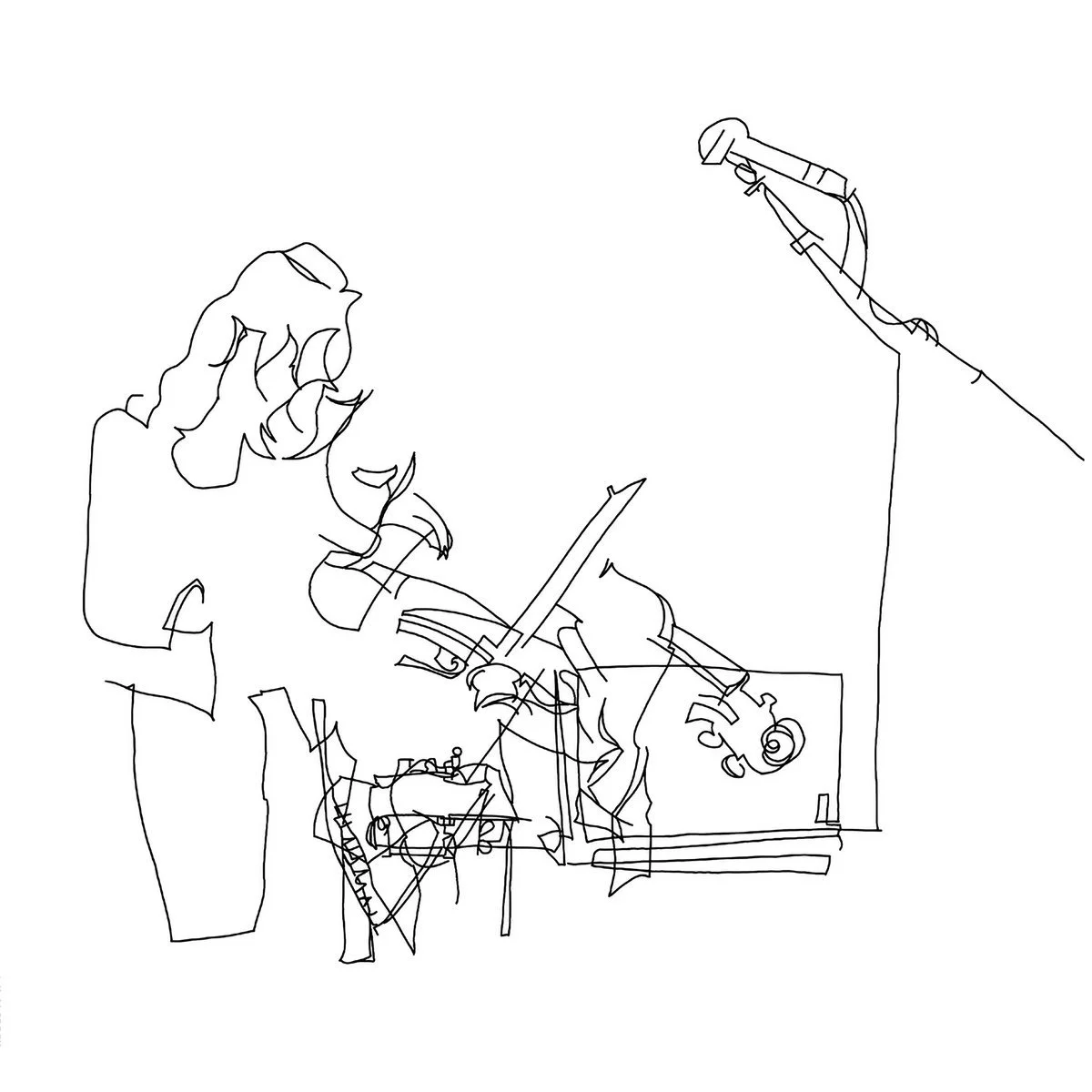
by Louis Pelingen (@lammbi.555)
Amidst more eaze’s - the stage name for Mari Rubio - varied sonic detours in her distinguished discography, one thing is for certain: her experimentation is always linked with an idea or a concept that she is curious about. From the spontaneous musical patterns of Staring at a Statue of Paint to the sonic representation of her transitioning in Mari, she evoked such thoughts through her production and composition. This specific aspect of her process gave her collaborative works with acts like Claire Rousay and Wendy Eisenberg a lot of synergy, especially with how she has played around with electronic, pop, and classical tones that contributed to the soundscapes she built for herself or with others.
This year she has certainly focused on a specific theme, doubling down on the very concept of structure. In relation to music, it represents the cadence and progression of a melody. more eaze curiously adopted said concept on sentence structure in the country, released back in March, which goes into her electronic-tinged folk portraits with a pop centre-point, a set of characteristics that are tossed around with other musicians in the room, whose compositions contribute to the tone and motion of multiple songs across the record.
If sentence structure in the country focused on letting more eaze’s pop framework stretch apart by others, then her following record, valley and structure, goes in a different direction. She presents her most classically tinged tunes to date, focusing a lot of the melodies towards ostinato, a brief melodic phrase that gets repeated over and over. Initially, this settles the structure in focused territory. more eaze lets her compositions unwind across the opener “they tried to push me in the structure”. Its twiddling acoustics have a charming lilt, as additional violins and acoustic progressions add to its wistful charm. This blissful tone also echoes through the effervescent joy of “what’s wrong with the structure” as additional instrumentation joins the fray. Wendy Eisenberg (piano), Jade Guterman (acoustic guitar), Conner Simmons (upright bass), Nora Stanley (saxophone, clarinet, flute), and Sammy Weissberg’s (electric bass) melodic touch-ups adorn the ostinato with graceful notes.
Yet the next two songs snap the exploration of structure into place. “once you say to the structure” establishes its ostinato at the beginning, the core melody that settles the structure from the start. As it continues however, that melody fades out and the rest of the instrumentation tries to build from its absence. The piece eventually turns into this hesitant ambient section where the rest of the melody tries to find its footing, before the new ostinato charges through and finally resolves at the end. Afterwards, comes “i’m in the structure,” the song connecting this album with more eaze’s previous solo record. Here, the vocal melody of “the producer” from sentence structure in the country is swarmed by cycling violins. The answer to her thought of structure is clearly evoked. As the composer and producer, she has control over letting the ostinato work its way through, but with additional musicians in her world, the fixed structure branches out. The collaborative essence of sentence structure in the country lurks its way here, wherein it allows more eaze’s classical pomp to be disarmed from its pop delicacy, as the ostinato that acts as the chorus of these compositions is stretched out by the collaborators around her.
The album ends with “how can we get out of the structure,” a piece that spends its entire runtime trying to shatter the melodic structure as the piano calms down and goes chaotic with the rest of the instrumentation, just before it finishes with that foundational piano ostinato. It all unveils the contrasting nature of valley and structure with sentence structure in the country, the yin to the previous album’s yang. If the latter record emphasizes the freeing nature of bringing more eaze’s sounds and tunes down intriguing pathways through collaboration, the former represents the process of the structure being locked into that minimalist repetition that can sound initially charming, until it becomes lost in the shuffle. The only way to keep things in place is to allow other musicians to stabilize the structure’s fixed stasis.
The inquisitive headspace that more eaze carries is reflected across her two solo records this year. They may take different approaches in exploring melodic structure, yet they still bring a rich core to their process that becomes more engaging with additional musicians’ playing. The adventurous collective presence of sentence structure in the country provides an enriching context to valley and structure’s classical and folk arrangements, allowing its gleaming compositions, even when they drift out of the structure, to become delightful.