
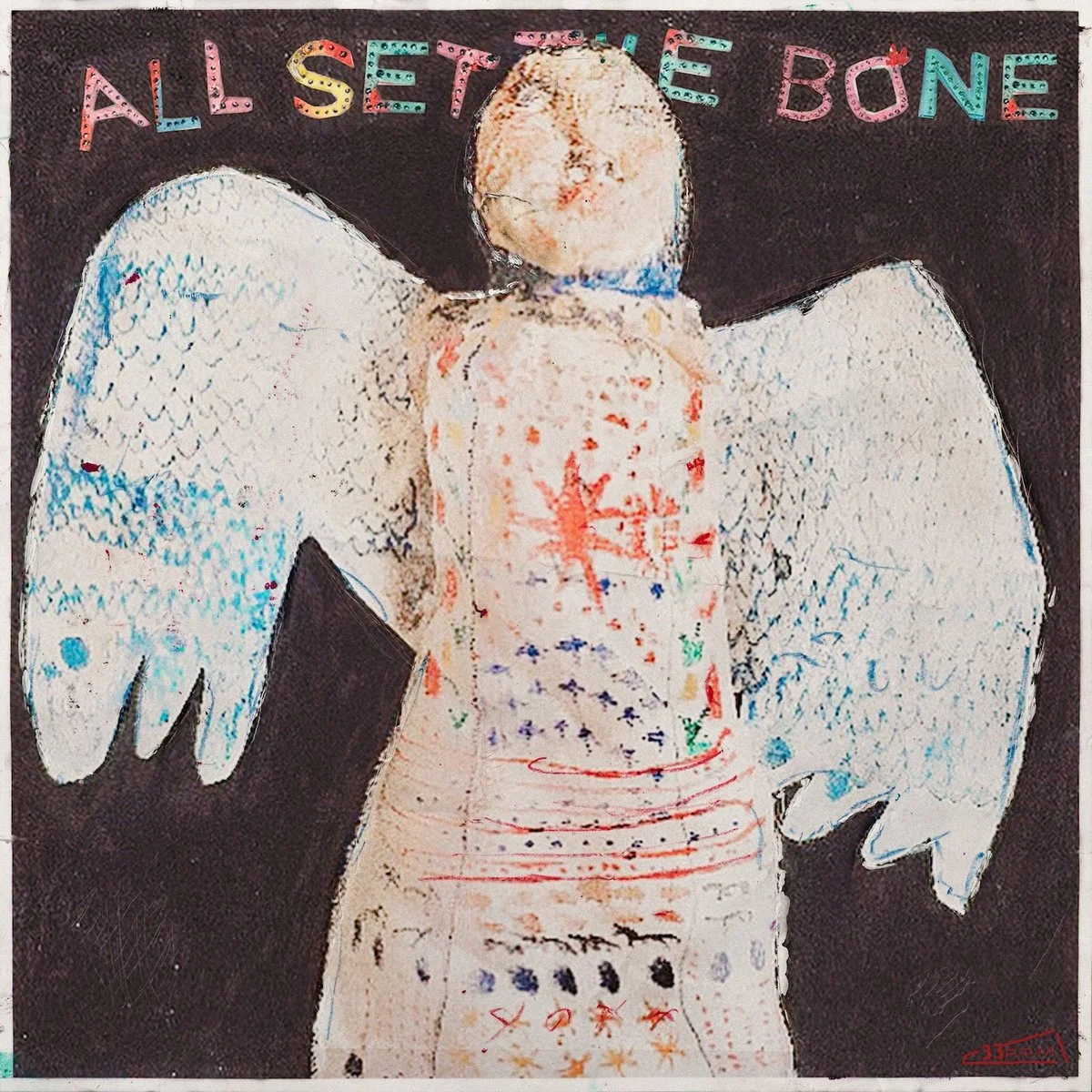
by Zak Mercado (@ciaoguaglione)
We’ve all been plopped down somewhere on the timeline between a mound in the earth of an ancient civilization and a modernity that includes a bit of credit debt, a reality that Greg Freeman confronts in his excellent new record, All Set The Bone. His music has always felt original, the synthesis of genre, melding of musical minds, and he’s doing it with such confidence. This record has hit a high water mark of Freeman’s best musical qualities, bridging the gap between folk, punk, and Americana, with “ramshackle” splattered all over like a Pollack. All Set The Bone proves his bona fides as a generational musical voice.
The Jason Molina comparisons feel exhausted for describing all of the arteries of the Americana leaning indie folk/alt-country tunes, but the thing that Freeman taps into from Molina’s oeuvre, maybe better than the other known-quantities of the “alt-country” umbrella genre, is the cosmic nature of the Jason Molina project. Freeman’s focus is on the decentralized universe, the chaos of it all. That’s reflected both lyrically and harmonically in the tunes on this record.
In “Cahokia,” after musings on the state of American culture, a whimpering populist screed, the refrain concerns a native population — a mound in the Midwest, evoking both the primordial but also the insignificance of what’s gone on and what’s going on now. Some comment on the lack of protest music in contemporary music, but here it is. It’s not early Dylan; it’s understanding the zeitgeist in the cosmic mix of it all (exactly what Bobby was doing in his early days, after all, right?)
On “Withdrawn,” a slow but certain build-up, gets deeper into the interior but also the exterior human, all too human, cosmic experience, like the Eames Office and IBM’s Powers of Ten video. “Got my molecules bruising… and now the world itself collapses as I oscillate between its axes/ and how the ceiling fan blades start to blur/my heart shakes and then runs backwards,” Freeman sings. The melody eventually turns into catharsis, the feeling of the cosmic grandeur and one’s interiority collapses itself until a generous acceptance that sometimes that feeling of being withdrawn is adequate to cope with existence.
On “Indu,” Freeman, still positioning the self with the great beyond, the Hindu deity of the moon is referenced to say it doesn’t matter how many miles away the moon is, or the time zones away from a loved one, “It’s only in her past I live in.” The other celestial bodies in the ether are used as reference points to backdrop our terrestrial experience: “Indu, where is your star tonight?” On “Loser’s Prize,” that positioning is further explored: “like the moon over your shoulder, baby/and silent like a lake.”
This record really lets the music marinate, like on nearly seven minute “Marooned”. Songs take form and reject form, give way to blasts of energy. Almost every track has an element of surprise and delightful shifts in tone. There are asymmetrical double tracked vocals at points. There are fiddles just when you need some extra emphasis and avant-garde abandon, and there are the horns. Oh, baby, there are warm horns, a Greg Freeman speciality (see “Culture” and “Withdrawn”). On “Costs,” he gives warm tribute to radio-friendly slow-tempo 70s rock ballads, but with the zeitgeist-y (anti-)therapized vocabulary, more a tribute to interiority than a fallen homie or breakup like “All The Young Dudes” or “Tuesday’s Gone.”
He also approaches a semblance of bedroom pop on “Next to Nothing,” which transforms from bouncy guitar ditties to distorted vocals and guitar to a defeated post-chorus. This is just one example of the spaces that Freeman creates that bolster up this record. The songs have catchy parts, little moments of tranquility, and delightful mixtures of wailing guitars with other instruments. He leaves us always with something more to ponder upon, like a Shakespearean bard one finds along the path of life’s journey, but so very post post-modern, “a string of words that make no sense.” In the end, the current state of affairs leads Freeman to the radical acceptance of our impotence to make changes to what one cannot control: “It’s not the end of the world, but it sure as hell might be the end of yours/but I’m so happy/Nothing’s gonna hurt me.” May this radical acceptance lead to many more Greg Freeman records facing down the barrel of a contented nihilistic ride through the cosmos. We’d love to see where the ride takes him next.