
by Khagan Aslanov (@virgilcrude)
I remember the first time I heard Zu. My path toward the trio’s stirring catalogue lay through Thurston Moore. I had picked up a copy of The First Original Silence, Moore’s free improvisation supergroup’s debut. Somewhere in that album’s glut of free noise, my attention became fixed on the bass-work. It was incredible – dense and abrasive, packed with industrial propulsion, and, through effects, made to sound like a being in a throat collapsing in front of you. A quick skim of the band’s personnel gave me Massimo Pupillo’s name, and then immediately sent me down the Zu rabbit hole. I’ve been listening to the prolific Italian collective’s body of work ever since.
The music of Zu has always been rooted in a dynamic dialectic – an unholy marriage of the meticulously empirical patterns of progressive rock and technical metal, and the nihilistic unrestraint of free jazz and noise punk. Put more simply, it’s music that feels both immaculately arranged and utterly feral. That push and pull is the foundation of the trio’s tumult, and what has always made their live shows such an engrossing experience.
In the run-up to the release of their latest – the gargantuan-sounding Ferrum Sidereum - Post-Trash sat down with Massimo Pupillo to talk about the fixation on spiritual and humanistic ritual Zu’s latest delves into.
The trio, composed of Pupillo on electric bass and 12-string, Luca T. Mai on baritone sax and keys, and Paolo Mongardi on percussion, has yet again made a record that feels like a sequence of tectonic collisions. These chaotic and groove-sodden pieces converge into something more than the sum of the genres and frequencies explored – a cavern of spirits and sound.
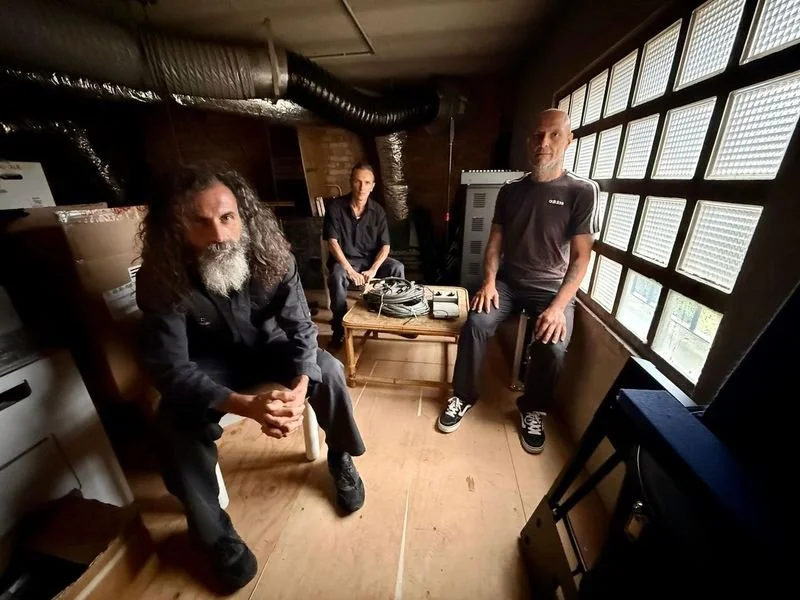
Zu, courtesy of the artist
Khagan Aslanov: Tell us about the new album! It’s an excellent and colossal undertaking.
Massimo Pupillo: Thank you for the kind words. Ferrum Sidereum emerged from a year of intense daily writing—every day, all day. We felt an urgent need for new music, unaware just how much was ready to pour out. At some point, we started joking about our next release of a quintuple album and how to say this to the label. Paolo and I had been sketching ideas in sessions for a couple of years prior, just the two of us, not thinking even once that these ideas would end up in Zu. We ended up filling two folders with over 50 sketches—yet only a single one made it into a section on the final record.
Then, we began weeding out the material: early drafts were longer, requiring ruthless cuts to entire sections. After years of deep uncertainty since 2020, the vibe echoed our first album. We poured everything in, uncensored, without trying to sound like classic Zu. Just three people in a room, fishing for ideas.
KA: What is the process like when the three of you sit down to write? Does each member bring individual ideas and you meld them together during rehearsal? How much of the studio material is improvised and how much is composed?
MP: When we enter the studio—and later on stage—nothing is improvised, not even a single note. Our only freedom lies in the intention and delivery of individual parts. At times, we might emphasize an aspect that's hanging in the air that moment, but that's essentially it. With 99% of our music in highly unusual time signatures, everything is tightly interlocked.
A recording studio is a new step of the work, offering endless sound possibilities, so the material must be rock-solid. You shouldn’t have to look back at the composition at that point, because there are other choices to be made.
It's very rare for us to bring pre-formed ideas from home. Across every album, there might be just one such seed, which typically transforms entirely, once immersed in the collective process. We discovered early on that our music gains far greater power when it emerges together, fueled by real-time human feedback—ideas crafted in isolation tend to stem too much from the brain, and we take great care to avoid that.
KA: The song titles reference Judaic mysticism, Gnostic ideas of completeness, Christian symbolism of evil, the Virgin Mary, homeopathy, artificial intelligence and astronomical phenomena. How does all this tie in with cosmic iron? Is the idea of the album that a meteorite gave birth to superstition? Is this meant to underline the irony of all that what we’ve learned from meteorites scientifically?
MP: I feel that the biggest superstition – and here I’m aligned with John Trudell – is believing that we live in a civilization. That also explains the title of our EP from some years ago, Goodnight Civilization. It’s not that we know nothing, but we surely know infinitely less than we think we do. That includes even forgetting the possible questions, and just assuming one single version of reality. It’s no surprise that people are intrigued by drugs – I’m not advocating their use, disclaimer put – I’m just saying I understand it. When the box available to you is so small, some people will try to pierce holes in it with a chemical screwdriver. Coil put it perfectly: “constant shallowness leads to evil.” And I see only shallowness in our culture. We have replaced dogmas with shallowness, and a kind of Wikipedia-level awareness. When you’ve been through many dark nights of the soul, you see these images appearing. It’s all still there.
KA: You have said that artificial intelligence could not contain spirituality. What’s your stance on artificial intelligence’s growing presence in the arts? Do you perceive it as an inevitable demise? Do you think an undemanding consumer would not want to discern between real art product and artificially-generated one?
MP: My view is that everything has become so predictable in pursuit of marketability and profit that humanity itself has grown increasingly machine-like. It's no surprise then that machines can learn to mimic that effectively. It's a tragedy or a real danger for those who embrace such thinking. This doesn't apply to us, luckily, at least not yet, because our work is neither predetermined nor predictable, even to ourselves. It demands deep passion; you must love it unconditionally, beyond any financial incentive, because there's something inherently more valuable in it—call me naive if you like.
All material rewards are happy by-products, not the driving force. In general, it's not only AI. I never understand musicians wanting to clone others—not cover bands, but the endless copycats of originals. Sure, inspiration and templates have their place, but to me at least, the key is absorbing a vast array of models, and then venturing into the spaces between them to forge something that, whether good or bad, is at least uniquely yours .
KA: You achieve something truly beautiful on the album. The mixture of prog modalities with metal atmospherics and jazz-punk is incredible. As I listened, I instantly thought of Ruins, and then read that you have a live collaborative album coming out soon! Tell us more about this.
MP: Ruins were a major inspiration when we started the band, particularly for the idea that you don't need a guitar—which we couldn't find anyway. We toured with them extensively in the 90s, and played Japan several times. When we stopped after 2020, it was Yoshida who reignited the spark, offering us the idea to tour together, so there's huge gratitude there.
Ruins remain one of our steady reference points, but they represent just one aspect among many bands and musicians that have shaped us. Most importantly, we share core influences—Ruins lean toward Magma, while one of ours is Red-era King Crimson—though I could name plenty of influences that resonate deeply with me, but might not make sense for someone hearing Zu for the first time. We grew up steeped in industrial music too; Coil are one of my favorites, and Luca, our sax player, has always been a Godflesh fan. We sought our voice organically—digesting it all, then letting everything go.
KA: The umbrella genre of experimental music has always been defined by a strong collaborative spirit. Often when I speak to other avant-garde musicians, they say that even in the best of times, the future of experimental music as a viable marketable force is uncertain, and coming together for collaboration gives them strength in numbers. Is this something you feel/agree with?
MP: Not necessarily. Collaboration feels to me like a new friendship or relationship—you pursue it because something genuinely calls to you, and not for any other reason. I'm probably an idealist at heart, but I deeply believe you should do what feels truly important to you, simply because it's the key to your wellbeing in this world. There should be a pure joy that asks for nothing else; whatever follows—some level of success or recognition is welcome, but numbers or market strength, or general outcomes, can’t be the prime motive. We can’t pretend to genuinely pursue experimental music if we’re not experimental in our thinking and ways of life.
KA: You recently came up in conversation when I was speaking with Eugene S. Robinson. You’ve also played live shows with Damo Suzuki on vocals. If you were to make another album with a vocalist, who would be your dream collaboration? Are there any plans for something like this?
MP: No, there are no plans. We've worked with Mike Patton, and released Zu93 with David Tibet—all distinct and equally inspiring encounters, much like those with Eugene S. Robinson or Damo Suzuki. Thinking of a vocalist now would be something that comes from the brain, something that “everyone does.” So you feel compelled to, but things happen, and I have to say that when we play live and we’re fully immersed in the music. I don’t feel any need to have vocals on top of our music. Again, you never know, everything is always possible in life but there are no plans for anything like this to happen.
KA: My favorite piece on the album is “Hymn of the Pearl,” but the entire record is fantastic! Thank you so much for speaking with me.
MP: “Hymn” is one of my favorites too—it's probably the piece where we expanded the possibilities most. It's very tricky to play, for me at least, with three basslines overlapping in one section; I use a looper pedal live, but it demands intense focus to nail.
Thank you so much ! We poured everything into this record, so it's heartwarming to hear such positive reactions. Thanks again!
Ferrum Sidereum is out on Jan 9th, on House of Mythology.