
by Benji Heywood (@benjiheywood.bsky.social)
How does meaning emerge? If you’re Peter Katz, the answer seems to be slowly, over time. Peaer, his Brooklyn-based band, is a perfect case study. Founded in 2014 as a bedroom project, the band has evolved over four stellar albums. Its latest, Doppelgänger, out now on Danger Collective, is the second with the lineup of Katz, bassist Thom Lombardi and drummer / engineer Jeremy Kinney.
The album arrives six-plus years after its predecessor, A Healthy Earth, which codified Peaer’s approach to guitar music. The 2019 album’s blend of melody, math and troubled lyrics resonated. Which makes sense. At the end of a decade that saw the fade of egalitarian movements like Occupy juxtaposed against the rise of New American Fascism and persistent climate denial, we yearned for something that expressed the angst of the moment. Peaer delivered.
Today, Katz is in a very different place. For one, he’s recently married (to Blair Howerton of Why Bonnie) and two, he’s working his first nine-to-five. The changes are reflected in the music. While the album is equally thrilling to previous efforts, Doppelgänger is the band’s most personal release yet.
The afternoon of our conversation found the singer-guitarist in a reflective mood, expanding on several aspects of Peaer’s new album, how it was made and why the creation of meaning isn’t always intentional. Here’s our conversation with Peter Katz of Peaer.
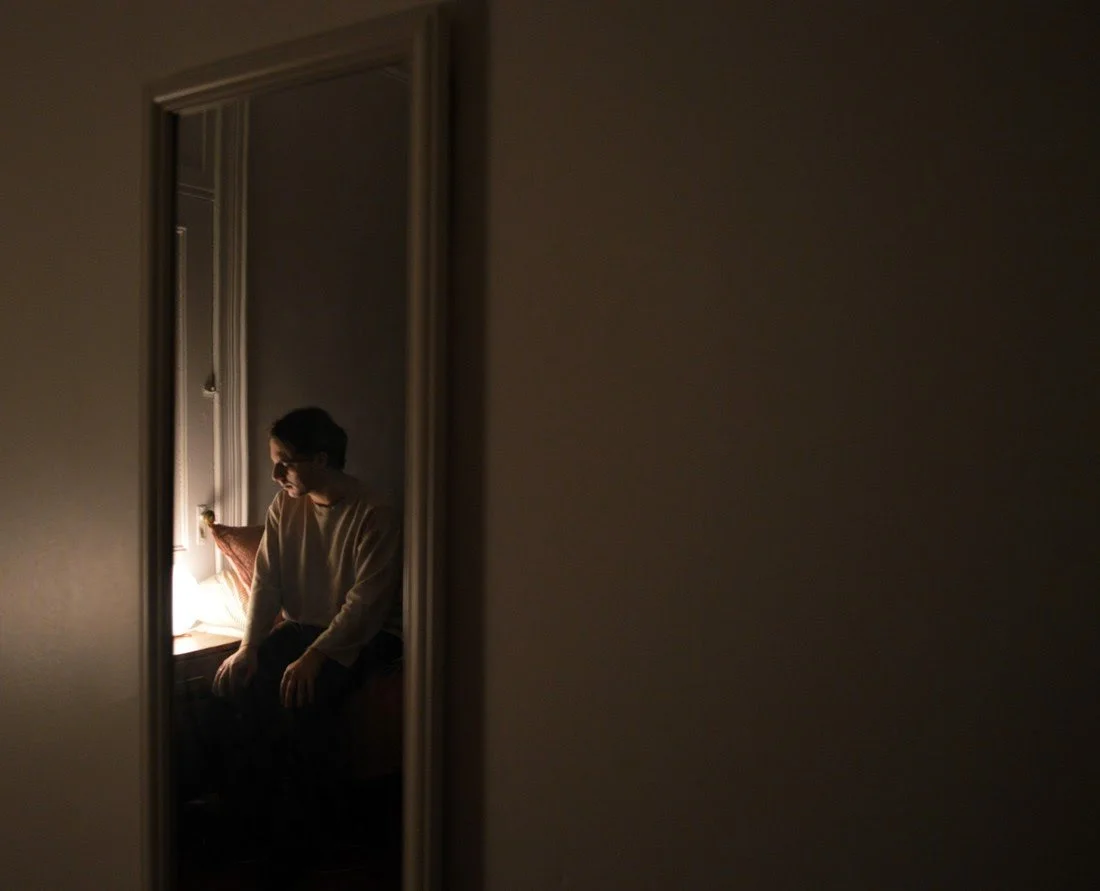
Peaer courtesy of the artist
This conversation has been lightly edited for length and clarity.
Post-Trash: You last put out an album, A Healthy Earth, in 2019. What have you been up to in the space between albums?
Peter Katz: Well, I just got married. That was the best day of my life.
PT: Congrats!
PK: Yeah, thanks! What else… well, the pandemic happened. That changed everything for everybody. I also got my first office job—I’m there right now. I tour manage orchestras and choirs and things like that.
PT: You like it?
PK: It’s a cool job! But it’s full-time so it’s taken some getting used to.
PT: I know you have a music background. What was your exposure to classical music prior to this job?
PK: I got into classical music in college. Back in high school I was really into math rock, prog, post-rock, but for college I really wanted to try composition. There was a studio composition option where you work on pop songs, and then there was classical composition program. (The classical composition program) seemed more interesting to me.
PT: How was it just jumping in like that?
PK: I had no idea what the fuck I was doing! I can read music, but I can't sight read music like a classical guitarist. And I'm not a horn player. I just dove in headfirst and was made to feel like a huge idiot. But I really loved it. I expanded a lot of my horizons. It made me think differently about music and explore a lot more.
PT: Knowing that makes a lot of sense, because your songs tend to slide in and out of different keys, and they obviously mess with time signatures. All that's in classical music. It's not like, you know, Don Caballero invented it, right?
PK: It’s so embedded in classical music. And not just Mozart and Beethoven, but also Schoenberg and Stravinsky and stuff being written today. It’s funny. When I listen to Sleeping People doing a five-over-four-over-six thing I’m like “Oh my god!” But meanwhile, classical people are totally unimpressed.
PT: WNYC has a show called “The Open Ears Project” where people talk about one piece of classical music that really moves them. If you were on that show, which piece would you choose?
PK: A couple come to mind. I’d love to talk about György Ligeti. He died recently and his two pieces for solo cello are so fucking cool, beautiful and intense. They remind me of my other favorite, Bach’s cello sonatas. You listen to Cello Suite No. 1 and it’s transcendently beautiful. There’s a scene in the movie Master and Commander where they play that entire piece and it reminds you how truly divine it is. Ligeti’s work evokes that same magic while also bringing a modern sensibility to it.
PT: That’s how I feel about your new record—it evokes things I loved in the past while remaining modern. I was recently traveling and Doppelgänger made a huge impression on me. It became the soundtrack to my trip.
PK: Thank you! That is so cool to hear that you traveled with it. That’s a great way to experience an album. I have similar journeys with other albums.
PT: Listening while I traveled, I got the sense of being in motion, which made me think of time and its passing. And then I looked at the song titles— “End of the World,” “No More Today,” “Future Me”—and then the motifs in “Rose in My Teeth” being reminiscent of death, and I wondered, is time a particular obsession for you?
PK: That’s a great question. First, let me answer on a granular level. When it comes to writing music, any chance I get that I can manipulate the time signatures, I’ll do it. It’s very satisfying to me to make those left turns and to be all coordinated with it. It scratches that brain itch, right?
PT: And then big picture?
PK: Conceptually, this kind of question would come up when A Healthy Earth came out too, because there's a lot of doom and gloom on the album. It’s been such a tenor of the world for the last 10 years. Every other movie is post-apocalyptic. We all went through a huge pandemic that killed millions of people and changed everything forever. Not to mention the war crimes being done every single day—not just by the U.S. government, but by countries all over the world. There is such a pervasive idea of Armageddon that it's impossible to ignore. And so, yeah, it comes out in my writing, but I wouldn't say on purpose. It's mostly just by nature of commenting and living in the world. The song “End of the World” became a response to this and grew into a message of defiance. I got so mad at the defeatist attitude I kept seeing, like, I guess we'll all just fucking die, or, sooner or later, it’s all gonna be over anyways. So, I was like, there is no easy way out, but I don't want to sing about the end of the world. I absolutely don't want to concede to that.
PT: One has the impression listening to the album that you are dealing with these larger themes, but what makes it so affecting is that these themes are always grounded in the personal. For example, the song “IDWBWY” (I Don’t Wanna Be Without You) feels like the emotional core of the album. What can you tell us about the writing and recording of that one?
PK: The original guitar riff I had written in 2015. It'd been bopping around the voice memos for a long time and so when I finally brought it to the band, 2019 into 2020, musically I had this very specific image in my head. Remember those old Windows screen savers? There was one where you were moving through a star field. I wanted this song to feel like that. We knew it was going to be quiet, we knew it would be precise. I think a lot about bands like Bedhead and The New Year. Not a single note is wasted, the arrangements are so precise, and I found that very inspiring. Lyrically, something I’ve tried to avoid in my writing is using “I” too much. I always try to step out of myself when I write. But I wanted to write a love song. For “IDWBWY,” a lot of the lyrics to the final version were stream of consciousness. I would be in my room and put on the demo and just try certain things. And surprisingly, the lyrics just came. It was also early on in my relationship with my now wife, and I was thinking about her a lot. I wanted to embody that closeness that I felt the song had. I wanted it to feel like a small moment. There’s a line— “I hope you can stay the night”—which touches on a small moment of intimacy.
PT: A lot of truth can come from a stream of consciousness approach like that. It reminds me of this artist named Damien Jurado. He has a song called “Medication” that was apparently written on the spot, stream of consciousness, and recorded in one take. There’s something about sitting with a piece of art and reacting in real time I find terrifically moving.
PK: I am often the biggest hindrance to my own songs ever being finished, because I constantly want them to be different or be better. Getting out of my own way and just creating first, then refining later, really did bring a truth to life that I hadn't thought about yet.
PT: “Bad News” is another song that really struck me. If you had to define Peaer in one song, “Bad News” would be a good candidate.
PK: I hadn’t thought about that, but I think I would agree!
PT: It moves like a classical piece, with distinct movements. Did you write the parts separately and then put them together to form one song?
PK: “Bad News” was essentially three different parts. I had the ending part and I was like, I don’t know what to do with this. Then the chorus has a specific chord progression that I really liked. Then the baseline from the other part came from me fucking around in the studio one day and thinking I want to write a Pinback song. Then I took those pieces to the studio where Thom and Jeremy and I put it together. It’s one we very much built as a band.
PT: How does the recording process work for you? Do you record these songs over a long period of time, or do you book a specific amount of time in the studio and go bang it out?
PK: We built it out of several sessions. For most of Peaer’s existence our drummer, Jeremy, has been a studio engineer, so having him in the band, and his expertise and his access to various studios, made recording a little bit more flexible for us. For Doppelgänger, we didn't have an idea to make a whole album at first. We booked studio time out in Ridgewood at Livingrooms, and we recorded “I Don't Want to Be Without You” and “Bad News” pretty much in two days. We thought, “let's start with these two. Maybe we'll send them out, maybe we'll put them out as a single, blah, blah, blah, let's see what happens.” And then, over time, we're like, “you know, let's just get back into the studio.” We booked time at Mason Jar with my friend Sam Skinner in Brooklyn, and we did drums for “End of the world” and “No More Today” and maybe “Rose in My Teeth.” Then supplementally, throughout it, we would either go to Jeremy's apartment, where he had a little setup, and mix and lay down parts, or we would rent out another studio, do vocals and guitars and keys.
PT: I wanted to wrap up by asking you about the concept of doppelgängers. Do you feel like you have a doppelgänger, musical or otherwise?
PK: I don’t know. I’d have to think about it.
PT: I’ll give you an example. I’ve always felt like Dave Bazan (of Pedro the Lion) was my doppelgänger. We’re both sad bald dudes who write songs, grew up in the church then left. Obviously, his music means a lot to me, and I definitely look up to him, but the comparison has always stuck with me.
PK: You know, it's hard to ask somebody in Brooklyn a question like that, because everybody in Brooklyn constantly compares yourself to somebody else. You're always wondering, where do I fit in amongst all my peers? That said, I’ve always felt a kinship with Joe Sutkowski of Dirt Buyer. I don't think our music sounds terribly similar or anything, and I'm not even sure if we share a lot of the same influences, but I think aesthetically, we both dig the same things. And I look up to him quite a bit. He's very good, and he's a fantastic fucking guitarist. It’s such a hard question. It’s easier when it’s someone like (Dave) Bazan or Rob Crow of Pinback, some of my bigger influences—I don't shy away from that. Like I said before, when I was making “Bad News,” I can say I want this to sound like Pinback knowing ultimately, it's not going to sound like Pinback.
PT: Why won’t it?
PK: Because they're Pinback, and I'm not! Whatever I do is going to (sound like) me instead.
PT: That’s an important point. Especially for those of us who may not know how influence and creativity balance in songwriting. Having the confidence to know that once you put your influences through your creative filters, it comes out sounding like you. Where does that confidence come from?
PK: I think it's innate in everybody, in every song, in every artist. Growing up on the internet, one of the biggest insults you could throw at another musician was “you sound just like so-and-so.” Sure, there's something to be said about not wanting to rip somebody off. But I do believe for every artist, in order to figure out what you actually sound like, you have to start with what makes you want to make songs in the first place.
PT: In folklore, and in films like (Denis Villenueve’s) Enemy, there’s a sense that seeing your doppelgänger is a harbinger of darkness. It’s usually a bad omen. Does it have the same connotations to you?
PK: My wife, Blair, will tell you one of my irrational fears is one day opening the front door and seeing my doppelgänger who then kills me and assumes my life. That concept is so fucking terrifying to me that it's kind of compelling. There was that show Westworld where robots were killing politicians and assuming their identities. That shit’s a nightmare scenario for me.
PT: Because you don’t know what is real, or…?
PK: I think the fear comes from the idea that we all want to believe you’re the only you there is. The fear of losing that…
PT: Well, the fact you just said that to me—now I'm thinking about the end of the record in a totally different light. The last song “Future me” ends mid-breath as if someone just turned the tape recorder off. Now I wonder—did your doppelgänger show up and kill you?
PK (laughs): I'm glad you're interpreting it like that. When we were putting together the record, there was no throughline, no unifying concept ahead of time. We were playing with album sequencing, and I was looking at all the songs and trying to see what themes were there. I realized I was talking to myself on a lot of those songs, so the idea of another me, a reflection, emerged.
PT: And this was unintentional?
PK: The record accidentally became very personal. At the same time, I would love for people to interpret the themes their own way. The contour of the album starts off in this kind of bright place (“End of the World”) and in the end, it darkens, which is sort of unintentional, but also, a big part of it.
PT: In hindsight, how do you explain that progression from light to dark?
PK: When I was writing this album mid-pandemic I was really questioning, who am I as a musician, what am I doing with this? When is it worth it? When should I stop? It was depressing me.
PT: Can you expand on that?
PK: Right as the pandemic hit, we were about to embark on a full US tour that included SXSW and Treefort Festival. As fun and awesome as it was going to be, we were marred with lots of logistical challenges. It's hard to justify your time (touring) when you know that it will essentially bankrupt you. My feelings got very blended together and I grew resentful towards the 'process' of being a musician: touring, making no money and expecting that to be the norm while simultaneously seeing peers have seemingly 'lucrative' career paths. But also knowing they are struggling just as much as you are. It is a real dark place to be, and it feeds the resentful parts of your soul. I kept thinking, "if music is making me so depressed, why did I build my entire life around it?"
PT: What a question to ask yourself. What was your answer?
PK: Now, years later, I am much less dramatic about the whole thing and feel much more centered. I will always be a musician, and it's important to remember that my identity is intact regardless of if I am getting a Pitchfork review or playing at Coachella or whatever. But those things would be awesome, too.
Doppelgänger is out now via Danger Collective.