
by Nick Levi (@nick.g.levi)
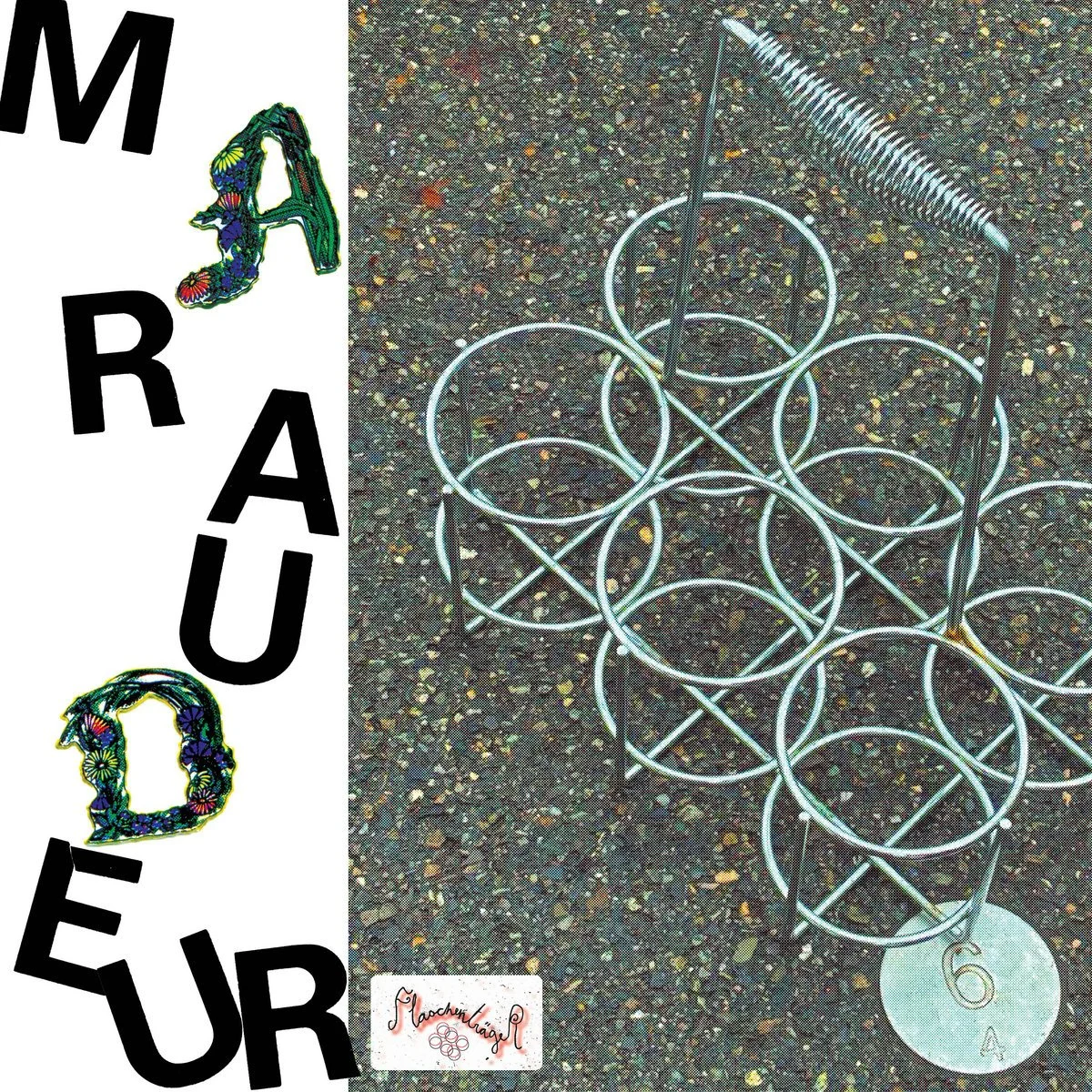
European music has always left more room for experimentation — a space where indie ideas thrive far from the gravitational pull of U.S. mainstream trends. That freedom often makes the music feel more intimate. Flaschenträger, the freshly released album by Maraudeur, feels not only intimate but also spontaneous, even deliberately unpolished. Recorded in 2023 in Geneva, the record gives the impression of stepping into an art-school jam session in a crowded studio apartment — and that atmosphere absolutely works in its favor.
Calling the record surrealist isn’t wrong, but it doesn’t fully capture its character. The opening track, “EC Blah Blah,” establishes a wiry, 1980s-tinged post-punk foundation: absurdist lyrics, clipped basslines, fractured guitar, and synths that recall the more angular side of new wave. It doesn’t take itself seriously, yet its charm lies in the tension between looseness and precision — a hallmark of early experimental new wave rather than the polished, radio-friendly kind.
While the title track keeps one foot in recognizable 1980s territory, thi,ngs become harder to pin down with “La Jaguar.” This song feels like controlled chaos: tight, fast, repetitive musical patterns paired with vocals that seem to float above the beat in a slower, more deliberate cadence.
The brief two-and-a-half minutes of “La Jaguar” play like a collage of fragments that shouldn’t fit together but do. That same jagged energy carries into “Ah,” where English and French lyrics are shouted rather than sung, giving the track an almost confrontational immediacy.
By the time “58141” begins, we surrender to its escalating synths and taut, unsettling, funk-leaning bass. The bilingual vocals and off-kilter groove push the album further into its own strange logic — not as a pose, but as an instinctive mode of expression. And just when a sense of direction seems to form, “Robot Machine” upends it completely.
Here, the lyrics take on a sharper edge as they compare humans to robots: never anonymous, working for free, trapped inside a worn-out body. The android-like synths and clipped rhythm section push the track deeper into experimental post-punk, but there’s genuine poetry threading through the noise.
As the album approaches its end, a more familiar structure surfaces in “(Legacy),” where the song feels momentarily more traditionally framed, its instrumentation less chaotic. But any sense of stability dissolves with the final track, “Hollow,” which gathers the album’s recurring elements — looping structures, shards of guitar, abrupt rhythmic pivots, bilingual lyrics, and echo-laden vocals — into one last burst of organized disorder.
A comparison to Kleenex/LiLiPUT — and other early, raw, female-fronted post-punk groups — is almost inevitable. The same minimalist urgency, surrealist lyrical approach, and playful-but-tense instrumentation run throughout. But Maraudeur aren’t merely referencing a lineage; if anything, they seem to remind us that we live in a time when coherence is optional and absurdity is an honest aesthetic.
Whatever the intention, Flaschenträger is a gratifying experience for listeners who enjoy music that embraces rawness, tension, spontaneity — and the beautifully absurd.