by Caroline Nieto (@caroline.nieto)
Emily A. Sprague’s Cyano isn’t just an album — it’s an entire world. Sprague, perhaps best known for her folk project, Florist, expands her sonic world through modular synthesizers and hazy electronics, all of which come together to represent an imagined planet, Cyano. Based in New York’s Catskill Mountains, Sprague blends the tactile symbols of her environment with her imagined supernatural world. The planet Cyano is elemental, but long uninhabited by humans. It’s a planet “destroyed by misunderstanding.” Still, Sprague points to the center of this work, the center of all her work, with empathy, what she deems a “key word for the project.” While the ties to our world, our collective struggle to coexist within our planet’s constant entropy seep into the album implicitly, Sprague never ties Cyano to the real world in any definite terms. Instead, she lets the album and its themes linger in unreality, a place that can be destabilizing, but still a beacon of hope. I met with Sprague to talk about Cyano, her goals for the project, and how she created an entire planet in just one album.
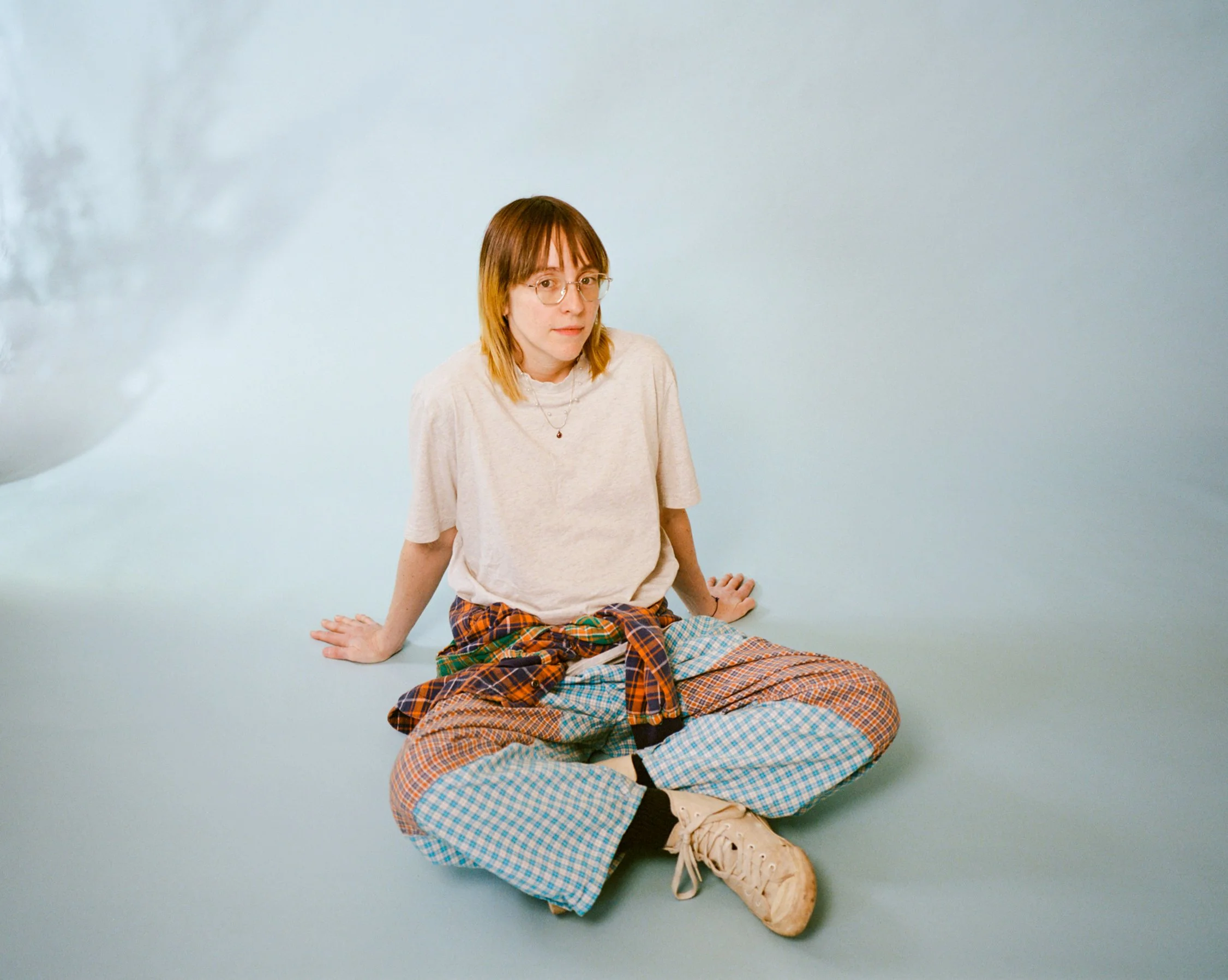
photo credit: V Haddad
Caroline Nieto: Cyano is somewhat unorthodox—a concept album based on a planet that you’ve imagined. How did you initially get the idea for the project?
Emily A. Sprague: It definitely encompasses a lot of different ideas. Over the years it’s changed a little bit, but originally, I was really interested in cyanotypes and thinking a lot about the actual scientific process of how light changes and chemical form. That feels really magical to me and really interesting, and photos and cyanotypes are really emotional. I find light to be really emotional. It became the central idea of emotional experiences tied to the ephemera that is printed images and prints, that can represent a feeling or an experience that can be shared. Somehow through that, I started imagining this world called Cyano, which was the idea that I was thinking about for so many years—that there was a planet that was destroyed by misunderstanding.
There's a few different allegories that Cyano can be for. One of them is an internal world. One of them could be our world or an external world. I was thinking about what happens when a society or a planet tries to recover and heal from being destroyed by people not being able to communicate with each other and not being able to get through to each other or have empathy for each other. Empathy is a key word for the project. I imagined this planet, Cyano, where over years and years and years, the planet and the inhabitants have evolved to be able to communicate symbiotically, without words, without language. It's like this utopia of sorts, but it's also very static. It's just sort of functioning and there's not much else. That started getting me thinking about the desire to continue to grow and change and feel and share feelings. Cyano was always this imagined place that I also feel inside of myself, and feel like we all carry inside of ourselves, of the desire to feel and share and grow and change, even through difficulty.
CN: There are so many visual examples like cyanotypes and photography that influenced the album. How did you take those visual themes and textures and give them sonic motifs?
ES: I was working on the music for Cyano for a really long time, and there were a lot of different iterations of the sounds that I was using. There was a whole era where I was incorporating field recordings and natural sounds and stuff like that. I was trying to find this sound that felt natural, but also sci-fi in a way and not quite of our world. For the sound design process, I heavily featured a physical modeling synth, which basically can replicate striking wood or metal, or hitting natural materials with mallets and stuff like that, and then processed that in a way that made it sound dusty and like it was left in a puddle for 100 years, kind of like this like aged transmission. I really wanted the sounds to feel intentionally lo-fi—not just lo-fi in the way that’s like lo-fi beats to study to or something, but more of a really weathered and kind of digital sci-fi kind of thing.
CN: Cyano is so steeped in these digital elements, and you didn’t use any acoustic instruments to record the album. Were you always writing on electronic instruments? Or did you translate anything from acoustic writing to a digital world?
ES: It was all written with electronics. A main element of the writing that was pretty different for this album versus my other solo records was that I really made an effort to incorporate melody, written and really intentional melodies, into pretty much all the tracks, if not most of the tracks. That maybe comes a little bit from when I write Florist songs on guitar. It's so melody based, and I find that melody that I hear through playing an acoustic guitar and the resonances, and then that ends up being a vocal melody. That process has never really been a part of my solo music up until Cyano. So I was playing a synth, I was synthesizing sounds, but for a lot of the melodies I was playing live and finding them through feeling in a similar way. I hope that gives it a more of a natural sort of feel and it doesn't just feel robotic. I wanted it to feel, not super primitive exactly, but sort of like a beginner's sense of just exploring.
CN: So many songs on the record flow into each other in a continuous way—there’s a sparseness to some of the songs, and then a vocal melody will intervene. How did you decide which songs warranted lyrics and when did you find it better to hold off?
ES: When I was making the record, I had a few different core patches on my synth, which I used for a lot of tracks just by changing the melodies or changing the tempo, but keeping the same instruments and sometimes keeping some of the same effects. So I think that helped things feel a little more cohesive and like they lead into each other. In terms of which songs got vocal melodies and which didn't, it was really just like a feeling thing, I guess. I just spent a lot of time listening to everything that I had been recording and sometimes it was during the recording process. Sometimes I added lyrics after. Whenever something came to me, I would record it, and pretty much all of that stuck, and ended up being the lyric tracks. Cyano is definitely meant to celebrate intuitive energy.
CN: You only spent about a month writing the album, right? Is that typical of your writing process or did you feel like this was a quicker process for you?
ES: The whole pre-production of thinking about ideas, like with Florist records, is kind of similar. I will, usually over about a year, spend a while not having any ideas for what the next record is going to be. Then I start finding these recurring things that are coming up in my mind or in my feelings and I'll just be like, okay, I feel like this might be something that I want to write about. With Cyano, it was years of that. It was like six or seven years of basically thinking about this place and this record and making a couple of demo records that aren't anything like what it sounds like now. In this particular moment, I just felt really connected to it. I made everything in a month and recorded it over the course of one to two months.
CN: What is the difference for you while making a Florist record versus making a solo record?
ES: Florist feels like I'm really on Earth, and there's a lot about Florist that is easier for me. All I need is an acoustic guitar and the right headspace. I feel like Florist songs tend to come from a much more minimalist, kind of natural place. Whereas my solo project, and this is something I really like, is a space where I feel like I can be more experimental and really show the sides of my inner world that are really strange. I really like breaking outside of boxes, and I feel like I have a little bit more room to do that with the solo music, or at least I can make really experimental-leaning things. With Florist, it's always been in there, but it's just kind of sprinkled in, and it’s also really important to me that Florist songs have this core of folk songwriting and have this really accessible, instant kind of thing.
CN: You play an inner/outer world dichotomy a lot on this record. How much were you trying to toe the line between creating the conceptual world of the album and relating it to the concrete world?
ES: I think Jellywish [Florist’s previous album] toes the line in some similar ways, where there's no explicit declaration of politics or ideas or calls to action, but my hope is that through music and through art, that just encourages us to consider what it means to be and to ourselves and to others. I did talk about this a lot with Jellywish, too, and I feel like I'm reiterating it a little bit, but I'm realizing that that's something that I must be really thinking a lot about, which is that it’s toeing the line, but it is also open-ended for the hopes that it can be applied to a lot of different things, that I think are generally encouraging curiosity and growth, and movement versus stasis.
CN: Is there any specific lyric or song with lyrics that you feel most describes the theme of the album, or what you think ties it all together?
ES: There's a song called “Spiraling to the Place.” That song comes towards the end of the record, and the lyrics are some of the most direct. That, to me, is more of a reflection of a genuine ask of the listener to tap into what it means to hear this voice sort of say, “You're just falling through this abyss and I want you to be free.” Those words are kind of powerful or kind of intense-feeling words, they feel that way to me. I guess the more sad feeling songs towards the end of the record feel like they hold a lot of the emotional meaning with them.
CN: There are so many spiral motifs in art and nature generally. What did you think about using “spiraling” in a song title, and what does it represent to you?
ES: To me, it represents a constant and something that we are never really outside of, even if we think we might be or even if we think that everything is under control. If you're solid and kind of immovable, the spiraling feels comforting. It can both—it can be comforting and it can be scary. But it's this idea that you are always in motion and the spiraling is taking you somewhere. I think we can choose to be a part of it or we can choose to try and stop it or control it or ignore it. A lot of the ideas of life beings and life forms in the record are about us having continual growth and change.
CN: There are several songs that have verbs in the title, like spiraling, listening, transfiguring. Was that an intentional choice? What was the thought behind giving a sense of continuity to your songs, and implying a kind of motion with their titles?
ES: Cyano feels like a very active record to me. I think part of my music-making process lately, also as a person living, is trying to find things to have hope around, and to not be pessimistic for the sake of writing things off as already over or ruined. Having verbiage in that way is, for me, about promoting, or at least for myself, just a reminder, that we can act, we can be active. All of this is in effort to have hope that our actions can have effects. Cyano has a lot of this active language in it because it's in active change, and it's through the effort of people wanting that to be happening and enacting it.
CN: There's so many great nouns, too, of wind and lava and liquid in your lyrics—things that are so visually stimulating and tactile. How much did you pay mind to creating this planet with the kinds of things we notice in our real world?
ES: I'm kind of obsessed with opposites and duality. Like lava and water, I just love as feelings, or how they both complement each other and are a part of each other's world in so many ways but are different. I knew that there was an element of volcanoes in Cyano. I really love volcano lore and imagery and history. And water, of course, is something that I am really interested in and find a lot of mystery and magic in, and the history of water and lava sort of preserving each other and all this stuff. That was always a big part of it. I was also interested in things like vapor, and water, these more elemental matches to some of the sounds that I was trying to make. Some of the themes in the visuals, too, like these faint, kind of glowing, dusty postcards come from a place that's a bit strange but relatable.
CN: Where do you think humanity has a place on this record? Even the music video for “Sing To” doesn't feature any people, it’s more of an environmental collage. How much of it grounds you to a human place?
ES: The story of Cyano, where it is right now in the timeline of this record, is that there are really not quite yet beings that are fully communicating with each other. It's very beginning stages. I guess the way that I relate it back to humanity or our world is that it serves as a hope and a reminder that what we do get from each other is worth all of the pain that happens, and we can use that as a power to connect. As we're on a track to have a lot of destruction at the hands of humans, we also can have a lot of empathy with each other and try to harness that and have some hope in that ability.
CN: Cyano is such a flowy electronic work, which I can imagine might be hard to represent in a live performance. Have you ever performed any of these songs live, or do you plan to?
ES: I'm currently figuring out how to do that. I have a few shows booked, but I'm intentionally not planning too many shows and probably won't tour or anything like that. I have three or four shows coming up in the fall and I plan on playing as much of the record as feels good to play, and we'll see. It'll definitely be a slightly different rendition of it, but I think the songs can definitely get there and have live versions. That's my project right now.
CN: It’s so exciting to imagine performing this album live, but I can imagine it’s pretty technically difficult. It’s so cool that the writing is done in the recording process—it feels so instantaneous in a way.
ES: Yeah, it's like bottling lightning in a way. I have worked like that a lot and I keep telling myself that I want to be more technical about things, but my emotions take over and just become what gets created more than keeping track of exactly how I recreate everything.
Cyano is out October 2nd, 2026 via RVNG Intl.