
by Benji Heywood (@benjiheywood)
Imagine that every night when your head hits the pillow, you could dream anything you wanted. Sounds great, right? Maybe not. The British philosopher Alan Watts believed that most of us would grow bored with getting everything we wanted. Eventually, he thought, we would dream a life indistinguishable from this one, with all its uncertainty, risk, and pain. If this is true, then who’s to say we’re not dreaming right now? Death, Watts posited, is simply the waking up.
Listening to Shudder to Think is like this: surfacing from some liminal state. Since forming in the late 1980s D.C. post-hardcore scene, the band has communed with something deeper. Get Your Goat and the era-defining Pony Express Record sound like a sexed-up Slint cutting Queen albums. This is music as charged and mystifying today as it was back in the ‘90s, when the band was challenging punk and mainstream audiences alike.
That Shudder to Think can still make new music as beguiling as this year's Who Sent You? EP signals that its members – Craig Wedren (vocals), Nathan Larson (guitar), and Adam Wade (drums), alongside Clint Walsh (guitar) and Jherek Bischoff (bass) – remain in touch with whatever it is that’s just beyond the surface.
We caught up with Wedren and Larson before their recent Los Angeles show. Ranging from the early Dischord years to the present, the interview touches on what it’s like to perform now versus then, the new record coming out in 2027, and communing with the dead, including an intimate remembrance of their friend Jeff Buckley.
This conversation has been lightly edited for length and clarity.
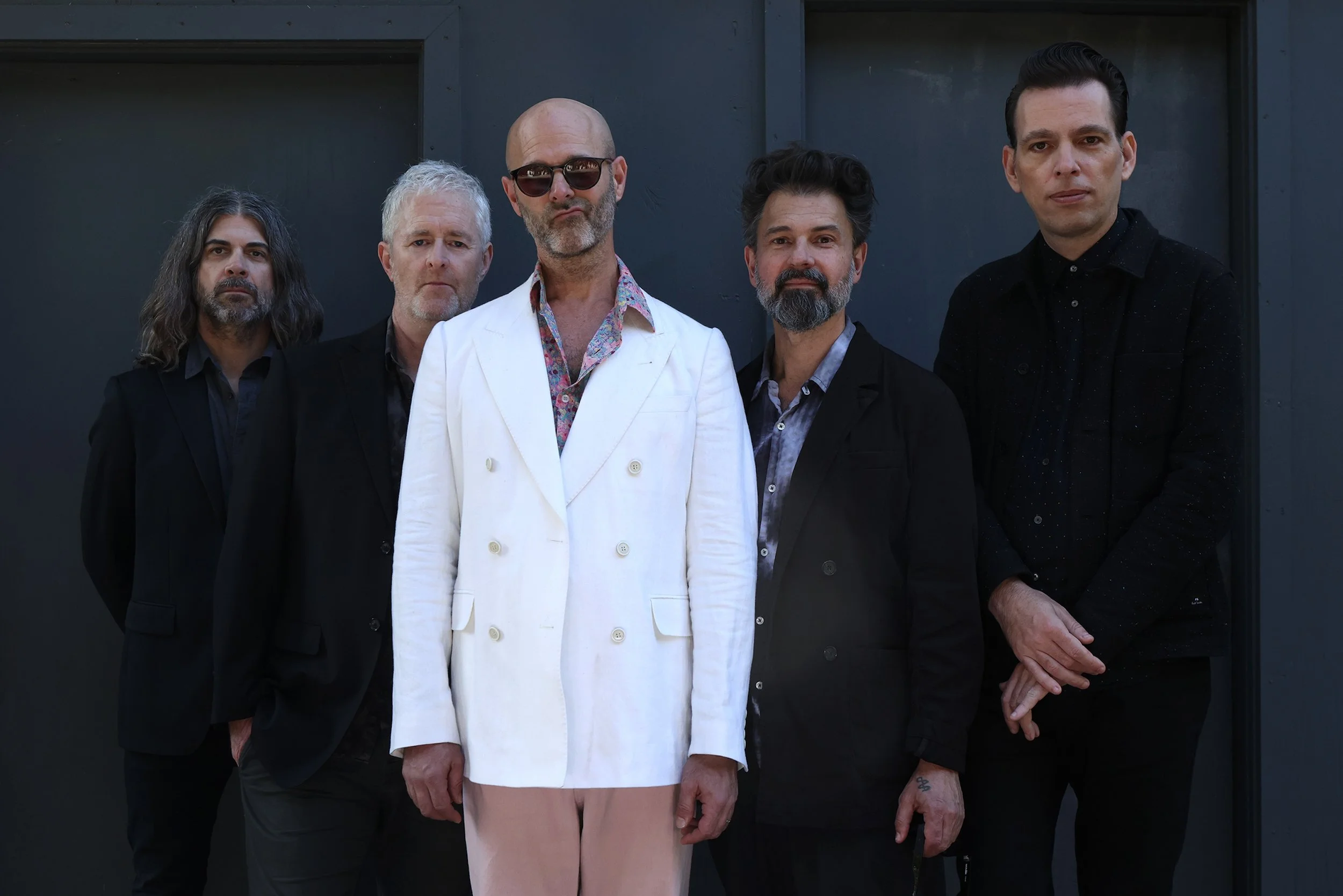
photo credit: Diona Mavis
Post-Trash: How have the shows been so far?
Nathan Larson: They were amazing — and very different from each other. The first was at the Unitarian Church in Philly, which is a hardcore venue: no lights, and that crazy rug on the floor—
Craig Wedren: —covered in God knows what. The kind of place where the industrial lighting choices are only: on or off (laughs).
NL: My son was like, ‘This is where Title Fight played.’
CW: It was wonderful, a total throwback to the very early shows we played around the Beltway in D.C. — Unitarian churches, moose lodges, whatever else. Low ceiling. Very Fugazi. But then, the dressing room was this gorgeous little hand-carved sanctuary with stained glass.
NL: Incredible. Very sweaty. Then, Saturday night at the Bowery was amazing. It was my birthday, about as nice as you could hope for.
PT: Virgo season!
NL: Yeah, straight up.
CW: In New York, my son had just started at NYU, so he rolled up with a whole posse of new friends. Adam (Wade, drummer) has a son who goes to NYU too, studying guitar. It was a total family affair. The shows were beautiful. It’s just a joy right now.
PT: Here in LA, we just had Echo Park Rising when the whole neighborhood turns into a venue, like early South by Southwest. It was like being in a time warp. All the kids were playing guitars and having a great time. Craig, you’ve said “Who Sent You” is kind of an anthem to being young and bored in suburbia. Are you seeing a contingent of kids, around your kids’ age, getting into your music now?
CW: It’s really sweet. I noticed it especially at the Philly show — this whole front row, mostly women, late teens to late twenties. One of them had been right up front at the Mercury Lounge show last year, cheerleading us. In this day and age, a certain kind of kid is what a crate-digger would have been in the analog days: turning over every stone, trying to find special bands that haven’t been overexposed. I get the sense — and this could be projection — that there’s a bit of that old ‘this is special, this is mine’ magic. Then there are kids there with their parents, which is really beautiful. One dad was rocking out, and his daughter was rocking out right next to him.
PT: You mentioned that crate-digging mentality, wanting to listen to something that sounded different, because you felt different. I can definitely identify with that, and I think kids now still do, too.
CW: Totally. Kids these days don’t have the rigid genre fixations we did back then, which were always so maddening. My son’s friends genuinely love Shudder to Think, and they get it. They’re not afraid of music that asks something of them — odd time signatures, funky non-traditional chords don’t scare them off or seem pretentious. They’re just like, ‘Oh, that’s interesting.’
NL: Same with mine. My son’s fifteen, about to turn sixteen.
PT: Something that drew me to Shudder to Think in the ’90s, and still does, is the feeling that the band was a kind of signal. It was like, if you’re a weirdo, this band is for you. Back then, if you were an artistic kid, you’d try to fit in anywhere: you’d be in theater, art class, wear bands’ T-shirts. What interests me is that it’s still happening — your new music still sends that signal.
CW: Basically, that’s Nathan’s and my meet-cute in high school. ‘Hey, cool Misfits shirt. Cool Celtic Frost shirt. Cool Chucks.’ And then it was on. Maybe we can coin a term for it — the baddie signal!
PT: It’s a welcoming thing, especially when you think about those purity tests of old hardcore, which were just so exhausting. How did you deal with those back in the day — and how ridiculous do they seem now?
NL: It was frustrating, but that was the context we were born into. Before Shudder to Think I was in Swiz, a hardcore band that had the same feeling about itself. By the time we started — ’86, around when Shudder to Think started — the scene had already moved on from hardcore. It was going melodic. Rites of Spring had broken up, and then it was One Last Wish, saying, ‘We’re not going to have any distortion.’
CW: It was such an amazing, creative scene in D.C.
NL: In Swiz, I got exposed to New York hardcore people, bands like Verbal Assault, bands from Pennsylvania and Connecticut — and it was this tough thing I never felt I fit into. Shudder to Think was a much better fit. But what I’m trying to describe is that feeling of being on the outside — that’s a human thing.
CW: It is a human thing, and particularly at that age everybody feels that way, so you’re looking for a tribe. The rigid categories make sense. But if you’re in it for expression, the gift of punk and post-punk was the freedom to do anything. That wasn’t the case for everybody; for some people it’s more of a club, a signifier. After Revolution Summer — the emo summer, with Embrace — it became okay to admit you loved the Beatles, to grow your hair out, to start making much more exploratory, experimental, psychedelic, interior music. That was within the Dischord scene, which was never intentionally prescribed.
PT: What happened when you started touring?
CW: Outside D.C., it took years for the strictness to soften. We’d go on tour and people would show up just because we were associated with Dischord — but ninety percent of them, or more, wanted a Minor Threat. It was difficult for a weirdo girly band like us for a while. No real complaints, though: it sharpened our teeth — our stage banter, not putting up with the bullshit, making our musical statements sharp and clear. It really honed us.
PT: Do you remember when that shift happened, the relationship with the audience turning from antagonistic to participatory?
NL: We had a strange transition. We signed to Epic and immediately we were touring with Pearl Jam — big crowds. For the most part, the people who’d be loudest and up front were not there for us. It was the mass audience, kind of the jocks we’d had to deal with in high school.
CW: It was the normal opening-band plague mixed with the MTV-alternative meathead crowd. But what are you going to do? When something gets popular, it tips over and becomes for everybody. That’s the price you pay. It was difficult, but it really made us good.
NL: These most recent shows, and the ones about a year ago — it’s the first time we really get to be in a room full of people who are just super, super psyched about Shudder to Think. It’s the first time I can lean back and enjoy it and feel it.
CW: I was thinking about that during the Philly show. It’s so nice that we don’t have to establish or assert our voice anymore. We can just express it naturally. The new record we’re finishing, and the EP, feel like that. It’s what we always hoped it would be if we didn’t have to prove ourselves or pound the pavement so hard. We just want to make our music, whatever it looks or sounds like, and share it. So, the new record has this very warm, natural feeling. Even though it carries so many of the staples and touchstones of different Shudder to Think eras — from the more difficult to the more traditional, plus a lot of new stuff — it never feels like it’s flexing.
PT: What else can you tell us about the new album?
NL: So much material came out!
CW: Too much for one record.
NL: Only because there’s a density to the new stuff. You’ve heard “Who Sent You.” It’s all like that. Dense, a lot of ideas, a lot of information, a lot of dramatic narrative arc.
CW: We sent the rough mixes to our management and PR team, and to Ian [MacKaye] and Brian [Lowit] at Dischord — the singles have been coming out on Dischord, and it looks like the LP will too, which we’re thrilled about. Ian said, ‘There are too many ideas in a single song — you’ve got to tighten the screws.’ So we distilled it down to nine or ten. It’s a full meal, but it leaves you feeling healthy and spry afterward.
PT: Besides this outpouring of music, has anything else surprised you being this far into the band’s life?
NL: Something I’d never have anticipated — and you see it with a lot of ’90s bands that get back together — is that we sound better than we ever did. We’ve figured out how to choose our guitar sounds together, how to find more economical, effective ways to communicate what we’re trying to communicate.
CW: We’ve also all been playing music every day for decades, which is unusual. Three-fifths of us are working career composers, so we’re thinking about music all the time — structure, dramatic presentation, how to put something across effectively.
PT: The internet has resurrected all these bands I never got to see as a kid. So how do you think about Shudder to Think now? Do you feel, for lack of a better term, “reunited?” Or are you just a band doing its thing?
NL: Yeah. We just raised the gate, turned the lights back on, and said, ‘I don’t know — let’s see.’ It was extremely natural; it fell together in a beautiful way. And it’s genuinely strange that our bodies and our playing are better than they were, in so many ways — we’ve learned how to manage ourselves and take care of ourselves.
CW: Along with collapsing a lot of genre boundaries, streaming has really done a number on time. The idea that the last time a band put something out was thirty years ago doesn’t mean the same thing anymore.
PT: Kids don’t feel that gap either. My best friend’s daughter is in a band — she’s in her teens; they played the Smell — and they covered a Jeff Buckley song because he’s her favorite artist. That Grace came out thirty-plus years ago — it just doesn’t matter anymore.
CW: The whole Jeff renaissance is extraordinary. My son and all his friends are obsessed. I never understood in the ’90s why it wasn’t abundantly obvious to the entire world that this was a historic, world-class artist.
NL: We’ve had to deal with “I Want Someone Badly,” the song we wrote for the First Love, Last Rites soundtrack [written by the band, it's among Buckley's final recordings before his death in Memphis in May 1997], which we’re now performing live for the first time. We had to figure out how to approach it and what it meant.
My son is in high school in New York City, and all the girls in his class know that song — but they have no connection to Jeff. So how do we honor that? When you meet a cosmic-intelligence trance-medium like Jeff, it’s fucking weird. It’s a little scary, a bit like a ghost experience. As artists, we generally have the ability to conduct this cosmic information; that’s what we’re doing, but we do it in fits and starts. When you meet an incarnation like Jeff, it’s so clear he’s operating on a different frequency. Someone like that isn’t going to be able to conduct his life very well — it’s too hard, it doesn’t quite work on this plane for some operators. For our generation, he was one of those people. What does it mean that we had that interaction?
PT: What do you remember about that time with Jeff?
CW: Jeff started showing up. I remember him coming to a show at the 9:30 Club around ’92 or ’93 — it was during Get Your Goat. We had a mutual friend, Rachel Felder, who told me, ‘This guy Jeff is a huge fan, a big Shudder fan.’ We were pretty full of ourselves at the time, because, we reckoned, there wasn't anybody doing what we were doing. We were young and it was like protective gang armor — you can’t fuck with us. And she said, ‘You really should go see this guy play, he’s brilliant.’ She probably used the G-word, and that’s the kind of bullshit that gets bandied about daily, so you take it skeptically — most people aren’t actually transcendent, even the very good ones.
I remember he showed up at the show and just sort of skulked around; I think he was shy, and that’s hilarious because that’s not how he struck us later. He was hanging out in the dressing room and we were like, ‘What is this James Dean bullshit?’ So we wrote him off. Then we were making Pony Express Record, and Andy Wallace mixed it. His project right before us had been producing Grace. I remember being in the mixing room and telling Andy, ‘Oh, we want to hear that.’ We’d become friendly acquaintances with Jeff by that point.
Andy put on ‘Mojo Pin’ on these great speakers, and literally, after hearing it, I immediately picked up the phone, called and apologized to Jeff — ‘Dude, I’m so sorry, I didn’t get it.’ There was so much bullshit overhype, always, and it’s so rare that something actually is the thing the hype says it is.
NL: Yeah. He was a mystical-poet guy wandering around, and then he did mystical-poet-guy things socially, too—
CW: —and he was very fucking dear to our hearts.
NL: You just don’t come across those purity agents. Most of us are working, channeling maybe thirty percent of the cosmic information. He was literally at a hundred percent — assaulted with angelic language — all the time. That sounds dramatic, but it’s true. And it makes you not very functional in other areas. He struggled with lyrics, so he’d find ways to work with different people, get into these relationships.
CW: He was sort of old school that way. Like a troubadour.
NL: Like his father.
CW: Speaking for myself, I still have an almost daily, jokey communication with Jeff. It’s interesting, when you have friends who are also high-bar examples of what you do. I toured with Chris Cornell, and then he died. We weren’t friends the way Jeff and I were; we weren’t peers. But he was lovely, and there was a lot of warmth and love there. If you live past a certain age, and you’re in the spin of it all, there’s a lot of communication with the dead. I’m not here to judge where it comes from, or whether it’s real — it’s real. A lot of it is just laughter: puny human, still alive, still on the ego plane, still worrying about these meaningless things: ‘This sucks, my voice is shot, I’m tired’ — and the answer comes back, ‘Ha — I’m not.’
PT: That’s one of the amazing things about music — it’s the link between the mystical plane and the physical one. So, when people are gone, you still have a way to communicate with them here. Does that make sense?
CW: A hundred percent. And it’s not only artists. My father died at the start of COVID, and my relationship with him is so hilarious and tight right now. It’s a living thing — unbridled now. He’s everywhere. (Wedren becomes emotional, Larson quietly comforts him.) When he was alive, he had his stuff, I had mine, so it was a narrow, fixed thing, even though the love was so deep. It was similar with Jeff: there was pain, it was hard, even with all that love. And now it just bursts open.
NL: I’ve been trying to articulate this better — the Alan Watts idea of how things work within societies and the world: that we’re all one entity, that separateness is an illusion, that we create these dramas, and ultimately, when our bodies die, we get reset. ‘Oh, wasn’t that a fun show?’
Everything you experience is an extension of yourself and carries information for you. For me, it’s less about talking to specific people than a general sense of being in touch with things — cosmic information before it incarnates. It’s a relief to feel that’s real. After Jeff died, there were a lot of poltergeist-y experiences in my apartment, and with his ex-girlfriend, who was grieving — mirrors, pretty intense stuff — that makes more sense to me now. And it’s great to be able to look at all of it and find it fun to talk about, instead of scary or impossible or something to push away.
CW: The way that makes sense to me is that we’re all individual nodes on a collective whole. There are these little ego-pimples — us — dancing and flopping around and then going back into One.
Who Sent You? is out now via Dischord.