
by Giliann Karon (@gilposting)
Minneapolis quintet she’s green has been on the move this year. They’ve performed at Nothing’s Slide Away festival alongside Hum and Chapterhouse, shared the stage with Turnover and Narrow Head, and will soon play across Europe for the first time. This past June, they released their swallowtail EP via Photo Finish Records, the follow-up to last year’s chrysalis. They’ve successfully bridged the gap between seminal shoegazers and the movement’s current renaissance, and they’re not slowing down anytime soon.
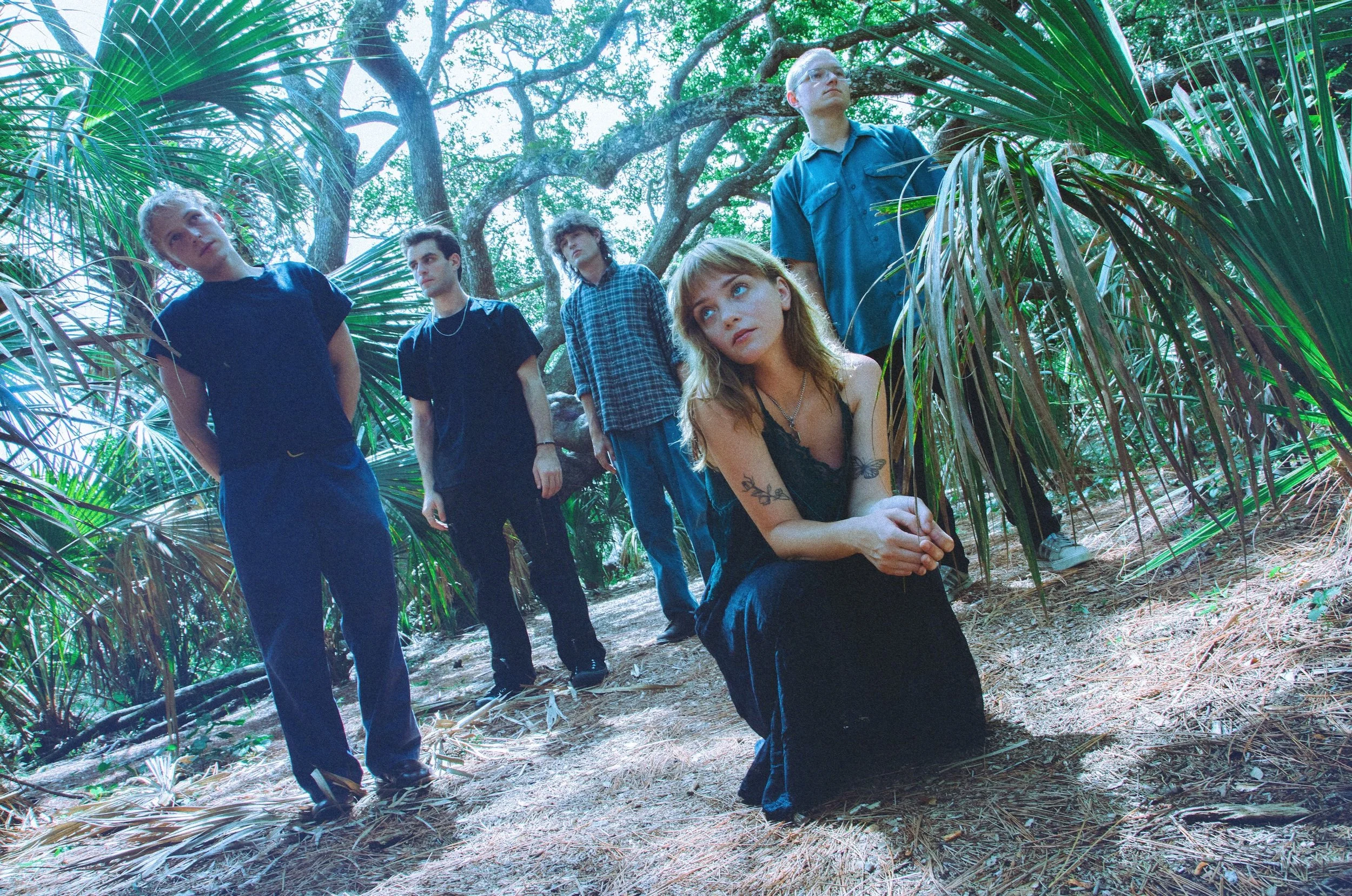
photo credit: Liam Armstrong
GILIANN KARON: You describe your music as moss music. In your words, what does that mean, and how did you land on that descriptor?
LIAM ARMSTRONG: It started as a funny saying we came up with. The idea of moss is very inspiring for us. It's very resilient. It's obviously green. It’s a symbol of these little microbiotic worlds.
RAINES LUCAS: Moss is like a whole little world, and it’s cool to think of music as a little world you can step into.
GK: In your minds, what bands evoke that same relationship with nature?
TEDDY NORDVOLD: Gordon Lightfoot.
LA: Vashti Bunyan, Jefre Cantu-Ledesma, and Brian Eno.
RL: Not long ago, we were talking about how most nature-y artists are folk artists, which can feel like a trope.
GK: Were there any specific environments, rituals, or physical experiences that helped you channel that while writing and recording?
LA: Spending time outside helps. We have spots back home where we’ll sit by a stream, and that constant rippling sound is really grounding. Going to parks and different places clears our heads. Writing feels more fluid that way.
ZOFIA SMITH: I don’t want to give the spots away, but there’s a river in Wisconsin we love. It’s on the cover of our EP, wisteria.
GK: You've shared stages with bands like Nothing, Hum, Slow Pulp, and Swirlies, all of which have left their mark on noisy and atmospheric guitar-driven music. What did you learn from being around them, and how do these lessons show up on swallowtail?
ZS: We played with those bands after we’d already recorded swallowtail, but I think we’ve definitely learned a lot from how authentic they are.
LA: What was crazy was that at Slide Away, Hum said something like, “This is the biggest show we’ve ever played.”
ZS: Having that in common with the larger artists on the bill felt insane.
LA: We’re more appreciative than ever of the love we’ve gotten. We’re a young band just getting started, and we don’t take any of it for granted. We’re just going to keep working as hard as we can. We look up to bands that have been doing this for so long, and we’re excited.
RL: A couple of years ago, we met Henry Stoehr, who plays guitar in Slow Pulp. He told us that when they record an album, they're in the studio from 9:00 to 5:00 every day of the week. I never forgot that because I realized they’re not casual about this at all.
Sometimes music can seem like such a casual thing; you just get lucky and have a chill career. But hearing that made me realize, “Oh, wow, they take this seriously and put in so much time, and that’s why their music is so good.” It was inspiring and grounding to understand that this takes a lot of work.
TN: The first couple of tours we did with bands like Glixen, Soft Cult, and Slow Pulp were such a new experience, being on the road, touring, and playing every night. It was very enlightening to discover how much work goes into touring, and how much you have to take care of your physical and mental health to maintain a good creative headspace through it all.
A lot of those lessons carried over into new music, rehearsing, and writing. It introduced us to music as a career and, now, as a way of life. There's a lot that goes into it, and there are a lot of small things that you wouldn't necessarily expect that make a huge difference.
GK: Your song “Mandy” became a viral hit and introduced your band to a much wider audience. What was that moment like from your perspective?
ZS: It was definitely wild. It wasn’t some huge viral TikTok moment, but it was cool to watch the listener count steadily climb. It lined up with when we started touring, so it felt gradual rather than a sudden hit online.
KEVIN SEEBECK: It took about a year. It definitely crept up on us.
ZS: One day we were like, “Oh, this hit three million?” Then the numbers kept climbing. It felt like real, organic growth, which was rewarding because it came from touring.
TN: I remember one moment in particular. Some Canadian YouTubers I didn’t know about—Slushy Noobz—talked about us on their stream, and friends started DMing me about it.
I guess one of their girlfriends is named Mandy, so they brought us up on stream, and the fandom latched onto the song. People DM’d me about it, and I thought it was cool that a corner of the internet I’m not part of found our music organically and made it part of its own gaming subculture.
GK: When did you realize you'd blown up?
RL: It’s still coming.
LA: We’re still building. I don’t think that moment has hit us yet. We’ve had huge milestones, like our first US tour and the Slide Away dates, but it still feels like we’re working toward the bigger goal of putting out an album and seeing how it lands. We’re so grateful for all the love and support, but we haven’t even done our own headline tour yet. There’s still work to do.
RL: It’s been very gradual. Our manager says we’re doing it the old-fashioned way by playing tons of shows and connecting with lots of bands. We didn’t get placed in a movie or have a TikTok go viral. Looking back, so much has changed in a year, but it’s all come from putting in the work and growing steadily as a band.
TN: There have been a lot of little moments on the road, especially while traveling, when my brain zooms out and I think, “Holy moly, how did we get here?” That still happens all the time.
ZS: I was really surprised when we went to China. Those were our first headline shows, and having 300–500 people show up was insane. We weren’t expecting much, and it felt completely different from our US shows, where we’d always been the support act and the rooms were smaller. That was a real mind-blowing moment—like, “Oh, these people are here for us.” I’m also really psyched for our own US shows this fall. That’ll be a big milestone too.
GK: How do you ensure everyone's contributions are heard when there are so many members?
LA: We try to leave space for each other’s ideas when we write. There’s a lot of discussion, but it never feels tedious. Everyone has their own role in the band and with their instrument, and there’s room for each person to express themselves within a song.
RL: The more talking, the better. If anything, the opposite would be more of a problem – people aren't tapped into a song because they don't connect with it. The best environment is when everybody locks in and throws out contributions.
ZS: When we're jamming on something for a long time and we aren't feeling it collectively, we know to move on. When someone isn't feeling it, we'll ask them why. It’s an open discussion all the time.
TN: We've spent so much time playing together, especially on tour, but even while jamming and rehearsing. We've gotten a good sense of each other musically, so we can effectively play off each other in a live setting, whether on stage or in the practice space. We've gotten really in tune with where something might go, leaning in one direction versus the other.
KS: A lot of trial and error while being in the same room all day.
LA: We are all the same person now.
RL: I think the coolest thing is when somebody has an idea, but then somebody builds off that, and then you build off that, and so on. Eventually, you're eight ideas away from the original thing. That's why writing music with people is so fun, because you start feeding off each other in a weird way.
LA: It’s a very visceral representation of your own thought process.
GK: How did you decide to write two EPs in the span of a year versus one LP?
LA: It’s what worked best with our touring schedule. We had collections of songs, some written around the same time and others written a while ago. When we finished touring, we felt that two EPs were the best way to release our music.
ZS: We wanted to do all of the songs justice. We had a large pool of songs, but it didn't feel like an album. We needed to release some singles and grow as a band before we could create a big project. Now that we’ve had more time to tour and sit with the songs, we feel more comfortable because our chemistry as a band has improved.
GK: What did you listen to while writing swallowtail, and do you think it shows?
ZS: I've been listening to Faye Wong a lot. She's so amazing. Her melodies are incredible. And also the Radio Dept and the Sundays. They’ve all inspired me personally to be more comfortable with a more vocal-forward project. On swallowtail, the vocals are bumped up a bit more, and you can tell what I’m saying lyrically, which was a little ambitious.
RL: Cocteau Twins and Slowdive. Crazy left-field answers, I know.
LA: The band E.
GK: How did your sound and process change between chrysalis and swallowtail?
TN: For one, it was the first recording that we've ever made that was in a full studio in one setting. That was a big difference.
RL: We were also just more prepared going in 'cause we knew we were gonna be on a schedule working with a producer. The songs were further along, or maybe we’d gotten more comfortable with them. As Teddy said, it was a higher-stakes environment.
ZS: Sonny Diperri [the album’s producer/engineer] made sure we were better prepared. He had us record videos of the drum and vocals playing so he could hear exactly what's going on with everybody in the song. Then, he dissected everything and let us know what to work on or change. We’d never had an outsider’s perspective on the writing process before, and it was cool to have someone there to guide us.
LA: We recorded chyrsalis in different places with our friends. The big difference is the bones of swallowtail. We recorded together in the same room, which translated into a more authentic, live feel.
GK: What was your experience recording in the studio, and was there anything that surprised you?
LA: I was surprised by how easy it was. We had less work, so we could really focus on our own parts, but we could also easily discuss the overall arrangements.
TN: We gotta give a lot of credit to Sonny and the team at Big Bad Sound for creating that very welcoming, streamlined environment. Obviously, there's a lot of work to do in a short time, but it was set up in a very efficient and welcoming way so we could get takes we felt good about.
ZS: In the past, we recorded things ourselves, and you’re anxious because you have more to worry about. Liam had been doing all that, so the studio environment took a lot of weight off his shoulders. All we had to do was perform.
GK: What's your favorite texture, instrument, effect, or sample that appears on the album?
TN: One jumps to mind straight away: I don’t remember exactly what the effect was called that Sonny used on your voice during some of the breaks on the final track, “Close Your Eyes,” but it’s this morphing, fluttering delay that pans really nicely around the stereo image. It’s one of his mystery tricks. It might be an unmarked pedal someone built for him.
RL: I don’t know if he used it in other songs, but it's good. “Dear Ivy” was one of the last songs we recorded. There’s an ambient backing in the second verse, and every time I listen, it puts a smile on my face.
We didn't want the first and second verses to sound exactly the same. We were tired and messing around, and I thought that addition was so cool. I love those little details that nobody else picks up on.
LA: I had so much fun figuring out the tone of the metal guitar. For that, he set up a Vox and a 4x12 cab. I got to be really loud and mess around with all these funny fuzz pedals, which were absurdly crunchy and insane.
TN: I hid in the corner of the live room when you recorded one of those tracks just to feel how visceral it was.
KS: I like when you guys hit the Memory Man during one of the breaks in “Close Your Eyes.” The RE-20 Space Echo.
TN: You get a little oscillation spiraling above you. Kevin, I was just talking with you about the thick snare on the Rise Against drum kit.
KS: That was a custom snare different from the drum kit. That thing just bangs. It's an 80-pound snare. That was cool. I tried to buy it from him, and he said, "I would not sell this to anybody on the planet."