
by Benji Heywood (@benjiheywood)
Some believe ancient instruments hold the spirit of those who played them. Concert violinist Vadim Gluzman plays an original Stradivarius violin built in 1690 once owned by Leopold Auer, to whom Tchaikovsky originally dedicated his Violin Concerto.
“I think that this thing is alive, and it has a soul,” Gluzman told WHYY in 2014. “We leave imprints. Those that play it, we leave our stamps. Whether I want it or not, it’s coming out.”
Haunted instruments may partly explain the alchemy of i think we’ve met before, the new album by Amy Rose Mills. The New York-based songwriter often finds herself in communion with instruments that once belonged to others. Perhaps best known as the guitarist in hardcore band Couch Slut, Mills also restores vintage guitars.
The channeling may have carried over to her debut solo album. Listen to Mills’ trembling voice on “idumea” or the chain-like percussion of “maybe i’ll see you in a year or 2” and try not to feel the hair on your neck stand up. It’s a dark-night-of-the-soul captured to tape, adorned with moments of ghostly beauty and, at times, startling intimacy.
We spoke with Mills shortly after the album’s release to gain insight into the album’s creation, the meaning we can find in everyday signs and numbers, and why Mills almost didn’t release the album at all.
This conversation has been lightly edited for length and clarity.
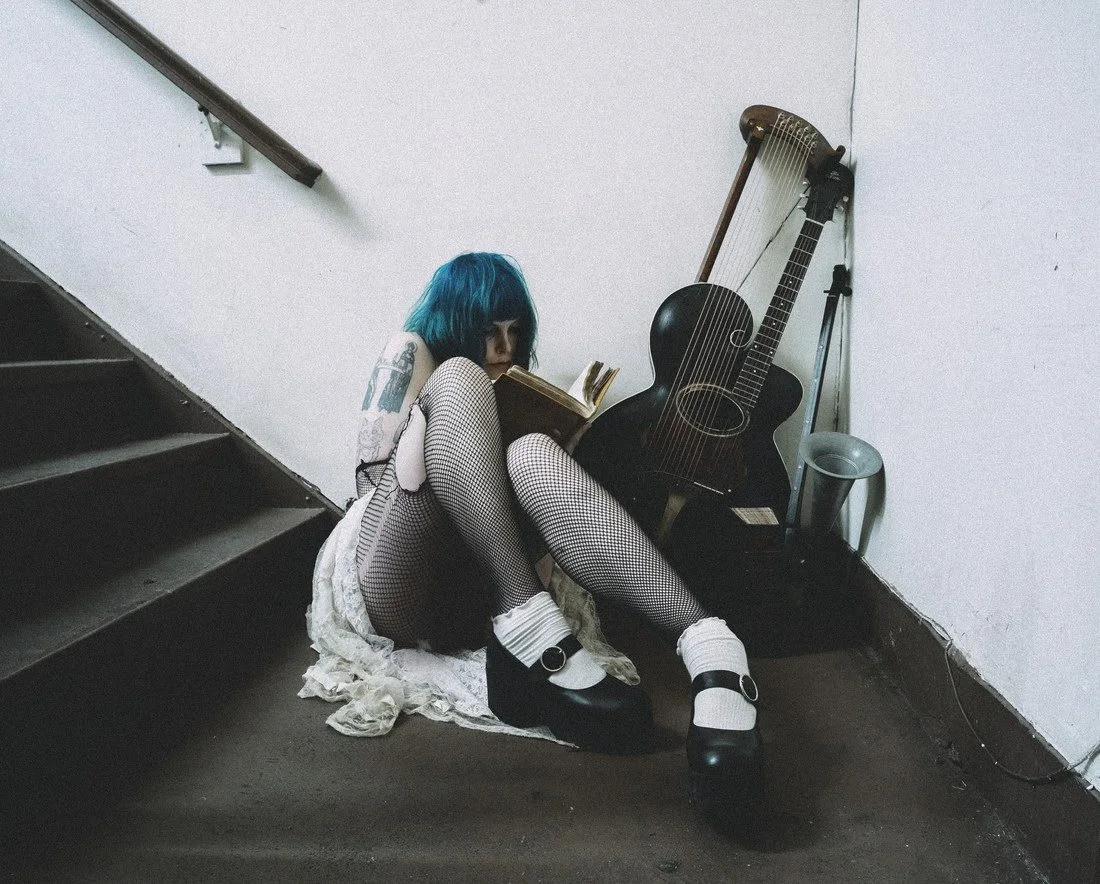
photo credit: Amy Rose Mills
Post-Trash: I saw you recently performed Glenn Branca’s Symphony #13 (Hallucination City) for 100 Guitars at Lincoln Center. That’s so cool. What was that experience like?
Amy Rose Mills: It was one of the most spiritually fulfilling experiences I've ever had. I was stressed out about it, but then once we started practicing before the show, I was like, "Whoa, this is crazy!” I don't think I've ever experienced 100 guitars playing at once, but once I did, I was like, wow, this is very special.
PT: What does that feel like physically, hearing 100 guitars playing?
ARM: It's just like this massive [sound] transforming and morphing around you. No one was playing the piece with 100% precision, and I think that's part of the vibe, being that [Branca] comes from the no wave background. There are a lot of rough edges, but I think the way that it all blends together, you start to hear stuff that's not even written in the music. It's like other sounds come out of the smashing of all the guitars playing together.
PT: Is it loud? The performance.
ARM: (laughs) Yeah.
PT: Is it pitchy? All those people playing stringed instruments with different intonations?
ARM: Every guitar is tuned to one note, and there's a few different parts, like alto, tenor, baritone, bass. My part was three high and three low E strings. I don’t think it mattered all that much if it’s out of tune because most of the time, everyone’s playing stacked chords. When everyone’s together in unison, either on a single note, or forming a big, huge fifth, it’s magical. And I think it comes from the dissonance of no one being super in tune.
PT: What kind of guitar did you play for the performance?
ARM: I played a 1965 Vox Phantom. I picked one I thought looked cool and that Glenn Branca would have been like, ‘Yeah, that thing is sick.’
PT: You seem to get your hands on a lot of rare, vintage guitars.
ARM: Well, I work at a vintage guitar store doing repairs, so I can work out deals and get first dibs on stuff that comes through.
PT: Tell us about that crazy harp-guitar thing I saw you playing on IG.
ARM: It was hanging on the wall at the shop ten years ago. When we moved the shop, we had a yard sale of stuff we didn’t want to move and that guitar was one of those things. So I grabbed it, and then, nine years later, I finally fixed it. I was like, ‘Wow, I should have fixed this way long ago.’
PT: It sounds so fucking cool on that Hum cover you do [“Stars”]. Is that recorded anywhere?
ARM: No, but I was thinking about putting out a single of two covers or work them into the next album. There’s a cover of a Nothing song I really want to do as well.
PT: What’s your recording process like? Or what was it like on the new album?
ARM: This one was pretty much entirely recorded in my bedroom, with a Universal Audio Arrow interface, an SM57, and another sort of condenser mic. A lot of it would start with me just noodling around on various instruments, and it organically grows from there. I would lay a framework, then I’d add layers, or sometimes move a part around. The words and vocal part would come last, or sometimes they would come together, but I'd develop it more later. It's an intuitive process, as opposed to really structuring things out.
PT: The album’s intimate feel owes a lot to those stream of consciousness moments, like the field recordings or voice memos. Were those things you had on your phone or were they recorded in the moment when you felt like adding something?
ARM: Usually in the moment. My best work is between midnight and three in the morning.
PT: You have two songs that cite times [“222” and “wednesday July 9th at 3:33 AM”]. Is time an important theme to your work or are numbers an obsession for you?
ARM: Not really an obsession. I just keep seeing the angel numbers on my phone, like, ‘Oh, it’s 1:11 or 2:22’ [editor’s note: angel numbers are repeating sequences of numbers people see in everyday places].
PT: How often do you see those numbers?
ARM: Almost every day. It’s very interesting because it just started happening. When I was working on the album, I kept a folder of screenshots I’d take when I would see a number. It’s very full.
PT: What do you think it means?
ARM: I don't really know, honestly. There's a lot of different meanings that have been assigned to those numbers, but I can't tell specifically what it could mean. I think it's something good, though. Everyone tells me, ‘Oh, that's a good sign.’
PT: A friend of mine was telling me about pareidolia. It's where you ascribe meaning to otherwise random things in everyday life, like seeing the numbers of your childhood address on a receipt when you’re on your way to visit. This friend is into the paranormal and UAPs. I'm more of a ‘that’s probably a coincidence’ person. Where do you fall on that continuum?
ARM: I want to lean more towards ‘the paranormal is real’ thing. I think there's a certain point where it stops being a coincidence because it has happened so frequently, but it can also be that I’m subconsciously looking for it in situations. Generally, I tend to want to believe in the paranormal explanation.
PT: It’s certainly more fun.
ARM: Yeah, I watch a lot of YouTube videos of various paranormal compilations.
PT: Is there a particular one you’re into right now?
ARM: Nuke's Top 5. It's this guy that compiles the best [videos] he gets sent or that he finds on YouTube and TikTok and other video platforms. During the pandemic lockdown, I think I watched his entire history of uploads, like 24 hours’ worth of videos.
PT: Have you had a paranormal experience?
ARM: No, unfortunately. I'm waiting for it, but it hasn't happened yet.
PT: New York has so many haunted places!
ARM: You'd think! I live in a building that's from 1900, and I have all this old shit in my room, and I’ve been to all kinds of old, what would seem to be haunted places, but I've had nothing happen. I have friends who have experienced things. Maybe I'm just not sensitive to that, you know?
PT: Well, at the risk of sounding cheesy, is it possible that your sensitivity is tuned into a different side of the paranormal? Because I think there is a sense of conjuring when it comes to creating music. Like, where does the idea for a song come from, right? It's possible that when you're picking up these vintage instruments that are decades, if not over a hundred years old, that you're channeling something from the past.
ARM: True. I like that.
PT: I mean, listening to the album feels like reading your diary, perhaps there’s a channeling there. It has a real claustrophobic feel at times. Or like, it turns the listener into a voyeur. There’s a sense that we’re hearing something we shouldn’t be. Was that intentional?
ARM: No, not really. But I had a similar feeling listening to people review the album. It’s very strange to hear people you don’t know discussing your album and what they think it means. It feels a little bit surreal.
PT: It may have to do with the sound of these recordings. They really feel like they were made in the middle of the night. It creates an intimacy.
ARM: It was definitely a very personal, intimate experience making [the album]. I almost didn't release it because of… I don't know. It was difficult.
PT: What changed your mind?
ARM: I just knew I needed to do it. I always have a lot of doubt when it comes to anything creative I do. I was like, ‘I just gotta ignore that and put it out.’ Recently, people have really connected with it. It’s a lesson to ignore those thoughts.
PT: Where do you think that hesitation comes from?
ARM: I think it mostly just comes from me being insecure because I've never sang on anything before. It’s my own creative thing and it’s like, if I put this out, and everyone hates it, then I'm gonna feel really bad. But that’s the risk you gotta take with anything, you know?
PT: Did having collaborators help with that feeling a little?
ARM: Yeah, it was reassuring that they were excited about working on it. There was Mari [Maurice, the sound artist and multi-instrumentalist behind More Eaze]; she’s an insanely talented violinist, composer, and songwriter. I look up to her and respect her music a lot, so that was wonderful.
And then Isabella [Bustanoby], who did almost all of the viola parts, is one of the most talented musicians I’ve ever met. She wrote all the string parts. It was all very improvisational. That kind of spontaneous creativity is something I really admire. Then my friend Anya [Good], who did the animal sounds tracked and played synth on a few things. She’s a genius songwriter and visual artist.
Then I’ve had a lot of friends I look up to who are like, ‘if you ever do a solo show, I'd love to play in the band.’ So that's also very heartening.
PT: Do you think you’ll do that?
ARM: Definitely. I’m just figuring out logistics on how to make it happen.
PT: Did you ever find that recording yourself created any kind of obstacle or barrier to getting the song to come out of you, or sound like how you wanted it to?
ARM: No. I feel like, if anything, it might have been easier. If I was in a studio, I think I would be more self-conscious about it. While there's some room for spontaneity in the studio, generally — unless you have all the time and money in the world — you can't really just go in there and record it the way I did in my bedroom.
PT: Yeah, that’s right. What is the title of the record in reference to?
ARM: It’s a phrase that I think fits the ambiguous nature of the music, the mysterious conversation inside it. It’s a phrase meant to evoke the listener’s imagination.
PT: It certainly does, especially in light of this conversation, because you're tuning into wherever it is that music comes from. Do you ever have the experience of playing something for the first time, but feeling like it’s already somehow familiar?
ARM: Yeah, definitely. I feel like I've had experiences like déjà vu a lot in my life, or a feeling that I've had a dream about something that I'm currently experiencing. Like, I don't know whether it's actually true or just a psychological phenomenon, but I've had many occasions where I've felt like I dreamed about it at some point. I usually take it as a sign that I’m doing what I’m supposed to be doing.
i think we’ve met before is out now via Brutal Panda Records.