
by Jade Marantz
Downtown Boys have things to say with their new album, Public Luxury, released June 26th on Sub Pop. The Providence group have been community activists since the beginning of the band in 2011, coming together while organizing a union at the hotel they were working at. Following Cost of Living (2017) and Full Communism (2015), their third LP fits well into the band’s legacy, delivering direct messages via their unique style of punk rock. I sat down with band members Joey DeFrancesco and Victoria Marie to discuss the new record and hear more about their experiences as Downtown Boys.
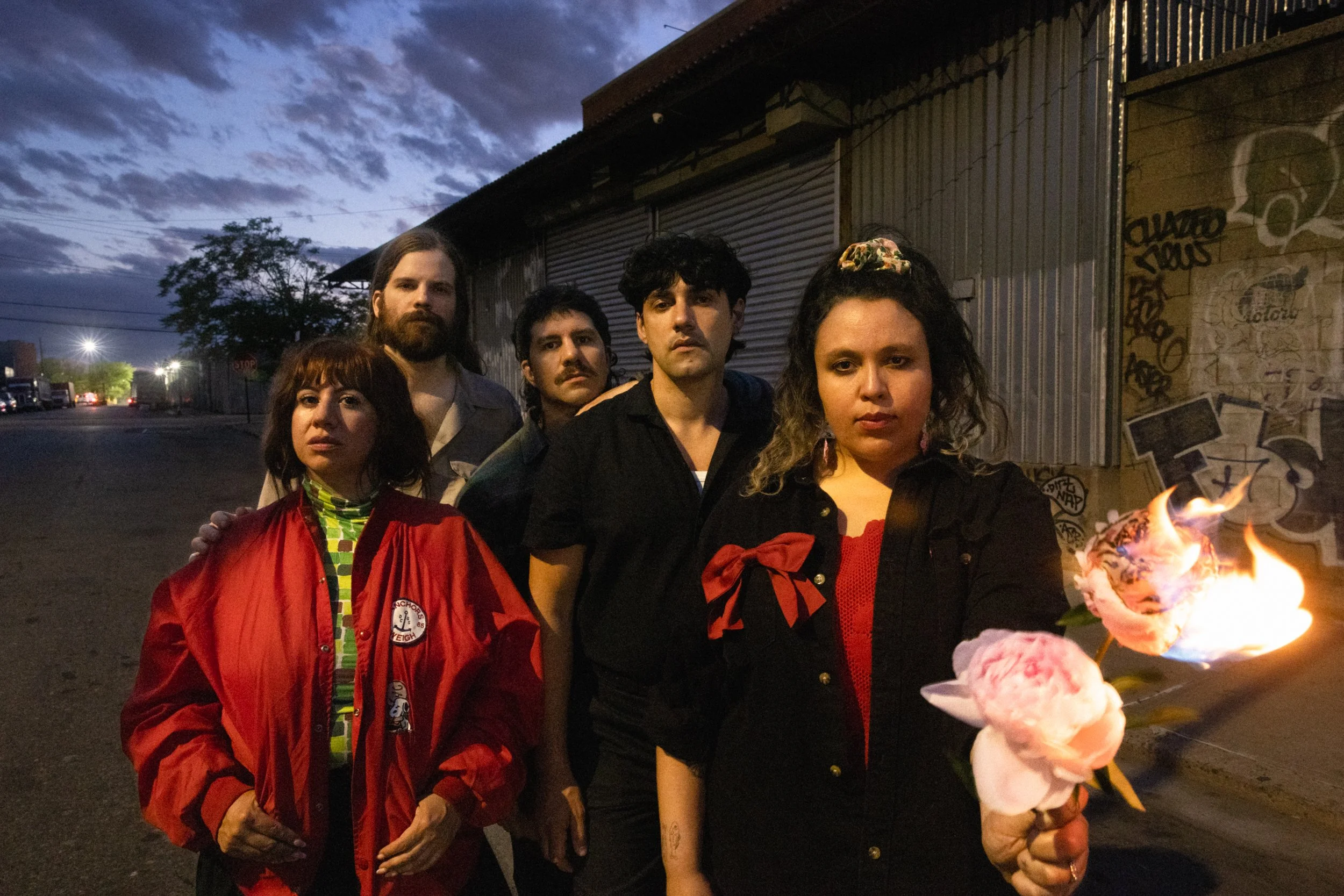
Downtown Boys by Ebru Yildiz
This interview has been lightly edited for clarity.
Jade Marantz: Could you talk a bit about the title of your new album, Public Luxury?
Joey DeFrancesco: There's a couple songs on the record (the last two songs, “Public Works” and “Public Luxury”) that have this as a refrain, saying “public works, public luxury.” I think this goes back to themes we've come to again and again in the band about everything for everyone, building a better world, insisting on the possibility of building a better world where everyone can be provided for, despite how horrific our daily reality is. I think that gets encompassed in that lyric back and forth of “public works, public luxury.” There's a very real necessity for doing a lot of work right now, a lot of energy, a lot of organizing and everything that’s required to build this new society. I think it harkens back to the record names like Full Communism and Cost of Living as well, in terms of envisioning and insisting upon a better future.
JM: Speaking of these themes, you both have been involved in music and activism since before Downtown Boys. Was there a point in time where music and activism came together in your life? Have they always been connected?
Victoria Marie: I think there's also just the forced aspect of politics and music meeting, just because we have women and people of color in the band, and it's punk music. Being a person of color, and the front person in the band, I really love that there is this platform that exists where we can use our shows and our music in order to join a larger message for liberation and for, you know, everything for everyone. There's limitations to that too, because I think there's a lot of projection onto our music and onto our identities as well. And I think that's obviously gonna be inherent in all aspects of life. We had the opportunity to play with some really incredible Riot Grrrl bands in the past few years. It's interesting seeing maybe an older fanbase, a more white male fanbase. And then also seeing young people of color in the crowd that are there for a Riot Grrrl band from decades ago and for us at the same time. I think that that all goes to politics and music, and how we're able to use and leverage a platform that we may have in order to to speak towards a wider message of liberation.
JM: I am curious to hear a more about your involvement in United Musicians and Allied Workers (UMAW). Do you feel that the knowledge that you're armed with as organizers of this allied force changes the way you operate your band?
JD: Whatever you do, whatever your industry is, whether it's music or anything else, the way to make change is through collective, concerted action. You're seeing artists really engage collectively together in such a powerful way, in winning important victories in a way we've never really seen before. So, for me, this is the most inspiring kind of action. The purpose of UMAW is that as an individual, as an individual band, how we're running things, there's limited options available, limited agency, because you're only one individual. However, when you come together, you can really do a lot of things, and really get a lot done.
JM: You've mentioned a few times about your time organizing a union as hotel workers in Providence. Was there a moment when you decided to start writing songs about your experiences?
JD: Yeah, me and Victoria met while working at that hotel, and then became closer friends via the organizing committees and this sort of thing, and then also just shared an interest in a lot of music and participating in the arts community in Providence. So it might not be quite as literally direct as, like, you know, we went to a meeting and then wrote a song about it, but I think this is the stuff we were thinking about when putting all this initial music together. Experiences came out on you could say all of the records, but certainly the first recordings we self-released 13 years ago or whatever it is now.
JM: You already talked about punk a little bit, and how you guys fit into a punk lineage. I was wondering if there are particular style influences that are important to Downtown Boys, and with that, sort of how the actual sound of your music connects to the message that's in the lyrics and behind your whole movement.
VM: The records have all kind of had this chant element to the vocal delivery, and I do think that that's tied the records together. I feel like 10 years ago, when we were doing these interviews, we spoke a lot about Bruce Springsteen, and Selena being this Mexican American voice that took on English bilingual lyrics. And we've always spoken on protest chants. Going into the studio on Public Luxury, on my mind was sort of the vocal styles of Los Psychos and Turnstile. And we got to work with Seth Manchester, and it felt like he was kind of reading our minds on references. He’s recorded so many great bands. How this sound relates to the message…I do think that the protest chant delivery is very special. I think that there's been more of an appreciation and almost mainstream for these sort of deeper louder sounds.
JD: Definitely agree with all that. Previously we’d tried to capture some of the live energy onto our recordings. I think we all believe that's where the band excels the most. What's great about our live shows is Victoria does an amazing job of really connecting with the audience and really moving the audience, and I think it gets to a point where we're really kind of breaking down the audience to where it's a sort of collective experience in some ways, like a rally or something like this. And this is kind of our goal, live, to reach that kind of catharsis. And so, on this record, we try to do as best we could to capture some of that catharsis and chaos and energy that we get when we perform live, and so on this record, there is a lot more depth, there's a lot more width, and just a lot more layers to the music. I think when you're listening to Public Luxury sonically, it brings you to a similar place of experiencing it live, where, you know, you're hearing a lot of different instruments, you're hearing the saxophones and the keyboards, you're hearing Victoria, you're hearing the crowd, you're getting moved around by the band and the audience simultaneously. So I guess, you know, in some ways, this connects it to the message that we're going for. But I think it's also okay for the sound and the message to be sort of things that spin around each other, or are in opposition at times, and sort of come together.
JM: Yeah, that's definitely something I noticed a lot in especially the “No Me Jodas” music video. I was like being at a show, but, like, augmented and edited, and I loved that. It was very exciting energy. Are there other new sounds that you're exploring on Public Luxury that you're particularly excited about? Like, I like that you mentioned there's audience sounds in there. I noticed some kind of spacey synth stuff going on. What else are you, like, really excited about?
JD: Yeah, so the single we just put out, “You're a Ghost,” it's definitely our most electronic sound. It's really led by drum machines, and in the chorus sections has all these electronic elements as well as the screeching saxophone, coming in at the end, as well as some more traditional Downtown Boys elements. I think we're leaning into this industrial sound that we haven't played with as much before. I think everything sounds fuller.
JM: Yeah, definitely. Tell me a little bit more about the song, “You're a Ghost.” What does the title refer to?
JD: I can give at least one answer. I don't think it needs to be so literal and direct. If you look at the video for it, it is referring to protests around ICE, and around ICE's terrific mass deportation regime, and is realized as the band, the protesters, the collective, sort of declaring this and manifesting it toward the ICE agents, to sort of say, you know, this way of being is a thing of the past. You could also think of it in the sense of our other song “A Wall”: “A wall is just a wall, and nothing more at all.” It's not saying, of course, that real border walls aren't this horrific violence that exists, but rather that there is a possibility to destroy, and to get rid of the horrific things, that they're built by people and can also be removed by people.
JM: The video is really intriguing as well, with the collage, plus the clay sculptures and the scrolling thumbs. What was the process of making this video? You worked with an artist in Lebanon, I believe?
JD: Yeah, it was a guy named Khalil. He had worked with Yasmin Hamdan, who's one of my favorite artists. We'd kind of gone in with this general idea of making it a video game about navigating ICE, mass deportations, and citizenship and these sorts of things, but I think Khalil really transformed that into something much more fully realized, which is the version you see now. So yeah, we're very lucky that he wanted to do it with us, and I think he made something that's really crushing and moving, but also really engaging to look at and beautifully conducted.
JM: What was it like to write a song for Miss Marx? After having done some punk albums, what was it like to work with a soundtrack?
VM: The director of the movie, Susanna Nicchiarelli, was really incredible to work with, and her film repertoire is so wide. I think all of us in the band identify as Marxists, or at least heavily influenced by Marx. It really did just feel like such a great combination of a lot of different interests and parts of our identities. Susanna is Italian, and the band really loves Italy, we've probably toured there more than we've toured anywhere else except New England. And we always have such a great connection to fans there, so it really was a cosmic connection. She chose some of the songs we already have, and then we did a recording of the “L’Internationale.” I think there's this headline of, like, “oh, Public Luxury is their first thing in nine years,” and, getting to work on Miss Marx was something that was really great, and really fun, and was something that we did and put out.
JM: Anything we haven’t covered that you would like to add?
VM: We feel very grateful to Sub Pop for doing this album. We know that the music industry is changing a lot, having to confront, sort of, the political web, and how difficult it is to get to make any type of statement. Having the opportunity to do this, we're really appreciative. We've released a music video for “Sirena” with Sarah Elawad, and for “Yellow Sun” with Romy Matar. Getting to work with these incredible artists, and artists of color in particular, is why we need more public resources towards culture. You're able to say a lot more with your message when you are collaborating and working with other artists, and it's not just in the silo of your own project. And I think that goes directly towards why the war machine takes down universities and health and why the war machine wants to inhibit the transmission and the movement of communication and education. This album just means so much, because it's a glimpse at what anyone with a passion and with the drive and desire to make culture should get to have at their disposal, and we're really grateful to get to do this.
JM: You’ve talked before about not being nihilistic and not giving up, and how you choose to channel your energy into optimism. How do you maintain this position while you're constantly spending so much time with topics that are, you know, rather distressing?
VM: We didn't start this band thinking that we were still going to be making records after 10 years. We started it because we believed in getting to use music and culture, and having live shows in order to create these spaces where maybe we could fundraise a little bit, maybe we could remind people of the protests coming up. Maybe we could just let somebody dance and scream it out after a long shift that they've had. To get to still be doing it, I think that it's already positive. But I think for me, my grandma was a huge fan of the band, she just thought that the band was literally the coolest thing ever. She was illiterate, could not read in English or Spanish, yet spoke both of them perfectly. And I think that's really rare in our country to learn a second language when you're illiterate. And music would just really impact her, and just having her as a guide has certainly always helped in tough times. Remembering what guides us and what inspires us and influences us really helps. It's knowing that it's bigger than any one person. We're making what we make because of what we believe in. I think that always adds to why I'm 39 and so tired after every show, but I can't wait to put on Bengay and take ibuprofen and do it again the next day.
JD: Yeah, perfect response. The only thing to add about the song “Yellow Sun,” the lyrics are taken, in part, from a poem by a Lebanese poet named Etal Adnan from a poem called “Beirut 1982.” She says, “I never believed that vengeance would be a tree growing in my garden. Trees grow in all directions, so do Palestinians.” In our version, it's “the trees grow in every direction.” Later in the poem, she says, “heavy with love.” For me, that message is looking at who is on the brutal receiving end of U.S. imperialism. Still a refusal to submit, still an insistence on building something else. And if that can be done, I think it's shameful to retreat into a nihilism or kind of hopelessness. It's not not easy to avoid doing that, of course. I think we all look at everything every day and want to hide and give up, and say it's impossible, but there's a discipline and responsibility. Discipline is necessary to teach yourself to keep moving.