
by Kurt Orzeck
While ‘90s-era indie-rock bands continue to reunite at a dizzying speed, it could be argued that the phenomenon can’t be reduced to simple concepts like aging musicians trying to cash in, cement their legacy, or cling to nostalgia as a means of escaping from an anxiety-inducing present. While many bands that have re-formed are guilty of those charges, there is also clearly a contingent of groups that are playing shows and even recording new material out of love for their age-old bandmates, fans, and the music they made and celebrated together.
There are several fairly clear indicators that a band is reuniting for the right reasons, such as making people happy at a time when depression is the baseline mood in the U.S. The bands that don’t get back together primarily so they can bilk bucks from their fans are typically the same bands that refused to sell out in the ‘90s, that adhered to many tenets of the punk-rock ethos, and that refused to condescend to or placate their fans. Slint, the Jesus Lizard, and Sunny Day Real Estate fall into this category — but one of the greatest exemplars of this admirable approach to reuniting is June of 44.
What follows is a conversation with one of the band’s four captains, Jeff Mueller. From start to finish, you will learn the history of June of 44 and get a deep understanding of the band’s ethos and spirit. You’ll learn why reuniting was a transcendent experience in which the band members discovered new meaning in and appreciation for songs they had written decades prior. You’ll discover that a group of musicians who appeared stoic and even intimidating in their heyday are empathetic to the core. And you might enjoy a laugh or two — surprising for a band whose concerts were considered to be serious, chuckle-free engagements back in the day.
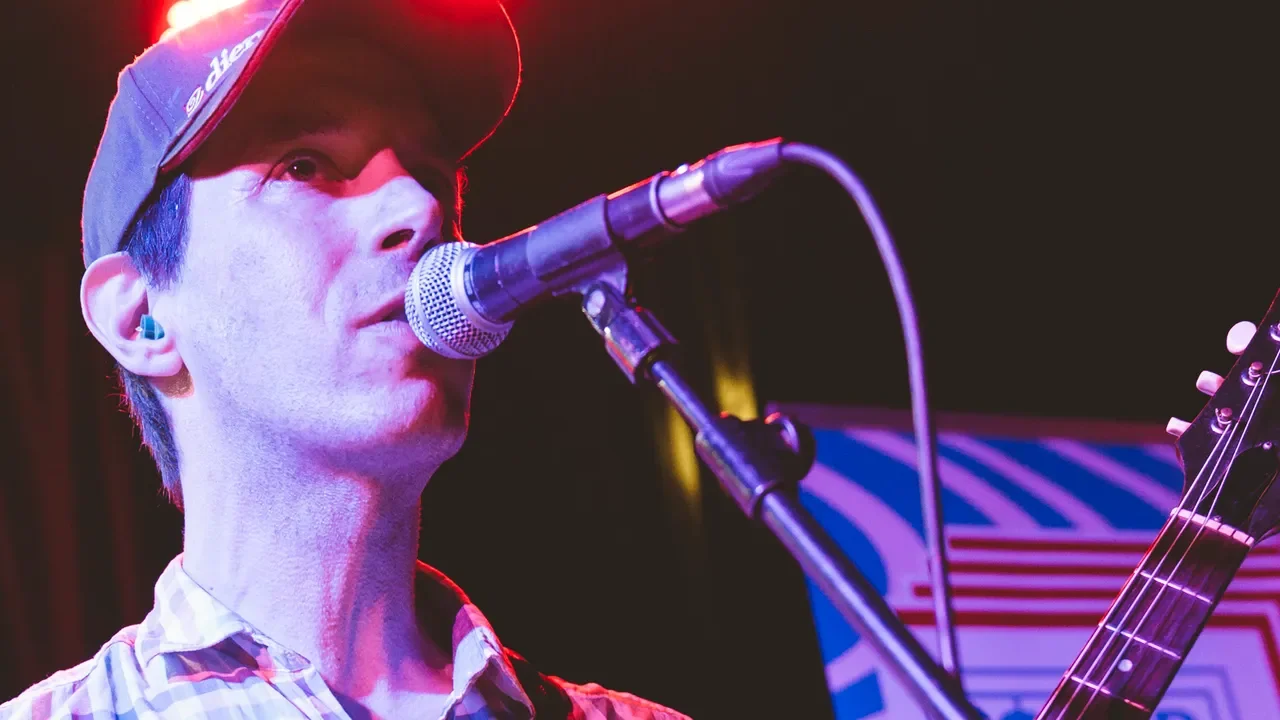
Jeff Mueller by Mariano Regidor/Redferns
Post-Trash: I’ve never actually spoken with you before, even though you were such a huge part of the development of my taste in music. I was absolutely blown away when you indicated any availability and willingness to want to talk with me. So, I'm wicked appreciative that you're taking the time for this interview for Post-Trash and grateful that we're finally connecting.
Jeff Mueller: The reality of the matter is, is I do feel like I have some interesting things to say, perhaps. So when people are interested and inquire, it definitely gives me a boost.
PT: All right. So, for starters, what is life like with you these days?
JM: Life is pretty good. Life is busy. I do several things to generate streams of income for my family. My main job is I run a small letterpress printing company printing a lot of music packaging and fine artwork, [as well as] wedding invitations, stationery and those sorts of things. In the summertime, I always turn to my second job, which is working on houses. I do a lot of trade work. I paint people's homes. When summer hits, everybody wants to open up their windows and have me into their place to do that. So, work is busy. I'm really behind and scattered, as my forgetfulness indicates. And I have two children. Hanging out with them is always a pleasure.
PT: Cool. So, I know you prefer not to answer the same old questions, and as luck would have it, I don’t like asking them. With that in mind, here’s one from out of left field that you might enjoy answering: What is the historical significance of “June of ’44”?
[Silence ensues.]
PT: That’s what comedians call a “very long walk,” Jeff.
[He laughs.]
PT: I was just trying to break the ice and let you know that this is gonna be a fun time. No holds barred.
JM: Okay, well …
PT: No, no, no, no, no, no, please don’t answer that question. If you do, then it was nice talking to you, however briefly.
JM: I would have so much respect for you if you did that and ended the interview. That was great, Kurt.
PT: Thanks.
JM: But it is a fair question. Do you …
PT: No, seriously man, please don’t! Instead, I want to go back to your penmanship and printing. I imagine you were responsible for June of 44’s album artwork?
JM: Mostly, yeah. The records of ours that feel a little bit more handmade — like the first record, the EP, the second record, and then all the way through Four Great Points. In fact, the first June of 44 record, which came out in 1995, was the first job that I ran on my own on a letterpress machine in Chicago. It was the first time I printed anything, printing that record, Engine Takes to the Water.
PT: But even though you did that job in Chicago, you guys were in Louisville, and that first record grounded you very quickly, did it not? Were you surprised by how fast you seemed to gel and catch on?
JM: Sure, yeah. We actually found each other initially while on tour with other bands through 1992. ’93 is when we sort of meshed together. And then when the band that came before June of 44 disbanded [Rodan], I had a whole grocery list of new music that I wanted to present and make. And no time seemed better than to call the friends that I made while on tour previously.
When we found ourselves in the same rehearsal space in November of 1994, it all happened really quickly. I think it was happening so fast that we weren't really aware of whether [the music we were making] was good or bad. But it didn't matter, and we weren’t even aware if it was actually happening. It was more a matter of just making music.
Once we went into the studio, made the record, and then the record came out, it wasn’t until probably three or four months later that it was possible for me to actually revisit that music and listen to it in a way that was less subjective. I could listen to each song on a case-by-case basis. But yeah, it came together pretty quickly.
PT: Now, where was this? Geographically, where were you at this point?
JM: I was living … well, collectively, we were sort of in and out of New York City quite a bit. I was bouncing around between Chicago, Louisville, and New York City quite a bit. [Vocalist/guitarist] Sean [Meadows] was living in Baltimore. [Drummer] Doug [Scharin] was living in Williamsburg, Brooklyn, before Williamsburg was really anything at all. It was a few empty warehouses and one café. [Bassist] Fred [Erskine] was living in Washington, D.C.
PT: And New York is where the James Murphy connection happened, right?
JM: Yeah. We met James in Rodan. We played a concert in his studio or his loft space on … I think it was Avenue A or Houston or somewhere on the Lower East Side. We played some shows with his band Pony before he became the LCD Soundsystem music machine that he became. We really wanted to work in his studio because it was hyper-convenient to where we were at the time. But also, he was a friend, and it just seemed like it could be really comfortable and he would know how to kind of approach it.
PT: I always associated you with Bob Weston and Steve Albini, since Shellac and Big Black were on Touch and Go’s roster and June of 44 was with Quarterstick, an offshoot of that bigger indie label. But during the course of preparing for this interview, I noticed maybe for the first time that Albini maybe had no involvement with June of 44. Weston engineered your middle two albums (1996’s Tropics and Meridians and 1998’s Four Great Points) and was credited as the producer for your fourth full-length, Anahata (1999). But did Albini ever enter the picture?
JM: As a friend, yes, throughout. He was super-supportive of our music, always had really generous and kind things to say, and was always very approachable — despite the fact that I was intimidated to some degree by being in proximity to him. But as far as being physically involved with the making of our records, the closest that we got to Steve was when we wrote and recorded in his [North] Francisco [Avenue bungalow in Chicago] in 1993. [Albini legendarily built a studio in the tiny quarters. -Ed.] But June of 44’s first record [1995’s Engine Takes to the Water] was recorded with James Murphy. And then each subsequent record that came out following that was pretty much recorded with Bob Weston.
PT: Speaking of June of 44’s studio albums, what’s up with the nautical theme that acts as a recurring motif or throughline for the album titles? Did the concept of orienteering in combination with maritime adventure and research, perhaps, fascinate you as a kid? Were they motifs that you couldn't find a way to factor into Rodan’s releases? The Shipping News also shares some overlap with June of 44 in terms of theme, but as someone who grew up in Boston — a true coastal city — I just never thought of kids who grew up in Louisville, Kentucky, fantasizing about seafaring and all that.
JM: What you’re saying makes sense. I'd start by saying with Rodan, the band that came before June of 44, and before the nautical themes presented themselves, we were so new and so barely able to play our instruments – like, barely capable, at least myself. Jason was a little bit ahead of me and Tara was far ahead of me. And our drummer was way, way ahead of me. But as a collective of four people trying to make music with each other, it was always this exercise of trying to make sure we were playing together.
We were playing the songs, and we were making the music, but there wasn't really any overarching aesthetic or theme that we had any capacity or bandwidth to allow to seep in. Then, when June of 44 came together as a concept — because we were so, so rooted in this collective idea of a transient project. The whole idea was that we were going to come together for three or four weeks, make a record and see what happens and then set off to sail in other directions.
We didn't know we came together to make the record, and we had no plans beyond that [other than] maybe doing a few shows to support it. But then Sean and I continued to have these elongated conversations, and themes started to manifest — [including] the travel theme. Also, there's always an obsession [with anything historic featured] in my artwork and my writing to some degree as well. I have an admiration for anything that endures historically. Without sounding cliché, I think we collectively had a certain romantic idea of what was possible with music.
And I think we still do. More than a car or a bus or even a train to some degree, old steamships are pretty attractive, romantic ways to get around the planet. So we started to kind of fit that in. And the aesthetic … there's no shortage of imagery that was attractive to us as far as trying to encapsulate this aesthetic theme for June of 44 as well. It was like a stew of a bunch of different things that helped metabolize this theme that carried its way through the first three June of 44 records and the first one or two Shipping News records.
PT: Did you eventually become trained in sailing, rowing and other kinds of maritime activities?
JM: Not even close. The closest I got was sitting on a ferry as a means of transportation to get across the English Channel. My father-in-law was a recreational sailor. He's long since given it up. We would take his tiny sailboat out into New Haven Harbor together. But there was never anything deeper than this romantic idea of what nautical themes were.
PT: So I put together a really cheesy, five-question nautical quiz for you. Here goes: What is a jibe? What do lee and alee mean? What would have saved the Titanic? I won’t suffer you through the rest.
JM: You know, the interesting thing is that, from being on the boat with my wife's father, I did learn some of the lingo: what a jibe is, what it means to tack, and other terms used in recreational sailing. But as far as making a lifestyle choice centered around boats, it was never even an idea that I [considered].
PT: Your lyrical content, from a storytelling perspective, always struck me as rather intriguing, especially in their originality. They seemed to often provide descriptions of the workings of a ship, and the notion of mobility, as opposed to a destination you're trying to reach. Or looking into the future and having an image of where you might land, something like that. Did this fascination connect with the essence of the band, which, as you said, was permeated by a sense of transience? Like, one moment you’re here, but then you’re over there … the concept that you can move at will, in a way?
JM: Well, I don't want to give the impression that everybody was in accord with the themes that developed around the artwork either, because when June of 44 started, everyone was really busy with their other projects. Doug was really busy with his band Rex, and Fred was really busy with his newer band, The Crownhate Ruin. Sean was also in a band called Lungfish as well as playing somewhat with [bassist/vocalist] Tara [Jane O’Neil] from Rodan in a band called The Sonora Pine. So a lot of the artistic decisions and design ideas were perpetuated by the need just to have them.
I was sort of the catalyst to making sure that much of the artwork and production for the first two or three June of 44 records came together. So that nautical theme that you're talking about, that we were embroiled with, that was my fault. I don't think the other guys would disagree. We all have this similar throughline, which is [the idea of] the constant oceanic motion, and the metaphor, of the sea. Activity, the need to produce, all the things that are common threads but aren't necessarily specifically identified within a shape, or even in the ocean as a metaphor, they're still tucked into it.
But then, as the band evolved, we slowly pushed away from straight nautical themes that we had [embedded in] our first three records [Engine Takes to the Water, Tropics and Meridians and June of 44’s 1997 EP, The Anatomy of Sharks]. And then we completely branched away from it with our third [full-length] record, Four Great Points, which just has a ceramic tile on the cover of it. There's no talk of the ocean at all on that record.
PT: Pardon the corny question, but …
JM: Hit me, corny question.
PT: … What would you say was — or is — June of 44’s White Whale, the big aspiration you had that you strove for that you either did or didn’t achieve? Was there something that, either over the course of time — or maybe even in the beginning — was collectively in your minds, that you were striving for as a band?
JM: I think we each would probably have a different answer to that question. Some of us might answer to generate enough income to have a stable career with music. Some of us might say travel, being able to get to places that we might not otherwise be able to reach, and using music as a vehicle to get us to places like Japan and Australia. That was a tremendous, very significant goal of mine. I don't come from any means or a really strong financial background, so travel was always of interest to me, and I desperately wanted to get to [new] places. Music has always been a big tool for that for me: travel.
And then some of us might say that the creation of a song itself, just trying to find the core and the main nut of a piece of music, was our goal. That was also a pretty significant goal of mine, trying to really get to the heart of a song or cut into the concept of a piece of music and give it everything we could to make it what we wanted it to be.
PT: So the impetus for you to go to Japan, where you recorded the recently released album LIVE IN TOKYO, was at least partially. your affinity for travel.
JM: Yeah, that was the first time that June of 44 had been to Japan. That record [documented] the first show of the four or five that we played in Japan in 2023.
PT: So, was the reason you guys got back together to put that final feather in your cap?
JM: Well, we stopped making music in 1999, and then we started up again in 2018 when some friends of ours from Sicily asked us to come and play at a party of theirs. It was one of those things where you know you kind of wanted to do it, but we never thought we actually would. And there was no way we could have said no to our friends. That was initially why we got back together, and then — like when we started making music in 1994 — one thing led to another. Back then, we recorded a record, then we went on tour, and then we thought, “Oh, that was great, let's maybe try to write some more music.” There was never a real binding element to it other than just trying to see what came next.
And that was sort of the case when we got back together in 2018. We played four or five concerts and then started talking about how it might be interesting to revisit some of the music that we didn’t feel like we really completed back in 1999. So we revisited a bunch of songs that each of us had a little bit of a problem with that we couldn’t [resolve] because we couldn't get over ourselves when we were originally writing them some 18 years earlier. So we had an opportunity to revisit that music, restructure it or play it better or whatever, and we ended up making [2020’s] Revisionist [Adaptations & Future Histories in the Time of Love and Survival].
It’s a really strange, interesting mash-up of music. And there's no way that it couldn't have been a weird record. But we're proud of it. That record is what established our relationship with our new great friend Yoshi[-san, a promoter] in Tokyo, who licensed it and invited us to come to Japan and play concerts there after the pandemic. So we waited for the pandemic to clear out, and then he brought us over in 2023.
PT: How did Yoshi manage to foster a June of 44 fanbase in Japan?
JM: I don't know how it really shook out or how it happened. We showed up, and pretty much every night was, if not sold out, really close to being sold out. Full shows, really respectful audiences, nice and accommodating … it was just a lovely experience.
A lot of times when I do those sorts of trips and go places, I'm just so thankful to be able to do it. I’m thankful that I can get on an airplane and fly somewhere and there'll be a stage and maybe a PA and there'll be people there, hopefully, maybe to take care of us or whatever. I always do my best to think of ways that I might show gratitude for that action, that care. But something that I'm never really prepared for is when people express gratitude to me for actually putting forth the effort to come. I just don't know how to receive it. I kind of spin out. I'm like, “Wait, what? You're thankful that I'm here? No, I'm here for you.”
PT: So, do you have any other aspirations or plans you're talking about at this point?
JM: Well, June of 44 is on, I guess, a long-term hiatus. We finished what we [wanted to do] in Japan and Australia in 2023. We all have families. We all have other responsibilities and other music aspirations and other places that we want to go.
Fred is living in Indianapolis. He's a master carpenter and has a kid who, I think, just finished his sophomore year in college. Fred plays a lot of music. He was in a band called Justifier that got back together this past fall, and they played some concerts. I'm pretty sure they went really, really well.
Doug is just outside San Diego, in a town called San Marcos. He's very invested in the local San Marcos Soccer Association and teaching youth soccer.. I'm not sure specifically what he's doing with music. He might be doing some things with Rex, the band that he was in alongside June of 44.
I'm oddly swamped with the making of records, but not so busy with the actual act of executing performances. I'm in a band with Sean called Flowting Clowds. We put out a 7-inch in August last year and have another one that's coming out, hopefully, around July or August this year. We're putting together a series of singles that will lead up to the re-creation of that music, but in a broader sense and with other musicians. Hopefully that will happen sometime later this year or early next year.
[The Flowting Clowds] records are out on a really interesting label called Landland Colportage out of Minneapolis. Our friend Dan Black [an illustrator and graphic designer who owns the label] has been really supportive of us and trying to help us get [the band] off the ground.
Lastly, the first release by the first music project that I was ever in, a rap band called King G & The J Krew, is coming out [Friday; the album is called Indestructible Songs Of The Humpback Whale].
PT: You’re kidding.
JM: No! [Guitarist/vocalist] Jason [Noble] from Rodan, he and I — and Tara from Rodan — we played rap music [together before any of our indie-rock projects]. Yeah, it was really weird. But we put everything into it.
PT: Is that well known?
JM: God no. Nobody knows what it is. But it sort of was the precursor [to Rodan and June of 44]. At the time, as I mentioned earlier, we barely knew how to play guitars or bass instruments. Any of the instruments we were playing in Rodan, we were just figuring it out as we went. Again, some knew more than others. King G & The J Krew was more of a studio project.
What we were trying to do with that project back in 1989 and 1990 was take this studio project that was largely based in digital recording and analog recording — but with digital media and rap lyrics and non-traditional recording approaches and songwriting ideas — and turn the songs into live music. And it was just impossible.
That’s why we started playing rock music in Rodan afterward. But anyway, that record is having its 33 and a third anniversary at the end of this month. And a label called Solid Brass — it’s sort of split between Cleveland and Los Angeles — is putting it out. [Solid Brass Records was co-founded by underground-music super-fan Jason Pearson, former Alternative Tentacles employee Chuck Pettry and Atombombpocketkniife’s Justin Sinkovich.] Jason Pearson has been super supportive, very helpful. Full disclosure: We're not the easiest people to work with when it comes to that kind of stuff. So it helps immensely that Jason is so accommodating.
PT: All right, Mr. Mueller, speaking of super-fans of underground music, I’m going to conclude this interview in a way I never have before: By asking you a question provided to me by a dear friend of mine. We bonded in college over our shared obsession with June of 44, Rodan, Shellac, Drive Like Jehu and the Jesus Lizard in particular.
Here goes: Having listened to Live in Tokyo and seeing them on tour a couple of years ago, JM's voice has changed (maybe softened), and I found the songs came off as a bit mellower (if I dare say). I used to find myself getting pumped by their music, but these more recent live outings give me more permission to let out some pent-up sadness. It felt more aligned with how I perceived some of those original emo bands of the mid-to-late ‘90s. So I guess my question is how JM views his relationship to these songs at this point in his life. Maybe I've gotten older and now I've simply matured to find the beauty in their music that evaded me because the aggro part of them dominated my initial love of June of 44?
JM: What a good question and observation! I’ve moved through at least three different approaches to playing guitar and singing in that nearly 20-year June of 44 gap. My voice and skeleton have both certainly gone through some changes, as has the focus of the energy and aggression I may have been trying to cut through when I was in my 20s.
I think I mentioned in our June of 44 meeting, when we started up again, that I was super-interested in presenting the songs as they’d been written, and perhaps not as they’d been performed in the ’90s. Back then, for me at least, it was less about accuracy than it was about working some shit out … like, how hard can I beat on this guitar and have it still sound something like the song versus how well can I actually just play and present the music with respect to the music itself? I kinda think some of our fans interpreted that redirection of focus as a lack of interest or that I or we were just going through the motions — which couldn’t be further from the truth. From 2018 forward, I was deeper into that music than I think I ever had been, just coming at it from a slightly different perspective.
While re-learning and conjuring back the energy and core of those songs, I did my best to weave myself into the headspace I was in where and when they’d been written. That was a complex and fairly cerebral process. Along with the aggression and need to release, many of the places those songs are about no longer exist, and too many of the people within them no longer roam the earth. Performing them again with any honesty in the present tense became more of a ceremony and celebration of their subjects than an exercise in trying to replicate an experience and set of emotions decades beyond their origins.
I’m old! Ha!
Thanks to Geoffrey Sparks for assisting with this interview.