
By Christopher J. Lee
Tashi Dorji has undertaken one of the more singular artistic journeys of any musician during the past decade. Over the course of several albums, the Bhutan-born, Asheville-based guitarist has created an elusive body of work that is simultaneously statement-oriented, especially from a political standpoint, while equally maintaining an enigmatic presence that stresses tone and contingency in his playing over words or any other kind of forthright messaging. Like a young Ry Cooder who has internalized the ideas of John Cage, Dorji’s recordings are highly conceptual while also retaining the earthiness of the most elemental folk traditions.
His 2020 LP, Stateless, exemplifies these contrapuntal qualities. Consisting of ten tracks lasting 54 minutes, the album has Dorji alone with his acoustic guitar, using the instrument to create improvised melodies and complex percussive rhythms that teeter on the edge between the formal properties of songcraft and the more cacophonous qualities of unrefined noise. This artistic brinksmanship can be found on Dorji’s subsequent (and preceding) albums, though with degrees of evolution that signal not only concern with the making and unmaking of conventional song structures, but equally using such experimental methods to convey different emotions in new ways. There are moments on tracks like “requiem for jonas” and “impossible friendship” from we will be wherever the fires are lit (2024) that express the anxiety, brokenness, and lament of unresolved feelings better than any lyric-based songwriting could.
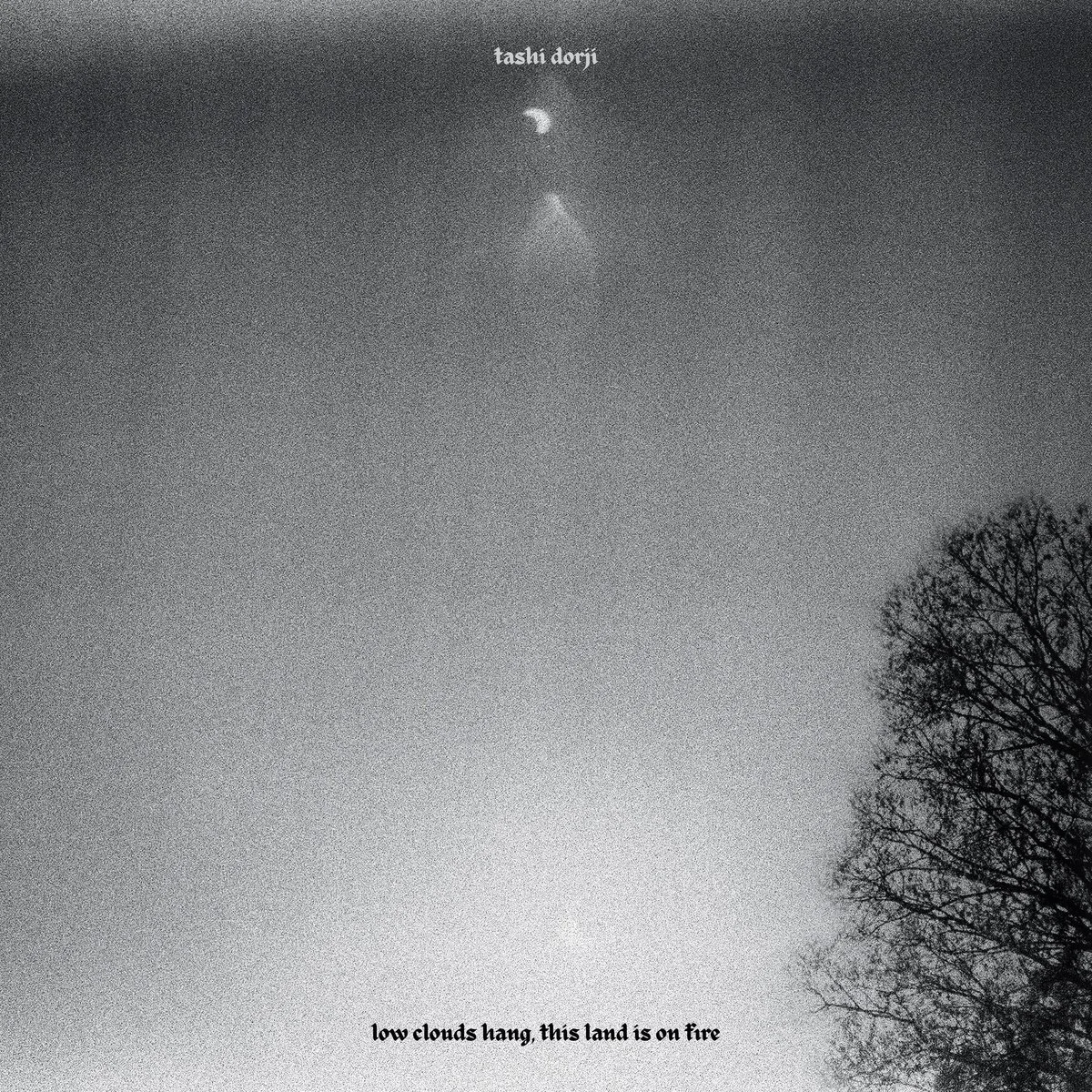
Dorji’s new album, low clouds hang, this land is on fire, continues this exploration of sound and technique, though with electric guitar this time. In many ways, this LP is his most beguiling and accessible without sacrificing his best tendencies. Over the course of 11 tracks lasting 52 minutes, the pace is slower and more introspective with reverb giving his songs a more haunted quality. Though improvisational and presentist, these tracks frequently sound weighted by memory and past misgiving. A defining mood of melancholia enters with the first track, which is also the album’s title track, allowing the listener to settle into what becomes a set of stations—emotional, spiritual, and communal—across the LP, amounting to an unplanned (but ever intentional) journey, undulating between moments of despair and reassurance, isolation and collective solidarity.
Like Dorji’s preceding LP, fire is cited as a central element in this album’s title with two different meanings imparted. Though no direct explanation is given, low clouds hang, this land is on fire is evocative of both crisis and commitment, the latter interpretation continuing the intensity habitually found on we will be wherever the fires are lit. Fire can serve as a signal and rallying point, providing a means of location and orientation. Fire as image, phenomena, and concept also appears to give Dorji a way of organizing his thoughts and his audience a means of grasping his unsettling musical style that can start slowly only to become repetitious, multidirectional, and then seemingly uncontrollable, hovering near self-immolation.
Through experiments with patience and restraint, low clouds hang, this land is on fire retains these qualities while taking them in new directions. With reverb that can delineate cavernous spaces and leave echoes that channel into semblances of the past and future, the electric guitar on this LP enables Dorji to cool the temperature down, to test the limits of minimalism. Similar to his previous recordings, silence is his omnipresent collaborator, perhaps even more so. Tracks like “murmur” and “black flag anthems” appeal to the void for answers that don’t arrive, while songs like “we overflow the streets and squares like the sea in a spring tide...” and “they fall because they must fall” are more agnostic and less concerned with philosophical remedy. Their titles suggest conflict and political resistance, but the object of refusal and the activism involved are opaque. Nonetheless, Dorji implies that such conditions of control versus political will must be approached and understood through indirect means. Feeling can be an effective tool against unrelenting material circumstances.
With its opposing impulses of hermetic worldbuilding and unguarded expressiveness, low clouds hang, this land is on fire recalls at moments the late solo work of Tom Verlaine. In the past, Dorji’s recordings have been far more kinetic and even chaotic, resembling the calculated disarray of music like Stravinsky’s “Rite of Spring,” albeit with Dorji playing every orchestral part on his acoustic guitar. That sounds overblown until you encounter Dorji’s frenzied, and at times explosive, style.
As noted, a sense of progression informs low clouds hang, this land is on fire, and this album ends with a turning suggestion of possibility on “a new morning breaks”. Not quite optimism, but all is not lost in this perpetually broken world we inhabit.