By Myles Tiessen (@myles_tiessen)
PISS are a lightning bolt. The Vancouver-based punk band’s debut three demos blurs the lines between hardcore, art-rock, and experimental poetry. PISS hits with the same onslaught of being thunderstruck.
Since 2024, the band has experienced a rise that feels distinctly organic and out of step with the contemporary industry. PISS has officially released only three Bandcamp exclusive songs, yet the four-piece is anything but idle. They’ve sold out venues all across Canada, booked international tours (with another one around the corner), and opened for fast-rising contemporary UK punk phenomena Lambrini Girls.
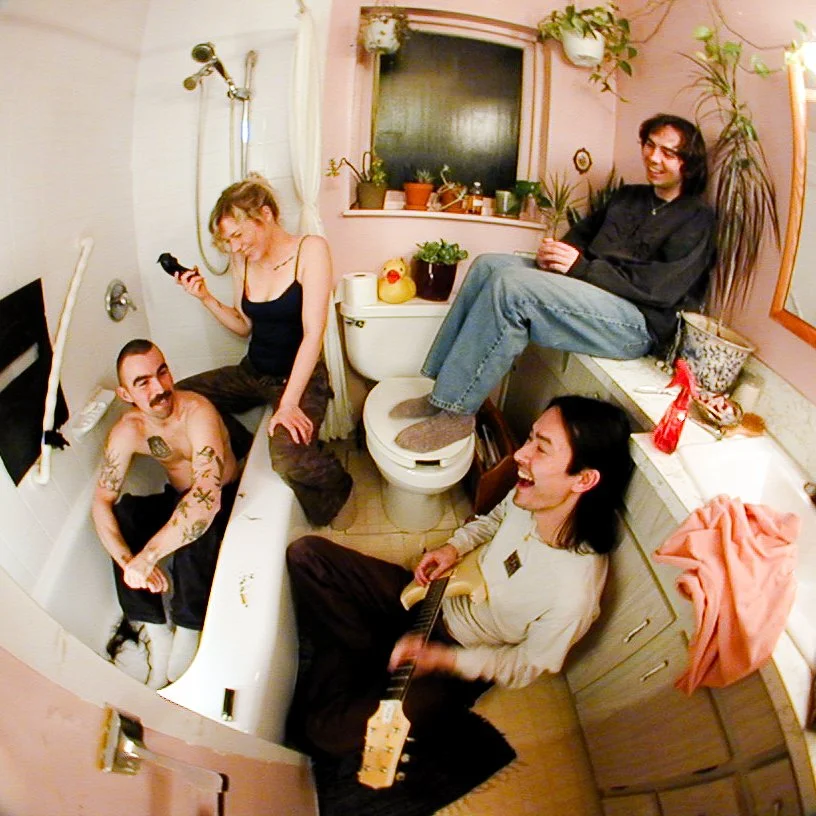
PISS by Grace Grignon
PISS’ success shouldn’t be a surprise given the undeniable talent of guitarist Tyler Paterson, bassist Gavin Moya, drummer Garreth Roberts, and vocalist Taylor Zantingh. But the seemingly (and most likely intentionally) indefinable artistic character makes it hard to pin down just what PISS is.
“It started as a very kind of conventional band setting, and it's kind of grown into something where I'm not really sure what it is,” Paterson reflects.
“[It’s] kind of like an assemblage self-portrait of one person's experience growing up in a culture of widespread normalized violence. And it has since grown into something that's difficult to describe. It's multi-genre, it’s very collaborative, and there are elements of performance art,” Zantingh adds.
Although completely ineffable, the songs on three demos are brawny, loud, discordant incursions that examine the grief and trauma of sexual assault and a culture that normalizes violence. The highly concept-driven approach to songwriting intricately navigates the challenges of weaving together the brutality of sonics with the significance of the content.
“I've been writing about the subject matter since I was very young. So I knew that it always seemed to fall short unless I was creating a larger project. At the same time, even just writing alone without the use of instruments and sound collage didn't feel sufficient because the subject is monstrous,” says Zantingh.
PISS’ music features samples from feminist writers and activists, drawing from various artistic disciplines like film, poetry, and literature, Zantingh says, “what I'm doing comes from a long lineage of women speaking about this stuff. So, I think when we're looking at the songwriting process, it's never ever just like ‘oh let's like write a song.’ It's like ‘what is this broader project we're trying to do, and what’s the next piece of that?’”
three demos opens with a quote from Andrea Dworkin before shifting to the industrialized noise of guitar and a discharge of clamour that sounds like it’s reverberating from a forge of the underworld. The EP flips pace and tone faster than what feels possible to grasp, creating a powerful tension between the elusiveness of its sound and Zantingh’s candid, undisguised lyrics.
Tyler Paterson describes the band’s highly collaborative approach and devotion to alternative song structure as creatively liberating.
“I think the cool part is having a very simple prompt that lets me get out of my cage and go fuck around with a bunch of shit and then bringing that back to Tay and seeing how we can kind of massage that and work that into something that she's written,” he says.
Outside of their thoughtfully crafted EP, what's truly transcendental about PISS are their live shows. The weight of the song’s content and Zantingh’s truly jaw-dropping performance leaves a heavy, thick air in the band's wake.
Zantingh’s hyper-physical performance, filled with genuflecting screams wrapped in stage chords and vocal chord annihilation, brings real hurt and pain to the live shows as the rest of the band surges through some truly knotty arrangements.
“I wanted to create something that jolts people awake and makes them look at something that exists everywhere all around us all the time, but is invisible. I wanted to make this invisible thing that's so omnipresent something you couldn't look away from,” says Zantingh.
PISS plays the same set the same way every night. No deviation. It reflects the ritual of institutionally endorsed assaults against marginalized groups and shows that, even within the rigidity of these structures, violence can also be wielded as a tool for liberation.
To Paterson, that is what makes PISS such a standout live band. “I think a big motivation is bringing the message of the set and that whole live experience,” he says. “And it's a hard thing to capture in the recording process.”
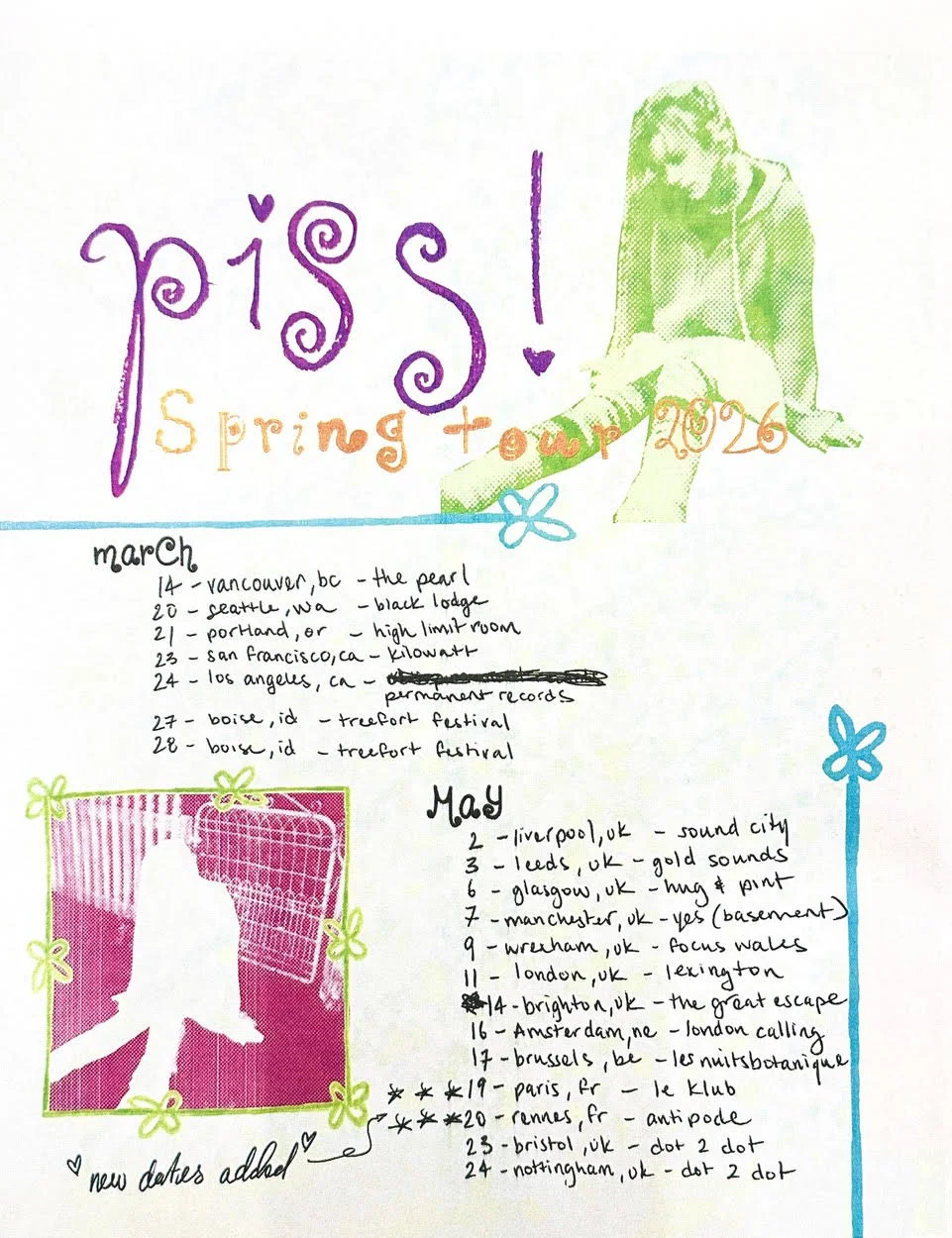
The band is taking their boundless live set across North America and Europe this spring, booking shows everywhere from Seattle to Nottingham.
Past tours have been hard on the band, balancing the authenticity of highly emotional, physically demanding performances without torturing themselves for weeks on end or turning the show into a caricature of itself.
But Zantingh says, “it's kind of hard not to feel motivated when we're playing live… I'm still often in a place of awe when I think about how deeply I get to connect with people that I don't even know and will never meet again.”
PISS and their music have a purpose, and now, Zantingh says they are “living that purpose.” As they take their tour across the world this spring, the charge that started with three demos nearly four years ago doesn’t seem to be fading. If anything, it’s surging into something new.
Catch PISS on tour this spring:
3/20 - seattle, WA (black lodge) TICKETS
3/21 - portland, OR (high limit room) TICKETS
3/23 - san francisco, CA (kilowatt) TICKETS
3/24 - los angeles, CA (permanent records) TICKETS
3/27 - boise, ID (treefort) TICKETS
3/28 - boise, ID (treefort) TICKETS
5/2 - liverpool, UK (sound city festival) TICKETS
5/3 - leeds, UK (gold sounds festival) TICKETS
5/6 - glasgow, UK (hug and pint) TICKETS
5/7 - manchester, UK (basement) TICKETS
5/9 - wrexham, WAL (focus wales) PASSES
5/11 - london, UK (lexington) TICKETS
5/14 - brighton, UK (for the great escape) PASSES
5/16 - amsterdam, NE (london calling festival) TICKETS
5/17 - brussels, BE (les nuits botanique festival) TICKETS
5/19 - paris, FR (le klub) TICKETS
5/20 - rennes, FR (antipode) TICKETS
5/23 - bristol, UK (dot to dot festival) TICKETS
5/24 - nottingham, UK (dot to dot festival) TICKETS