
by Benji Heywood (@benjiheywood.bsky.social)
It started as an absurdist bit. What if a band played d-beat hardcore without distortion? That would be funny, right? Dan Shaw, the songwriter behind Massachusetts-based Landowner, thought so. Yet as he began writing and recording the first Landowner album, something unexpected happened. The tension created by hardcore music laid bare of effects slapped harder.
Defying assumption has repeatedly changed Shaw’s approach to both his music and his life. Landowner’s newest album, fittingly titled Assumption, is the latest example, an album of minimalist, aggressively clean art punk. Performed by Shaw with guitarists Elliot Hughes and Jeff Gilmartin, bassist and backup vocalist Josh Owsley, and drummer Josh Daniel, Assumption delivers music where there’s nowhere to hide.
Thematically, it’s an album with enough cutting social commentary to be almost comic, yet gravely serious at the same time. Over taut drumming, kraut bass lines, and guitars that undulate between post-punk vise and off-kilter sparkle, Shaw laments modern decline, warns of environmental catastrophe and even sits down for a picnic lunch with Death.
We hit up Shaw at his home in Western Mass to talk about Landowner’s new album, its intensive recording process and how learning to mistrust our assumptions can be an invaluable hack to withstanding the relentless information assault of our modern age. Here’s our conversation with Dan Shaw.
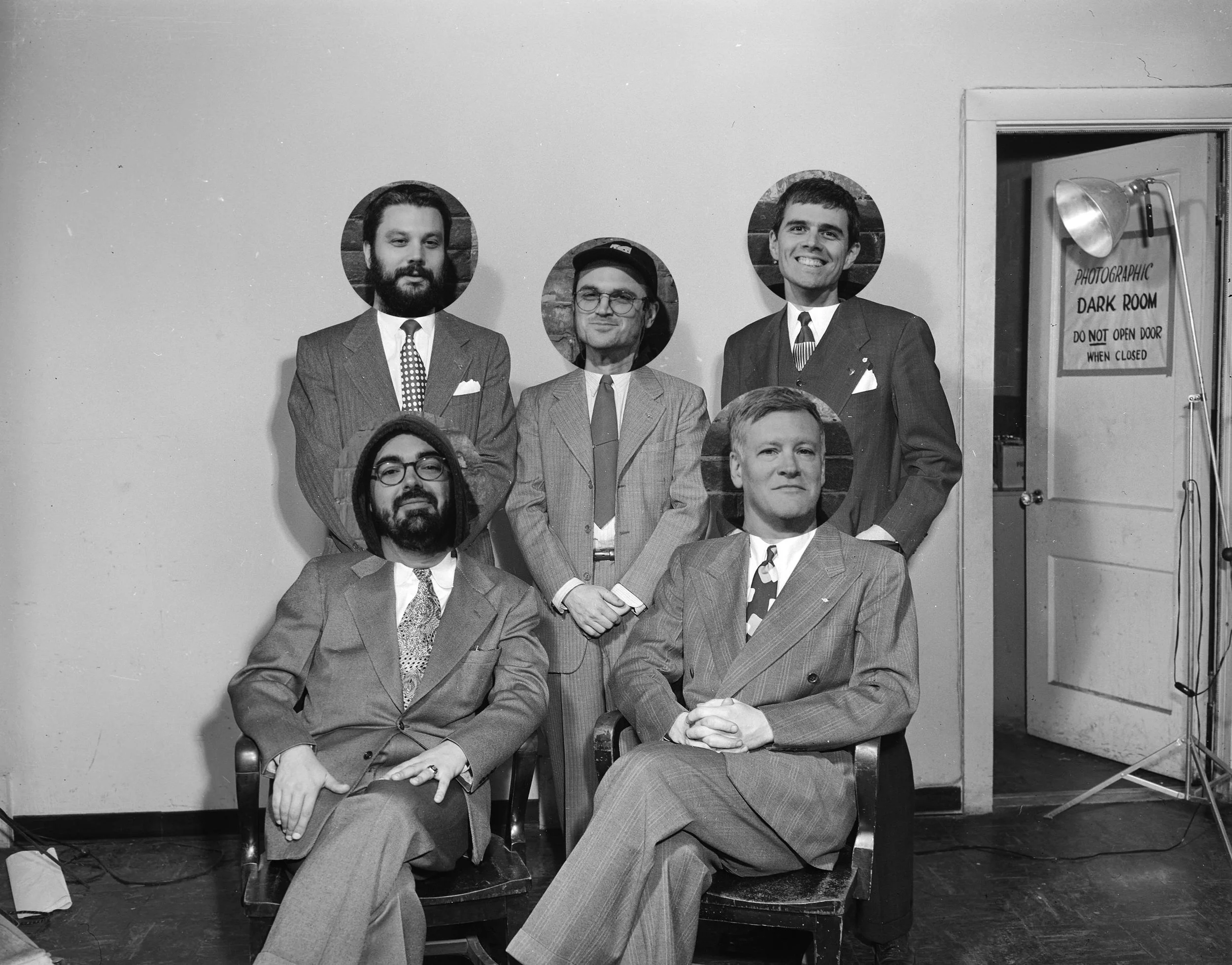
This interview has been lightly edited for length and clarity.
Post-Trash: I like that you’re holding a microphone.
Dan Shaw: This is the microphone I used to use at shows.
PT: Makes this interview feel very official.
Dan Shaw: I’ve had a few interviews where I didn’t plan ahead and used some haphazard Bluetooth headphones situation or my built-in mic on the laptop, to mixed results. I decided to stop fucking around.
PT: (laughs) It looks like a 70s news interview where the reporter is sticking a mic in your face.
DS: I’m not all the way there with a mic stand like a real podcaster. So, I’m holding it.
PT: I’m here for it. When I listen to a Landowner song, there are two different things happening simultaneously. There’s the musical aspect, which doesn’t really sound exactly like anything else, and then there’s the human story of it happening through your voice. So, I’m wondering, when you’re making a new Landowner album, which aspect comes first?
DS: We have our own set of rules when we make music. It's this idea of taking punk songs and stripping away the distortion and heaviness until it's just hilariously clean guitars. It almost sounds like it's wrong at first. The first time I was messing around with writing demos that way, like, nine or 10 years ago, it sounded funny but then I realized it's secretly good. Like, this is actually good. So, I just stuck to that.
PT: So, the music came first?
DS: Yeah, it's become a really practical, efficient format for writing songs — just plugging an electric guitar directly into a digital audio workstation. I set up a drum machine and just jam by myself. We set up the band so that's also the Landowner sound. And in writing the songs I've become increasingly interested in minimalism and restraint. It builds focus and intensity, which ends up making space for lyrics.
PT: Who or what inspired this experiment?
DS: Early on, when I was thinking about the potential for this band, I was listening to a lot of The Fall. Their music is repetitive and minimal, and then there's all this space for lyrics. They were one of the first bands that I got into because of the lyrics. They were so weird and entertaining and unexpected. The Fall inspired the format, but then pretty quickly, it became its own sound. All I'm doing now is just trying to reinforce Landowner sound. I'm only trying to sound like Landowner.
PT: How about lyrics?
DS: Yeah, lyrics take longer. I have a pocket notebook or a document on my phone where I capture inspiring-sounding phrases or words as they occur, then when it’s time to write lyrics, I string them together and add whatever personal reflections I might be thinking about at the time.
PT: So, themes arise out of improvisation, almost.
DS: Most of the time I wind up with lyrics I'm satisfied by when I just follow cool-sounding phrases and I'm not exactly sure what they mean. The finished song is a little bit open-ended, even for me. And over time, those have proven to be the ones that remain the most interesting for me, that are the most sustainable to sing over and over again.
PT: The new album, Assumption, has some more personal songs on it. Do those follow the same writing pattern?
DS: A song like “Uninhabitable” or “Normal Returns to Normal” comes in bursts, but that’s rare for me. Even then I was boiling it down to the essential verses that said what I wanted to say in the most concise and interesting way possible.
PT: You’ve described your writing process. How does that work when you bring it to the rest of the band?
DS: The way it works is, I pretty much write everything and email out isolated parts to (the band members) and then we assemble it when we play together. The arrangement is where the discovery happens. When we’re actually playing together, now that it’s human beings and amps, we make adjustments then.
PT: What did producer Brett Nagafuchi bring to the sessions?
DS: Brett's a good friend of ours. Our bassist, Josh, and him go way back and we've known Brett the whole time we've been a band. He's even filled in a few times at shows. So he knows the band really well, and in recording this new album with him, the intent was just to capture the sound of the live band. There were a few songs like “Unboxing” and “Assumption” where Brett got creative and did a good job of interpreting the sonic hallucination he was having as he was mixing the tune. He surprised us with various synth touches and samples. But the bulk of the album is just him working with us to just capture the sound of the live band without any obvious embellishments.
PT: Describe the recording process a little bit.
DS: Brett lives in a renovated hunter's cabin in the wilds of northern Vermont. It has a big high ceiling, and his bedroom’s up in a loft, so there's a lot of room for sound. The first recording session, we were contributing scratch guitars and scratch vocals for reference, just to capture the bass and drums live. We had both close and room mics to give Brett a lot of options. After we got good takes of those, we went home and Elliot and Jeff, the guitar players, recorded themselves the way I do the demos — plugging the guitars direct on their computers. That way they could take their time with (recording the parts). Then we came back to Brett’s house — this was like two months later — with our amplifiers, and we set up the room mics again, and re-amped the direct guitar signals. It was like hearing this ghost version of ourselves, an in-stereo of Jeff and Elliot's guitar parts playing together through their amps in an empty room.
PT: You did the whole album that way?
DS: We did the whole album that way. Then, later in the fall of 2024, we sat back and listened to (the completed songs), and we're like, all right, these five didn't hit the mark. Start over.
PT: Wait – you redid half the album??
DS: We were in no rush. Doesn't matter that we decided on a process that takes frickin’ weeks between each step. We don't want to live with songs that we're not 100% happy with. So, like the song “Linear Age”? It's a ripper, and we've got so used to just playing it at shows a little fast, because it's fun. We brought that energy to the recording session and got an energetic take. But when we listened back to it, we realized it was a little too much, like we were speeding up during it. It just didn't have the right feel. And so in round two, we were more methodical, paying really close attention to tempo. And you know what? It was fun every step of the way. It's fun going up as a band to our friend's house in Vermont. It's like a retreat. We're all there together, so even after you're finished recording your part, you're hanging around listening to your bandmate do his part, and we're all giving each other feedback. It ended up being like a really enjoyable process.
PT: An enjoyable process that requires a ton of patience.
DS: Brett is a really patient dude!
PT: He really captured the tension in the music. The repetition, the dissonant guitar parts —as a listener, you’re like, what the fuck is going to happen? There’s so much uncertainty that comes from listening to a Landowner song. Where does that come from?
DS: My favorite band is Lungfish. Their take on post punk is built around repetition. Committing to repetition at that level does interesting things in the listener’s mind. You begin to trust that the riff is going to repeat, and you become more aware of yourself.
PT: I found your use of repetition particularly instructive when considering what Assumption is about. The central theme of the album is that our assumptions are often misleading. And the music is doing the same thing. The repetitive motion in these songs invites the listener to make assumptions about what is going to happen next, and we’re almost always wrong. And that’s really satisfying.
DS: This is going to sound ridiculous. But I’d never thought of that!
PT: That’s why they pay me the big bucks! Does that make Assumption a concept record? What does the album mean to you? Take this in any direction you’d like.
DS: The album deals in various ways with us, as people in a society, making assumptions. And it starts off focusing on how social media and the information overload that we're subjected to cultivate short attention spans, which leads to us forming strong opinions about the world around us. These strong opinions are almost solely based on assumptions made from decontextualized snippets. We read the first line of an article, and then just assume the rest; we don't have the actual time to read it.
PT: There’s also a religious connotation to assumption, right?
DS: There’s the Catholic assumption, where St. Mary, the Virgin, because she was holy, is ascended into heaven rather than rotting in a grave. It’s a very important event in Catholicism; there are churches named after it. Like “Church of the Assumption.” That's actually a very funny sentence. And so, I like the idea of mixing those two meanings, where you've made an assumption about something, and then you hold that viewpoint dear to the point where it’s almost untouchable, like a religious belief. Your viewpoint makes you feel high and mighty, but it’s all based on your assumption.
PT: The tension I mentioned earlier isn’t just in the music. The lyrics certainly hold it, too.
DS: There are several songs on the album that delve into anxiety around the state of the world and the environment. In some ways, projecting fears is an assumption. And by the very end of the album, the last song, “Normal Returns to Normal,” I'm completely addressing myself, and I'm unpacking some of my own worst anxieties that I've experienced as a parent. When there's a threat to your children's health, or you worry about their future — those are some of the worst episodes of anxiety I've experienced. And like you said about the music surprising you, it turns out my assumption was wrong in this case, too.
PT: How so?
DS: It's been valuable for me to realize that when it comes to my kids I was fixating on a hypothetical fear that wasn't well-grounded, the crisis evaporates, and now, whoa, normal can return to normal again.
PT: That’s so interesting because I had a totally different interpretation of that song. “Normal Returns to Normal” made me think in two different directions at once. First, there's a little bit of hope in the idea that we actually don't know what the fuck is going to happen. We think we do, but it always shakes out differently, right? There's the famous quote, “History doesn't repeat, but it does rhyme.” But at the same time, I started thinking about how normal returns to normal could mean the complacency that comes with things getting shittier, just a little piece at a time. Like, because of the current regime’s actions, we've begun to accept as normal the fact that there are goons with masks on, in unmarked cars, that disappear people and kill American citizens with impunity. Or that one person can unilaterally decide to just bomb the shit out of another country. If you had told me that 10 years ago, I would have been like, that's fucking crazy. And it is fucking crazy.
DS: I think you could overlay the arc of the song onto this exact situation, which would suggest "the assumption that the masked agents win" will turn out to be an incorrect one. Something surprising will happen, and this shit's going to change. We'll all refuse to accept it, and the cultural tide will hopefully pull things in a better direction.
PT: You may have more hope than I do. I wonder, does your job as a landscape architect impact the music you make?
DS: When you design public parks, basically playgrounds and public spaces and things like that, it involves working with the public, and it's a creative process. And like with music, there's creative constraints. Some of the spatial thinking in landscape architecture translates nicely into musical composition, like designing a sequence of spaces that someone is meant to move through and do things and live public life, in music you're creating a space musically that the listener inhabits.
PT: I agree, there's a connection between your job and the music of Landowner. It's the idea that you are contributing something useful.
DS: Right. I'm not trying to redefine the whole world. I'm just glad to be able to help influence the quality of a park in a neighborhood where I live that my friends might use and my family might use. I’m just trying to try to wake up every day and contribute what I can.
PT: Do you think music can work collectively the way designing public spaces does to improve our lives?
DS: Absolutely. In some ways, the scale of operating locally is how we all contribute to the cultural tide. I'm super, super grateful that DIY music is a thing and subculture is a thing, and that I can go out a few times a month and play cool shows in the region, or, like, hit the road for a week with four of my best friends. You begin to know the familiar faces who come out to shows. That's the reward right there, that I get to do that. That's how I have community and a sense of belonging. And there's direct feedback there, where you play a small show, and your friends are right there, and people you haven't met are right there, and then they're talking to you afterwards, and you're engaging — it feels really good. It definitely combats our society's tendency towards isolation and loneliness. I feel super lucky to be able to have DIY music in my life. Working at that scale and being satisfied with the results of working at that community, regional scale — it contributes to the day-to-day quality of life, the artistic rewards and the community that comes with it.
Assumption is out now on Exploding in Sound.