
by Jade Marantz (@jade.marantz)
“I still think of this record as a dream within a dream.”
This is the last fragment of text in drummer Charles Hayward’s liner notes of the 1981 album Deceit by This Heat. As the words suggest, this record boasts a strange, hypnagogic, at times off-putting sound which has gathered a loyal fanbase. Cited as an influence for many alternative musicians, the record has been reissued on archival label Superior Viaduct (independently on This Heat Records outside of the US and Canada) as of November 13th, 2026. Whether you’re discovering, re-discovering, or re-listening to Deceit following its reissue, I hope to provide some interesting tidbits of information to enrich your experience.
Described as “pre/post-everything,” the London band released only two full-length albums and one EP before disbanding in 1982 (with live session releases and reissues to follow). Deceit is their last album, containing a mix of sound experimentations (closer in style to their previous self-titled LP) and more recognizably structured songs. Noise has always been creatively important to This Heat’s drummer and songwriter Charles Hayward as he’s recalled in interviews; some stories from his youth include playing piano in a “duet” with a loud thunderstorm and listening to static on the radio.
After playing in the Canterbury prog quartet Quiet Sun (which disbanded as guitarist Phil Manzanera joined Roxy Music), Hayward joined multi-instrumentalist Charles Bullen to form This Heat in 1976. As they began working on demos, the band felt a need for an additional singer to better connect to the audience, leading them to Gareth Williams. Discussing his lasting impressions of Williams, Hayward said on post-punk podcast New Musickal Chairs:
“Gareth had been the manager of a band I’d been in earlier… he was more like a performance artist. He wore an amazing yellow satin smoking jacket, and would walk around, swanning around like Noël Coward in the most incongruous of situations… he would just sort of swoop in and the whole place would go completely silent.”
There was a fourth This Heat member for the early demo-recording sessions, Phil Miller on guitar, although Hayward recalls Williams and Miller took an “instant disliking” to each other. They were able to get a handful of demos recorded, and Miller took the four-tracks away to mix. The band wouldn’t see him or the demos again until years after their final album had been released, and This Heat became a trio.
Love of sound manifests on Deceit as protrusions of talking, staticky distortion, auxiliary percussion, and various and sundry indescribable noises which are better to hear than to read. The tape machine plays an important role in this record, allowing the musicians to transcend the passage of time and keep the listener inside of the dream. Repetition in a more general sense is important to not only the sound but the message of the album. Listen to the fifth track, “Cenotaph,” and be told again and again that “history repeats itself.” If you weren’t sure of the political nature of the album during the first four tracks, this rumination on the empty graves of soldiers brings the message into light.
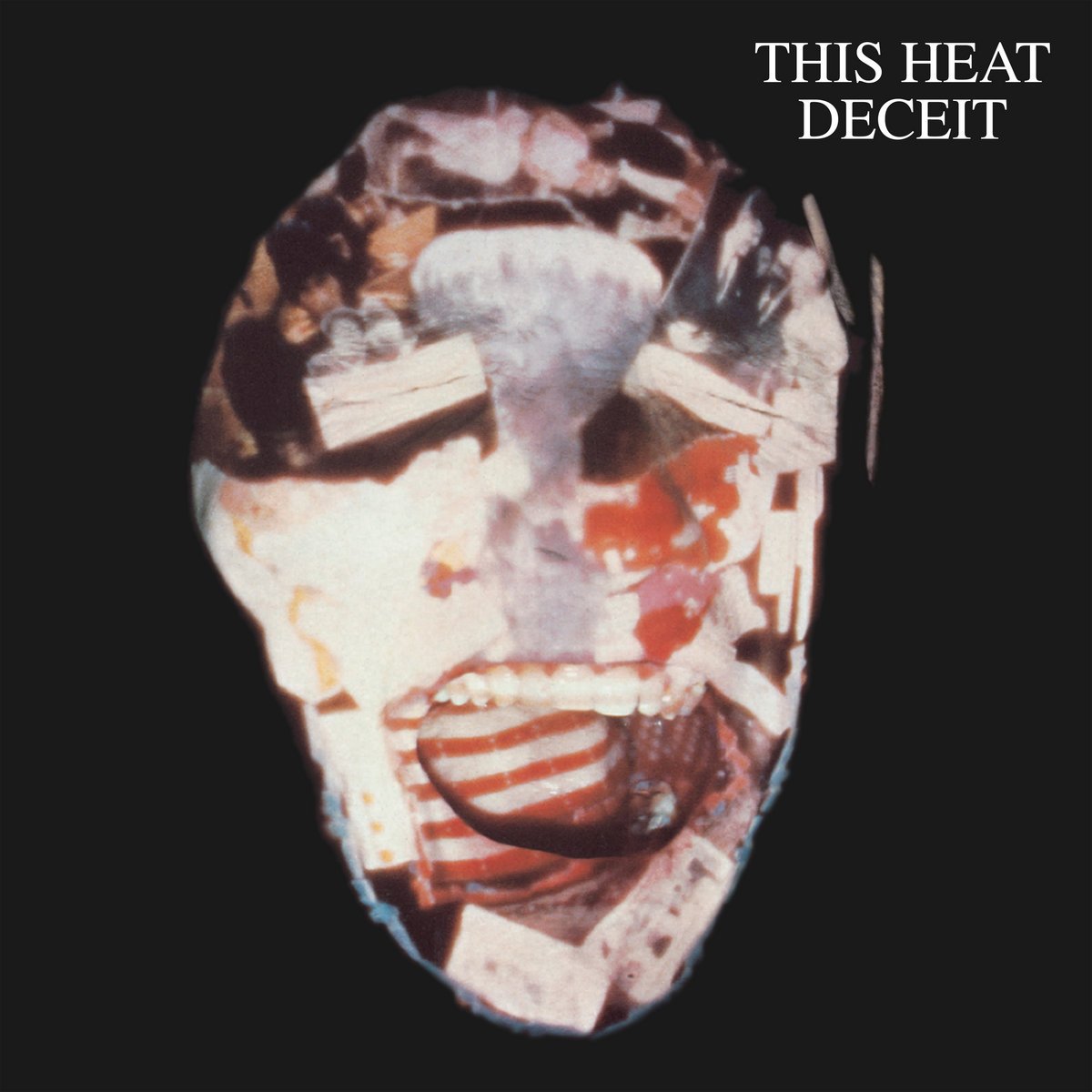
Deceit was put together as Cold War tensions escalated with Reagan’s arrival in the White House, and the songs were heavily informed by the constant looming threat of nuclear warfare which had colored the musicians’ entire lives. The mental and physical remnants of a post-atomic bomb existence form the foundation of the album: The cover presents a screaming face made of explosions, world leaders, and flags. Pamphlets with information about warning sirens and the risks of nuclear fallout collage the inner sleeve. Lyrics decode and question militarism, patriotic values, and imperialist structures. (Alexander Tudor’s article “Classic Political Records: This Heat Deceit” for Drowned In Sound is a great read for those interested in more details about the album’s political context.)
It is not just the lyrics and images that convey Deceit’s message, but also the music itself. The album in its entirety draws the listener into a sense of unease; with unresolved, droning chords, reversed and sped up playback of things we’ve heard before, vocals which move around the sonic space, leaving the listener surrounded by swirling music, noise, and shadowy spectres of an uneasy political future. At times we get aural deja-vu; for example, the drum beat for the opening track “Sleep” is sped up and reused in the sixth track “Shrinkwrap.” Deceit is simultaneously a collage of disparate sounds and thematically coherent; it builds a world that is surreal but knowable. It balances the listener within humor, surprise, and fear, using detailed and quiet soundscapes in contrast to outbursts of song, screams, and even kazoos. The final track is entitled “Hi Baku Shyo,” a transliteration of the Japanese term for radiation sickness or “bomb-affected people,” and is described by Hayward as a shape in which “time cracks and folds back in on itself.” In many ways, the atomic bombings of Hiroshima and Nagasaki marked the opening of the Cold War, and the events which turned the burner of nuclear anxiety up to high. For this album of mid-20th century unease to close with the only atomic bombings is a fitting conclusion to its multi-linear story, ending with the beginning.