
by Kurt Orzeck
If an ultra-prolific music maker writes and plays songs in the woods, do they really exist if no one can hear them? Not if they release the music in the form of records, one supposes. But it is kinda the case these days with Aaron Turner, the former frontman for Isis; member of Sumac, Old Man Gloom and Mammifer; collaborator of Pharaoh Overlord; father; illustrator; swimmer; and deep thinker. Join us for a journey into the mind of one of the most fascinating and prolific underground artists of the last 25 years.
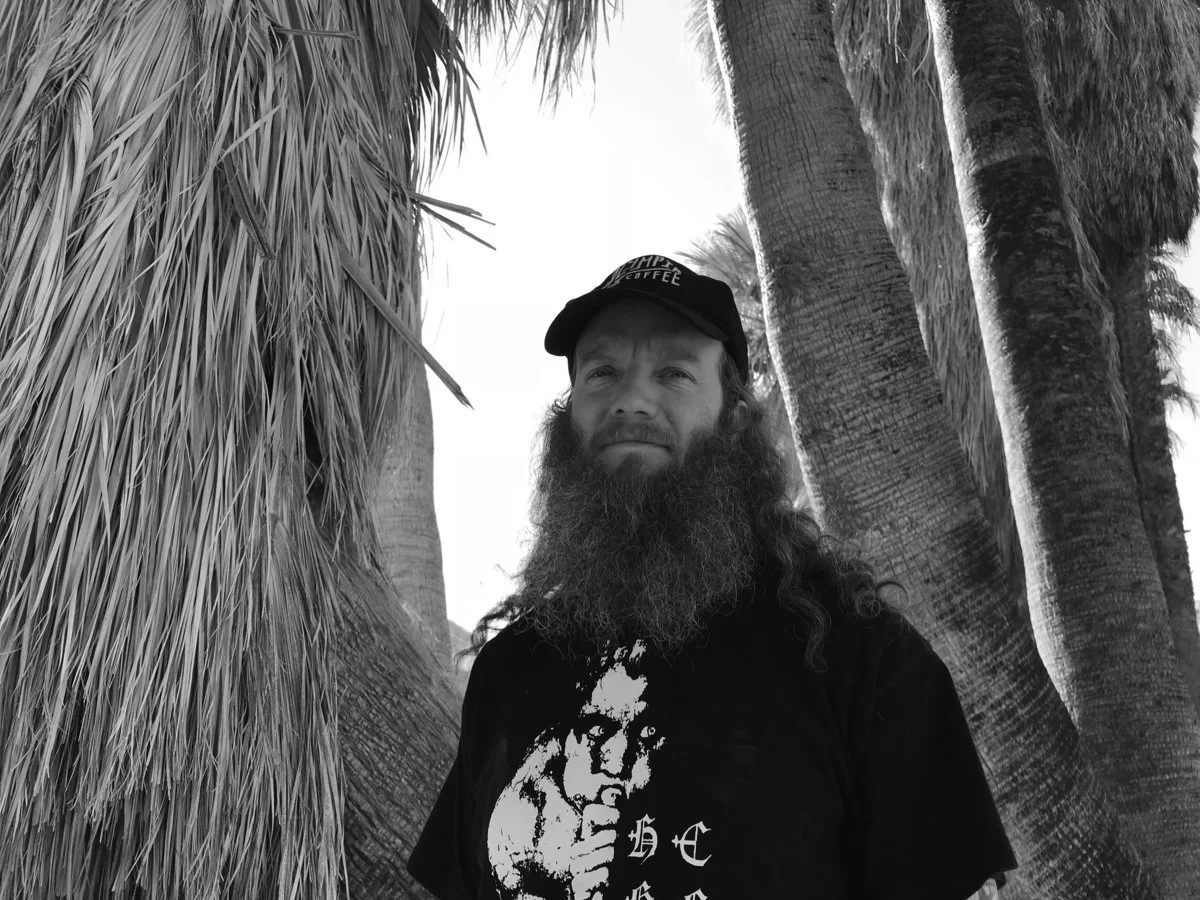
Post-Trash: So, what balls are you juggling these days, Aaron? If you enjoy mixing metaphors, you always seem to have multiple plates spinning at once.
Aaron Turner: I’m working on some stuff at home: demos and a few long-distance collaborations. I’m slowly starting to write some stuff for the next Sumac record and about halfway through finishing vocals for the next Pharaoh Overlord record, which actually we started before this one [July’s Louhi]. [Making a] Pharaoh Overlord [record] is a convoluted process.
PT: Is that due to logistics, since the band’s home base is Finland, or the creative development of the material?
AT: Jussi [Lehtisalo], who's the main instigator for Pharaoh Overlord, finished the recordings for the most recent record to be released and said, “We want to do this right away.” And I said, “OK,” because I felt like the momentum was there as far as he was concerned, and it was a different format musically that seemed like it would lend itself well to a more urgent and rapid-fire approach.
PT: So you typically defer to him with decision-making?
AT: I mean, Pharaoh Overlord existed long before I was a participant. The other main collaborator is Tomi [Leppänen]. They're very much the core of the group. They get things started and then, when they've got a musical foundation ready, they send it to me, and I do my thing. As far as what I contribute, there's implicit trust with whatever I send back. They're hands-off in terms of having any input.
PT: So you have creative control over your own contributions?
AT: I have free reign to do what I feel like doing, yeah.
PT: What attracted you to get involved with that project?
AT: I've been friends with those guys for quite some time and a fan for even longer, starting with Circle, the main group of which Pharaoh Overlord is an offshoot. We started collaborating. The first thing to be released that we did was [2013’s Enharmonic Intervals (For Paschen Organ) with another Turner project, Mamiffer]. Since then, there's been the two Pharaoh Overlord records, two Split Cranium records [featuring Lehtisalo and Turner], a 7-inch for one of Jussi’s other projects. The first Pharaoh Overlord record I was on was 5, but I was only on, I think, one track for that record ["Transgenic Papaya”].
Honestly, the foundation is friendship. I just really enjoy Jussi and Tomi and everybody else who's involved in that Circle camp. They’re just great people making interesting music. And I really appreciate their creative adventurism.
PT: How would you describe that, in which directions they go that maybe some other projects you've worked with haven't gone?
AT: I think they've gone many directions, and that's part of what makes it appealing. It's not about perpetuating a brand. In fact, I think there's almost a destructiveness they openly embrace where they want to be able to do whatever they are feeling in that moment. If we're talking about Circle, it could be a drone record. It could be an improv record. It could be a glam record or a fast thrash thing with psych overtones.
They effortlessly traverse a lot of different territory yet somehow maintain this core identity that's apparent across whatever they do. That's a big part of the appeal for me: They approach it more like an art project than like a band.
PT: What you’re describing reminds me of Ween, actually. You don't know if you're going to get a country record or a metal album.
AT: Yeah. It's highly unpredictable for sure.
PT: What other creative muscles are you able to flex with Pharaoh that you don't exercise as much with your other projects?
AT: I did play some guitar on the most recent Pharaoh record. However, with the previous record and the next record we're working on, it's mostly about my vocal contributions. So, in that way, I'm focusing almost entirely on vocals, which is sort of the opposite of what I do in many of the other things I'm involved with, where it starts with guitar for me and vocals are not a part of the process until the music is written and [vocals] are more of an addition or an intermittent element rather than a focal point.
In Pharaoh, I get to just really focus on the vocals. I don't have to think about the songwriting in the sense that I'm not responsible for the basic foundations. And at least with the last record, 6, I was working a bit more on melodic aspects of the vocals, which has not really been present for me in most of my other recent projects.
PT: Did you volunteer to contribute more vocals to the next record or did they ask you to do it?
AT: I think that, yes, the invitation to be a participant was based more around my role being a vocalist rather than a guitarist. Although, again, whatever I end up contributing is welcome as far as they're concerned.
PT: How often do you see those guys? Do you mostly collaborate remotely or do you get together in person predominantly?
AT: We've done a few live shows, so obviously those were in person. And some of the other things we've done, like Split Cranium and the Mamiffer/Circle record, were done in person. But all of the recording and writing for the recent Pharaoh stuff has been done remotely. So I see them, I would say, once a year or every other year. We just did a Sumac tour in Europe, and Pharaoh Overlord were the support for that. We try to see each other as often as we can, but living on opposite sides of the globe does not make that very easy.
PT: Before we get to Sumac, what's the state of Mamiffer right now?
AT: Faith [Coloccia] is working on a lot of music, some of which is recorded and some that may end up being Mamiffer music, but it remains unclear at this point. She's developing the songs and seeing what they call for before designating it for any particular project. I think there is some stuff that is going to end up being Mamiffer material, but it hasn't solidified yet.
PT: At what point would you then enter into the process? When it is solidified?
AT: Yeah, I suppose so. I mean, it's really up to Faith. I'm on standby while she's developing these things.
PT: How do you manage to be on standby for so many different projects? Maybe a better question is, how do you manage your time and availability?
AT: At this point, I'm no longer in a band that is full-time in the sense of touring three to five to six months out of the year. So I don't really have to worry about my schedule having huge swaths of time that are blocked out. And though I would consider Sumac my main band, we tour for a maximum of two or three weeks at a time – and, at most, that's two or three times a year.
I juggle my time as best I can, and not always successfully. Certain projects end up taking a long time to finish. But I think that, with the people I collaborate with – especially people like Jussi and Tomi that I have a close relationship with – there's a forgiveness there because we know that the point is not to adhere to a particular schedule but to get things done the right way. So that's kind of how I look at everything that I'm involved with. I just chip away at it until I can finish it or until I feel I've done it to the best of my ability.
Some things can be immediate and other things take a longer time to develop. I just fit them in where I can. There are certain records I've been a part of where I [work on it for] a day or two at some point, and then it's another three months before I can get back to it. This is just part of the juggling act of my life where I'm making a living doing what I want to do, which is music and artwork. There's never like a straightforward path to most of the things I'm involved with.
PT: Do you feel like that's a fundamental, prevalent wrong approach people take with music, in the sense that bands and careers are built on a timeline that is very rigid and homogenous? It occurs across all genres of music too. Shouldn’t music operate in a way where you wait till you feel creatively inspired and then do a record, and anywhere from six months to 10 years will go by before you make the next one?
AT: I don't have any particular thought about how music should be approached because it's a purely subjective thing. Something that works for one person may not work for another. For me, it's a combination of wanting to tap into the right spirit and figuring out logistically when things can work, with discipline.
Especially with these collaborative, long-distance records, I have to get myself to go out to the studio we have here at our house and work on things. And that process of discipline, of regularly trying to work on music and art is part of what allows it to become good. I can't jump cold into working on a piece of art or a piece of music after not having worked on music or art for a while.
I feel like I need to get back into the spirit of it by doing certain exercises, like sketching or practicing and then throwing stuff away. I think it's definitely a combination. I would say when I was younger, it felt like the drive was always present. But I also didn't have anything else going on in my life for the most part. I wasn't married. I didn't have a kid. And now it's like, I really do have to make sure that I am working consistently so that I am in tune with my own inner creative flow and also making sure that the things that I'm a part of do eventually get done, even if they take a while.
PT: So what does that look like on paper? Is there such a thing as “an average day” for you?
AT: There isn't an average day. But I'll try to give you a brief snapshot: Most of last week, I spent doing mail order, working on some artwork for another band and working on drawings for tattoos for clients I have. This week, after having gotten a lot of that stuff out of the way, I'm back in the studio most of the day working on demos and writing and maybe spending a smaller portion of the day doing a little bit of mail order and maybe a bit of drawing. But it's in between all the domestic stuff, like being a caretaker for my child and all that.
There are certainly times where I'll spend two or three weeks working mostly on mail order and artwork and no music whatsoever. And then there'll be times where I'm very intensively focused on some particular musical project. I do try to find a balance, especially when I'm home, where I could do a bit of each thing every day. And it doesn't always work out. But that's just the reality of the situation.
PT: To what extent do you get stressed out, especially when you're being pulled in multiple directions?
AT: I think I induce more stress on myself than is healthy. [It’s] something I'm actively working on. It's not having a lot of projects that cause me stress. It's my perspective on my life. And so I do certain things to help myself in that regard, whether it's exercise or therapy or whatever. I have to keep that in check, because stress never really helps anything get done. And it's certainly not good for my health.
PT: Do you feel comfortable talking about your self-care practices? I've also been curious for a long time, given the nature of your music, of the degree to which you practice meditation or don’t.
AT: I won't delve into it deeply, but I'll say there's a few things. One is striking a balance between family life and creative life. When I'm too connected to my creative life, I’m not a good participant in my family life, and vice versa. I choose not to tour a lot at this point because I don't want to be away from my wife and child. I feel like that's detrimental to my well-being. And therapy has been something I've done off and on for quite some time. I need to exercise regularly, especially as I get older. Part of my exercise routine is cold water swimming, which I feel has been really good for me and also a good way to curb anxiety.
I'm not always in balance for sure. And when I feel myself spinning out, I really try to focus on what it is that I need to do in order to recalibrate. Meditation is something I've been curious about, and I feel like I have a sort of meditative approach to certain things. But as far as actively making time and space to meditate, it's not a place I've been able to get to.
PT: I always considered Isis to be meditative music.
AT: Well, I mean, that's the joy for me. A lot of the stuff I'm a part of has a meditative and hypnotic aspect to it. Under the best circumstances, it does have those transcendental possibilities.
PT: Do you teach art or collaborate artistically with your child?
AT: He and my partner and I have done drawings together quite a bit, just for fun. That's really enjoyable. We occasionally try to coax him into playing a little bit of music, but it's definitely not something we're thrusting upon him. We don't have any need to see him follow in our footsteps. But we do want to make art and music available to him. We are actively doing those things so that it's part of the context of his life.
We'll see how that manifests for him. He seems to enjoy singing. He likes to draw. He likes being in nature. And he's a very good storyteller and enjoys reading and hearing stories. I like to think that's all building some sort of creative sensitivity for him. We'll see how that takes shape.
PT: Are you still living in L.A.?
AT: No, I moved to the Northwest in 2008. I was in Seattle for about a year and a half. And then my wife and I moved to Vashon Island outside Seattle, which is basically a pretty rural area. We're in the woods now, which is another self-care thing for me in a way. I feel like we're in the right environment that we need to be in and a good place for us to raise a kid.
PT: I’m glad to hear that. In this last portion of the interview, I’d like to talk a bit about Isis. You mentioned that Sumac tours two or three weeks at a time, only a couple of times a year. Do you think that's the key to sustaining a band? If I'm not mistaken, Sumac is probably your longest running project at this point, right?
AT: I think we still got a couple of years to go before we have been around as long as Isis was. This was 10 years for Sumac, and Isis made it to 13, I think. However, I was aware at some point during the trajectory of Isis that the process you described earlier of the cycle of recording, then touring, then recording, then touring, was starting to grind me down. And I didn't want to repeat that process with Sumac for a variety of reasons.
There's also a level of intensity that we want to achieve with Sumac that feels hard to sustain over longer tours. When we've pushed ourselves past two weeks into the three-week zone, it starts to feel like it's not totally sustainable. So I do feel like our ability to get along with each other and our ability to put the maximum amount of energy into what we're doing is to do it in those shorter bursts.
PT: When you say intensity, you're talking about performance?
AT: Yeah. It's physically taxing music and emotionally draining and requires a lot of mental focus. So to try to do that day after day after day is difficult. So, for me, I would rather be able to give it my all for 10 shows over the course of a couple weeks than to try to do a six-week tour and feel like, by the halfway mark, I’m just going through the motions.
PT: What other creative fulfillment have you found with Sumac?
AT: Well, one thing I had in mind when I started Sumac was just being the creative dictator. I don't need to be that in everything I'm involved with. But I did come to the realization that if I was going to start another band, I wanted to be the person who was controlling the aesthetic. And that's not to say that [drummer] Nick [Yacyshyn] and [bassist] Brian [Cook] don't make massive contributions. In fact, the reason I chose the two of them is because they have very well-developed musical identities and very recognizable ways of playing.
But as far as the character of the music and the compositions, I wanted to be the person who is in control of that. My thought behind that was, one, I had a very specific vision for how I wanted the music to be; and two, when I thought a lot about most of the artists that I really am inspired by, they are rarely groups that are totally democratic in their approach. They're often spearheaded by or at least largely shaped by one person's vision. And I think that there's a purity of sound that can happen when that approach is taken.
That said, I feel like there's deep value in other types of more balanced collaboration. But that was not how Sumac was going to be developed in the way that I needed it to be. Being the creative director was important to me.
Another factor is improvisation. I didn't want to be stuck in the process of re-creating existent songs and having it be more of a performance rather than a living and ongoing exercise. And so I wanted to make sure from the beginning that that was established as part of the parameters. And I wanted to have collaborative partners who I found very challenging. Both Brian and Nick are excellent players. And the way they do things, the way they play and the ideas they have constantly challenge me. I feel like that's really inspiring and a big part of what has made it feel like a success to me.
That isn't the case so much with Old Man Gloom. Old Man Gloom is a different idea. The idea with Old Man Gloom is basically just to embrace our primitive selves and to have fun and not strive for complexity and not overdo it in terms of thinking too much about what we're doing. It's very spontaneous. It's very much about a kind of basic punk spirit.
PT: So, in terms of upcoming releases, what record are we going to see first?
AT: Well, I have a collaborative record with a Swedish artist, Joachim Nordwall. He and I finished [a record] early this year, maybe late last year, and that's going to be out maybe in December. I'm not sure what's going to fall after that. There's another Sumac recording session with Keiji Haino from our trip to Japan this year. So we'll shape that, go through and edit everything, and figure out what selections to use. Those are kind of the next things on the horizon. There's other things in the works too, but they're not far enough along for me to really feel comfortable saying that they are imminent.