
by Shea Roney (@shearoney2)
Sleeper’s Bell, the songwriting outfit of Blaine Teppema and Evan Green, released their debut album Clover at the very beginning of the year. Fostering a reciprocal relationship with storytelling, Teppema’s presence within her words has always been one of desirable consciousness and stimulation – a full story, an almost novelistic dream of what it means to love and to be loved; to be hurt and to heal. But now embracing the vivid talents of the Chicago scene, the duo now work with a full ensemble of notable players including Leo Paterniti [bass], Ethan Toenjes [drums] and Rufus Parenti [saxaphone], bringing a newfound life into the already lasting structures of a Sleeper’s Bell song.
In the leadup to Ugly Hug and Post-Trash’s benefit fest this Sunday at the Empty Bottle, both sites are featuring each project on their respective sites. Sleeper’s Bell hits the stage third, bringing their memorable expressions and tender storytelling. Shea Roney recently sat down with Blaine and Evan about their upcoming album, life’s hidden alignments, and reflecting on their first big tour.
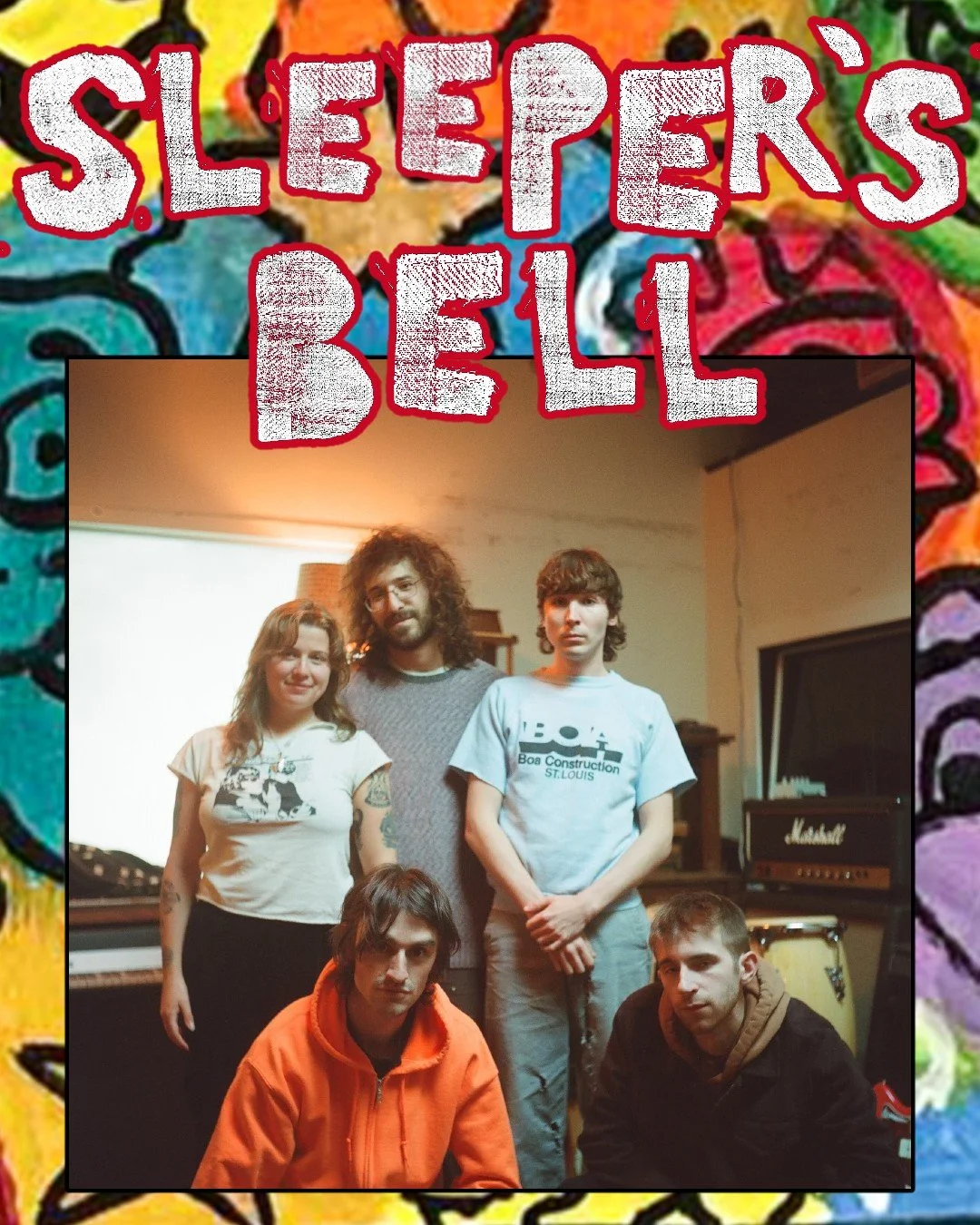
Shea Roney: I think the last time we talked was just before the release of Clover, but you had a batch of new songs already recorded too. This feels so long ago, but to go back to right after Clover was released, did you have much time to sit with it before jumping into something new?
Blaine Teppema: No, and I feel like that's a good thing. The time that we had spent sitting with Clover was before it had been released, so by the time it was out, we had a whole album written and were ready for something new.
Evan Green: We had already had that new full band for a year once Clover was released. So in the course of a year, we had just formed arrangements and versions of new songs. And then Clover was released and we went back to playing more of the Clover era songs.
SR: Thinking of it as two different eras is interesting. Was there anything that you wanted to take from the Clover era into this next era? Or did you want to see if you could try something new?
BT: We're still trying to tell the same story in a larger sense. You know, Clover was pretty ruminative and angry and chaotic – parsing through certain emotions and trying to figure out my place in the world. And I think this [next album] is the aftermath of that. It's a lot more accepting.
I wrote most of these songs after I stopped drinking. I think it's just more mature, maybe even understanding.
EG: It's a testament to your growth as a person [to Blaine]. Your songs are so brutally honest about where you are in your life. You've changed so much in the past three years, and I feel like your approach to music and your relationship with music has honestly changed a lot. You’re just dedicated to writing songs.
SR: Would you say more than before?
BT: Yeah, I think so. We had songs on Clover that I wrote when I was 16. These new ones were all written in the span of, like, two years.
SR: Blaine, you have a Substack in which you refer to as a dream journal. Keeping this conscious and thoughtful practice of something separate from songwriting, but something that's still public, has that shown you any deeper ways you approach your writing, or how you navigate what you see as something worth cataloging and keeping?
BT: I get really inspired to write when certain aspects of my life line up. Like, if I'm reading a book, and it relates to a dream, and then that relates to something that I'm experiencing – I focus on the intersections of art and expression and experience. It's hard to explain, but like in college, when you're taking science classes and math classes and English classes and history classes, and you start to notice the through line of all of them, where all of these seem to touch on stuff like exploitation or capitalism, or something. You just start to notice patterns. I like to write when I start just noticing the patterns. I was reading a lot of Carl Jung, reading about archetypes and fiction and poetry, but also, you know, I was in a relationship and I was talking with my friends about growing up. There begin to be patterns of bigger concepts.
SR: Are they more subconscious alignments that show themselves at random times? Or do you find yourself searching them out?
BT: When I read, like, Simone Weil, Gravity and Grace, or Jung, it fits every corner of your life. It makes you think deeper, and then also makes you want to treat people better and want to treat yourself better. It relates to health, and it relates to art, and it relates to presence, all of that.
SR: Does that lead us back to the new record, something you both touched upon was that this one is built from acceptance?
BT: And space, or accepting the natural flow of growing up and changing. Even relinquishing shame.
EG: Yeah, I feel like [Blaine] just has this ability to track the through-line and put them into songs that are just so tangible. I feel like that is just always gonna be the same throughout all of the music that [she] writes.
SR: And this new Sleeper's Bell full band, what does that bring to these songs that feel so tangible?
EG: I think our journey as a band has been all these tangential moments, but also interwoven parts of our lives. We're each going through our own journey with relationships, and our experience with past relationships and future relationships. And then, we're all in a band with each other where we play music together and it's this huge release for all of us.
BT: Yeah, and just outgrowing things, and growing into new things. We've all grieved together, and laughed a lot, too. Sometimes both.
SR: You all recently went on tour with The Backseat Lovers. Not so much in the backseat anymore, huh?
EG: We're loving it in the front seat. Blaine is the driver.
BT: I drove probably 85% of that tour. I love driving long distances because it feels like meditating for me. I learned Transcendental Meditation over the summer, and they give you a mantra. It's okay to let your mind wander as long as you favor the mantra. So, just like where I think the highway is something to favor, because you're thinking about it to the extent that you have to navigate it safely. But it's also kind of a muscle memory thing, where you're not really locked in, as opposed to being in traffic or something. The highway is like the mantra, and I feel that way when I go to a really good show. It just fills in the space of your thoughts. I'll go to a show, and for an hour, watch their set and just think about all the shit that I have to think about. And then afterwards it feels so good. A good show is to driving on the highway on the open road as a bad show is to being stuck in traffic.
SR: And this was the first big tour for you guys?
EG: It was like an experience where we were immediately thrown into the biggest show that we had ever played in our lives. For the first show, we got to the venue an hour late and then had to play for like 1,700 people. We were like, ‘what the fuck just happened?’ It was incredibly nerve-wracking to have an opportunity like that. But then immediately it was so much fun. They were the kindest people. We loved everyone. And the shows were just amazing.
SR: And then Blaine, you recently started this little postcard series. What has that been like? How has it been going?
BT: It's been going really well! I can do it all at the library, which is nice. It paid for my new amp, which was dope. But it's so fun, and honestly, I don't care if it's not lucrative because it's something fun for me to work on at work when I have down time. It's just a really nice way to put everything together – what I've been listening to, what I've been reading, what the band's up to. And people really like it, so it's cool.