
by Arthur Velez (@chillguy4000)
There is a barn along the turnpike, forty miles east of Pittsburgh with “DRINK MILK!” painted on its side in massive block letters. From context clues you can figure this is likely a dairy farm and they want you to buy their product. But when you’re going 81 mph in rural PA, the command makes for something slightly absurd; something that spurs you to think differently for the next few minutes. Listening to Kiwi Jr.’s fourth LP, Blowin’ Up (their first for Perennial / K Records) produces a similar whiplash, both interrupting and recalibrating expectations.
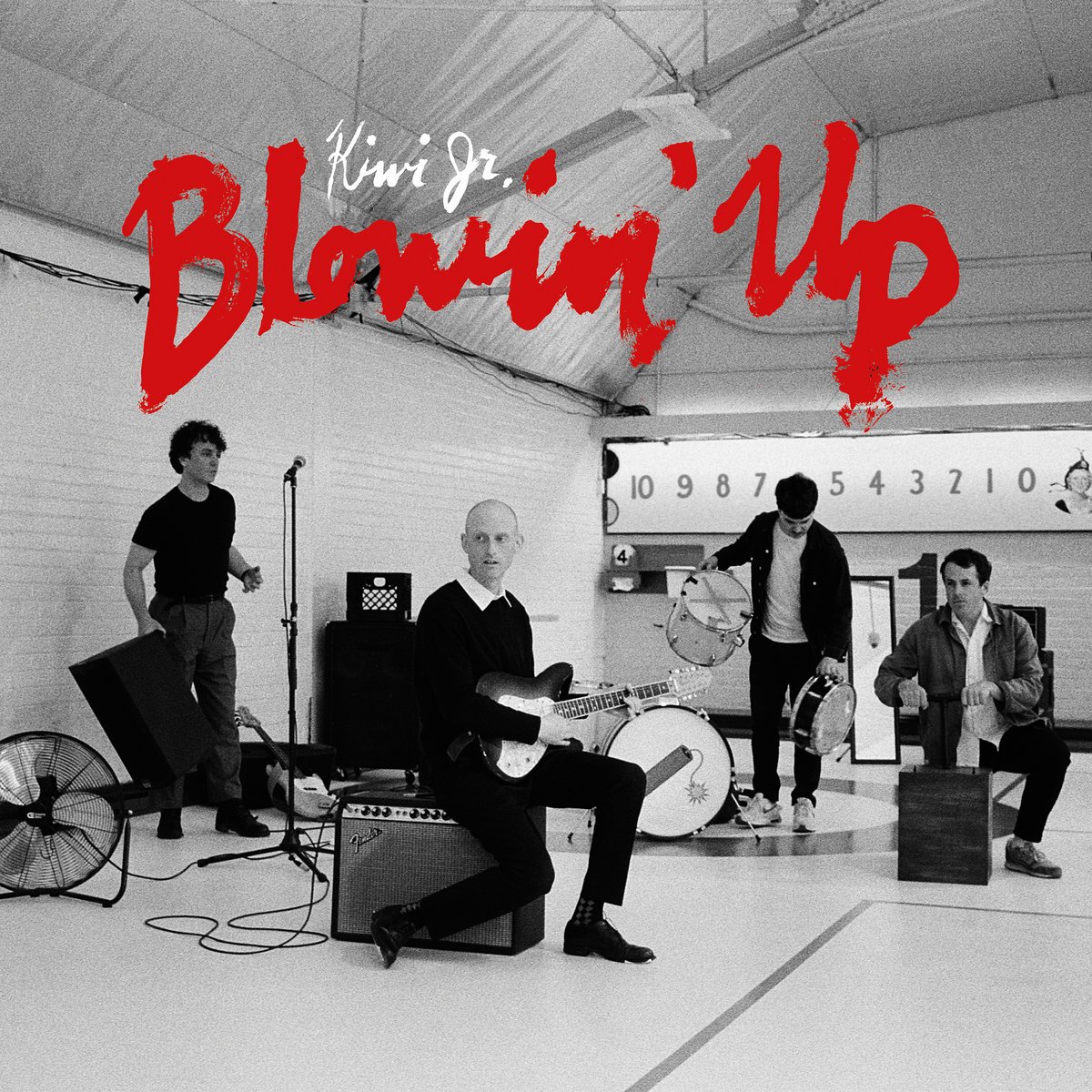
If you look at the album cover, it’s not too difficult to imagine the sounds inside. Pictured are four, seemingly 30-something year old musicians, perched near their instruments in the year 2026. Since their debut, Football Money (2020), these Canadians (Jeremy Gaudet, vocals, guitar; Brian Murphy, guitar, keyboards/synth; Mike Walker, bass; Brohan Moore, drums) have garnered complimentary, albeit knee-jerk comparisons to any number of their “slacker” or “jangle” rock forbearers. But from the opening harpsichord strums of “Photos Of The Reenactment,” Gaudet and co. remind us that the world of the Kiwis contains a much wider, weirder strain of power-pop than may first meet the eye. They’ve never been a shambolic band - quite the opposite, they arrived close to a final form - but there is an extra sense of confidence that is palpable throughout Blowin’ Up.
Across the record’s ten tracks, the band plays with a restrained swagger and self-assurance. They compliment Gaudet’s kaleidoscopic storytelling with codas on the plaintive “Caught In The Wind,” and the burning “Landscape With Limousine." They use moments of half time to amplify the floor-tom-led propulsiveness of the title track, and standout rocker “Stage Names.” Where past efforts may have kept blazing through songs, this wide angle instrumentation gives both production and performances ample time to breathe. Similarly, the synths and keyboards utilized on earlier records here feel much more like separate personalities. They’re expansive and malleable, acting as sirens, carnival ride accompaniments, calls to arms, and hot rods on Woodward Avenue in Detroit (see: “Pure Michigan”). The band was also confident enough to open up to collaborators, yielding impactful contributions from Margaux Bouchaudon of Parisians En Attendant Ana and members of Detroit’s Protomartyr.
Throughout Blowin’ Up, Gaudet cements himself as one of indie rock’s most inventive and evocative lyricists. Wordy without being exhaustive, he excels at pinpointing the moments in between the moments (“Everyone’s on the guest list / take the stamp from the back of my hand / dead men rise in the desperate hour / between soundcheck and the opening band”). His narrative range seemingly knows no end, and neither does his ear for melody: he sounds as if Jonathan Richman were raised on a mix of the Sports section and Scharpling & Wurster. Album highlight “Pure Michigan” is a synth- and handclap-backed chronicle of Midwest coming of age and cultural exchange (“I’m 19 in Windsor, that’s Pure Michigan”). Gaudet even veers into a lane often occupied by his countryman Nigel Chapman of Nap Eyes, conjuring mystique and emotion through the esoteric, as he does on “New Jade Rabbit,” weaving parallel narratives of a dead lunar rover and someone getting kicked out of a band.
In a way, Blowin’ Up is a bit like a minor league baseball game: you feel like you know what to expect - hot dogs, double plays, maybe a home run if you’re lucky - but you also have no idea what’s coming. From an effervescent, hazy swill comes quasi-Americana, pathos, and fireworks. It’s refreshingly honest. The players are all really trying. They’re on the cusp of it all. They drank the milk. They’re blowin’ up. Does it matter if they make it to the big leagues? Not really. They’re playing the game for the sake of playing the game, and that’s worth the price of admission.