
by Chris Coplan (@chriscoplan.bsky.social)
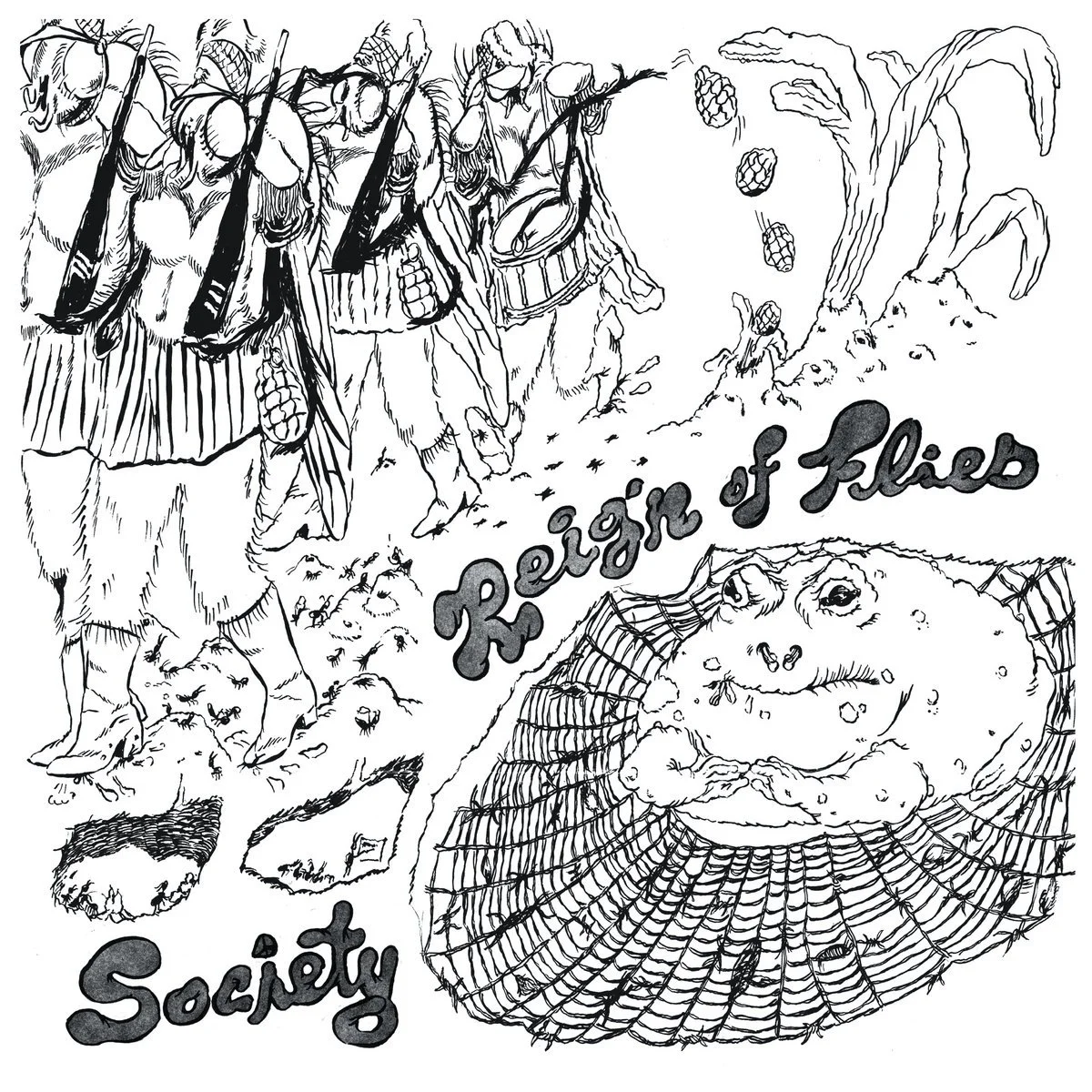
There's the hat, and then there's the head. Which is to say, there's the message and then there’s what someone really means. If we’re lucky, the hat’s only ever for convenience and/or efficiency. If we’re not, well, we all know a bad hat when we see one. If we’re to believe the hat that Sims Hardin wears on Reign of Flies (the latest from his Society solo project) – and I most certainly do – we’re dealing with a "scathing critique" of America in 2026.
Not only is Hardin tackling the great, snarling U.S. beast, he's doing it with "fist pumpin'/foot-stompin'/head-bobbin'" grooves, basement punk with teeth and pop flourishes to boot. Opener "Casualties of War" sets a certain pace – grimy Black Flag that’s all crunchy percussion and blown-out vocals to stoke the fires of angsty weirdos. "The Wall" adds twang to the formula, showing a little variation goes a long way to reinforcing this core approach.
From there, the hat starts to tilt a smidgen with "War-Torn Pub" and "The Shadow." The former is less a song and more a performance piece, with the murmurs of a half-packed crowd providing ambiance. The latter, meanwhile, is an overt about-face toward tracks one and two, an even more kinetic surge of pissed-off punk. What's it all mean? Well, it all feels quite meta — Hardin showcasing what it's like to play punk right now, with an urge to speak to our current moment and an aim to bash through the corresponding noise. A call to arms, if you will, that punk has to be bigger, brattier, and more brash to actually keep up. It's a critique disguised as a musical play, and it strikes like the unseen blade of a crusty assassin.
However, the hat basically falls off once we get to the title track. Spoken word interludes and skits are a dime a dozen, but this instance feels different. It's Hardin (or a proxy?) standing in a flickering spotlight, exposing the deluge of social and moral decay plaguing us today. Be it racial injustice or feckless fools like Kyle Rittenhouse, Society proves especially raw and naked in this monologue of anger, disappointment, and grief, doing away with pretext, etc. to rip through our collective chest right at our thumping hearts. I imagine this happening at the end of a show, and people staring blankly ahead at a snarling Hardin, utterly unsure how to react and process this cacophony of feelings and ideas that prove like glue in our ears and minds.
By the time "No Society" roars back to maximum fury and bile, you may think it's Hardin re-committing to the cause. That we must double down on our collective power and fury if we're going to take back the world. That society demands to be rebuilt in a way where social justice is powered via our ever-burning passions and dedication to militant action. In that sense, the album's first "arc" is wildly successful. It manages to weave a tale that's never just empty theater, but instead captures the arc of social justice movements in the last 50-ish years. It distills and disseminates that huge history to reinvigorate the souls of anyone seeking change – just as Hardin reinvigorated punk itself with uglier, braver tones to meet our present war.
Except the remainder of the album isn't exactly blazing a path forward. Nor does it seize on the mountain of kinetic energy to push us onward with renewed aggression. Instead, it all sort of... breaks down? "Bunker Blues" is a minimalist ballad of shiny-meets-junky guitar, a funeral ditty for after we've been defeated. "Endless Drain" and "Sarin Gas" each pick up the pace, but even those feel like merely stomping through the motions, repetitive tunes speaking to the grief of being lost/stuck. "No Signal" may be even sadder still: a '60s-tinged jam that plays during the terrible biopic chronicling our modern, shitty world.
The hat is clearly all bravado and bolster, with Hardin flailing wildly, manically to get us to pay attention to the world. The head is... well, a beguiling mix of depressing and comforting. Is it an ode to what we'll lose if we don't fight? An acceptance of the death and madness to come (as some kind of preemptive salve)? Is it all theater because that's the only thing that resonates these days? Maybe it's my own dumb brain processing years of structural strife and heartache? I can't exactly decide, and all of it feels like it's true to some extent. It certainly makes for the most perfect, unintentional concept album ever, a record whose narrative is both a commentary on and extension of the emotional and social trajectory of life in recent years. An LP that prepares us for bloody battle then reminds us we’re already in Hell. It’s a time capsule, a love letter, and a sick joke.
Still, if you're seeking clarity (as I clearly was), album closer "Gangstalkin" is interesting to say the least. It basically bridges the gap between the album's "two sides," a super-duper lo-fi ditty that hums with a stoner-level air of abandon even as Hardin muses on our topsy-turvy world (where he's assailed by the CIA). On the one hand, the song itself both informs and undercuts all the threads here, which only adds to its conceptual brilliance. On the other hand, it also feels like a post-credits scene. Ya know, something that comes after the fact, and serves as an epilogue to varying degrees of value.
Still, the thing that leapt out furthest during "Gangstalkin" is the line "People follow me wherever I go." Not exactly the most helpful bit of advice (and maybe closer to paranoid rantings), but if this album is a doubling down on our shared misery and combative prospects, a little camaraderie seems to be the way to go. It's ultimately the sweaty, nervous voice at the album's core, a humming personality that doesn't tell you it'll be OK — just that you can keep moving forward through both the shit and sandy beaches. There's bound to be more pain and confusion along the way, but with Hardin also moving through the muck, I certainly feel better about the prospects.
Even that message ("keep on keepin' on") is both earnest/sincere and a little trite/overplayed. A bygone message from the hippies that Hardin seems to rework across the LP with an air of respect and annoyance. In that way, Reign Of Flies is a true capital P punk rock record — both a commentary and a treasure map, a sacred document (that's also dumb and silly) for the way the world ought to be. That being gross and dumb is for punk rock and not politicians, and that the most honest dude on the block shouldn't be some schlub from Philly. But he is, and we're collectively better off for Hardin as an unlikely soothsayer (and by soothsayer, I also mean shit-stirrer).
Maybe the message is overly familiar and/or uninspired. But if you seek hope through the gritty determination to build something bolder and more scary despite sustained existential suffering, Reign Of Flies offers that in spades. The hat looks good, the head is above water, and that's all you need for a worthwhile existence.