
by Kurt Orzeck
It’s safe to say that when you’re about to co-headline a tour with Agnostic Front, who arguably belong on hardcore’s Mount Rushmore, and you’ve logged thirteen years as a band compared to their 46, that you’ve made it. Such is the case with Baltimore’s Angel Du$t, hardcore brethren who are soaring higher than both an angel or a druggie who has consumed an excessive amount of angel dust.
As stratospheric as their current rise most certainly is, Angel Du$t didn’t come out of nowhere. They used to count members of Turnstile and Trapped Under Ice among their ranks; and they stayed on major label Roadrunner Records for seven years. Ever since signing to Run For Cover Records last year though, Justice Tripp, the band’s mainstay member and lead vocalist, has been on a tear.
In addition to the upcoming juggernaut jaunt with Agnostic Front that starts September 27th in Richmond, Virginia, their album Cold 2 The Touch is destined to appear on many top ten lists at the end of the year – and for good reason. The record checks all the boxes of what a great hardcore record should be: it’s urgent, unrelenting, unassailable, uncompromising, unstoppable, and an unmitigated tour de force. Cold 2 The Touch is a record so good that it makes you forget the band existed before it – and that’s a compliment.
Anyone who dares claim Angel Du$t are simply a band at the right place and the right time should be put in the penalty box; Tripp deserves enormous credit for assembling the line-up that his band was meant to have, and the proof is found on every one of the 26 minutes that whiplash the listener through the breakneck LP — which, performed live, could certainly result in some broken necks due to the ferocity of the band’s vibrant virulent fanbase.
With Angel Du$t set to take it to the next level with their upcoming tour, we bring you a conversation with the Tripp-ster earlier this year.
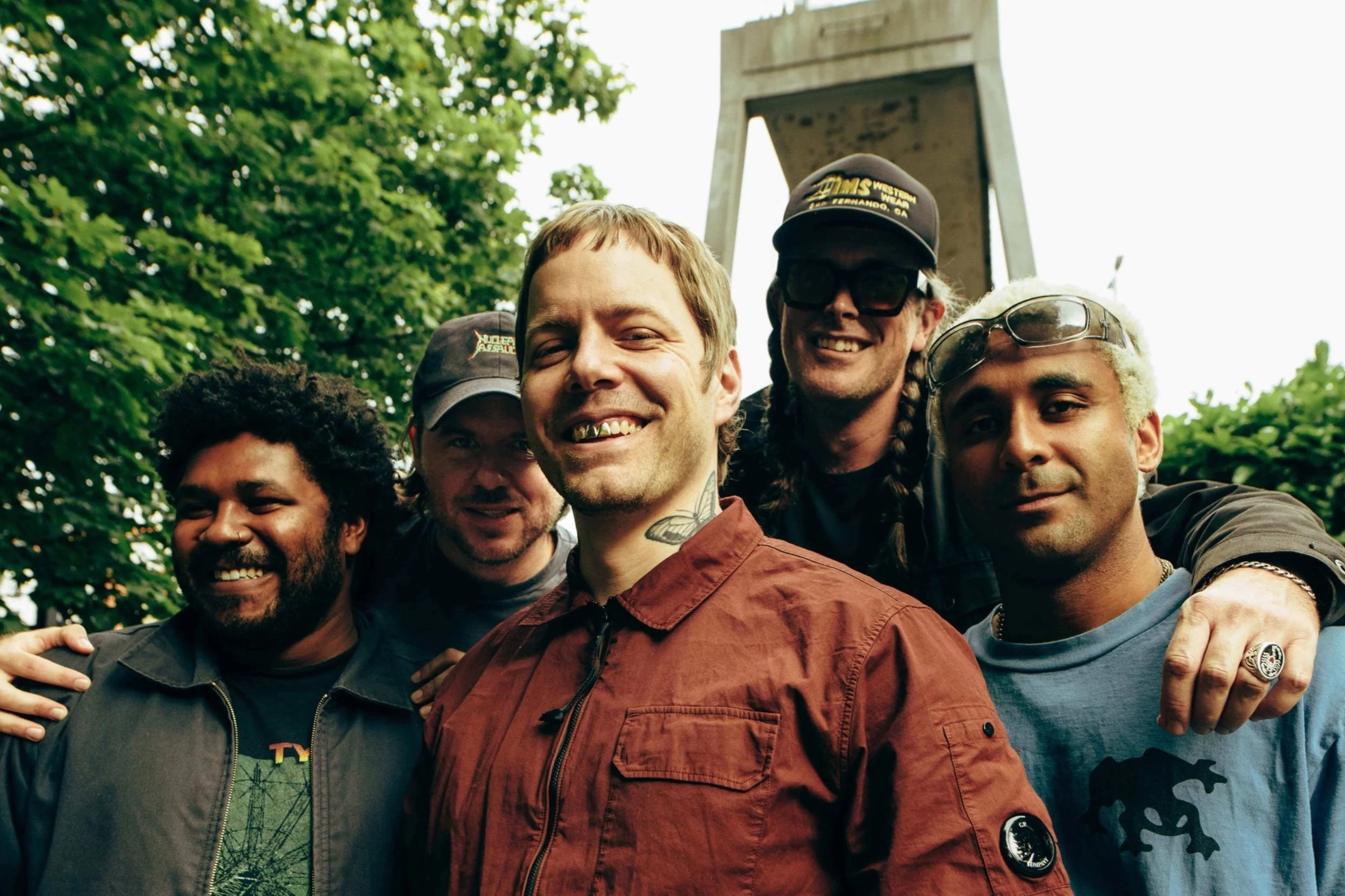
photo credit: Nat Wood
Kurt Orzeck: Congratulations on the record. It's phenomenal, one of those records that you can listen to on repeat for hours. What kind of vision did you have for it initially?
Justice Tripp: I guess the only preconceived idea that we went into it with was that we wanted it to relay what we love about playing live and make a record that we can play mostly live. We know, based on what we love doing live, it's like some of the more high-energy, fast, Angel Du$t stuff and some of the heavier moments that kind of demands crowd participation.
I think it's also important that a record has dynamics and energy, that it ebbs and flows, so it keeps you locked in. There's a song or two on there that might not work in concert, but generally I think we really nailed the live element. We just premiered “I’m the Outside” at Something In the Way Fest in Boston – I was like, “Let's just open with it,” and people went crazy. The energy felt awesome onstage and it felt like the perfect live song.
Especially in the independent music world – and I don't have any qualms about this whatsoever – but it seems like there's more of a tendency of wanting to create your art for yourself. If it speaks to other people, that's all well and good, but you're trying to do your own thing. My mission statement when I first started making music was, “I’m just gonna make this for me, and if I know what I like, and if I'm cool, cool people will like it.”
I do think there's some truth to that but I learned from [producer and Angel Du$t collaborator] Rob Schnapf that you're in service to the audience. I think my relationship with Rob helped me define what works about live music. Before he taught me that I would say to Trapped Under Ice’s [guitarist] Sam Trapkin, “Yo, this is entirely selfish, this is all for me.” And Sam would be like, “Dude, we got to think about the audience.” [Tripp is also the vocalist for Trapped Under Ice.]
KO: You curate an audience, you know.
JT: Yeah. I like that you mentioned that. I feel like I haven't really talked about that with anybody in a while. I write a lot of aggressive lyrics. Like, on this record, there’s a little hook [on “DU$T”] that says, “I got a gun in my hand right now” and that's meant to paint a picture and express how I feel. You got to take a step back.
I was battling with that lyric, where I was like, “man, I really don't want this to attract the wrong kind of energy or open a door for the wrong kind of person to say, ‘Hell yeah, brother, I got a gun too, I'm bringing it to the show.’” You have to be careful with that. Angel Du$t was my first time challenging myself to not do that. Especially during early Angel Du$t, where I was like, “How do I express being really angry without inciting violence?” Because I don't want to incite violence.
Especially towards the tail end of Trapped Under Ice touring and being a super-active band, the shows were very violent. We were crossing over into this younger crowd of people who were less familiar with the violence of hardcore. I've seen young people get hurt. So Angel Du$t was a response to that, where I was like, “I love hardcore music, angry music, but how do I do that without inciting violence?”
So when we started the band, there was a brightness to the lyrics. There's a lot of stuff about love and things that I didn't speak about as much with Trapped Under Ice.
KO: It's like you want to make the soundtrack to a great moment and not somebody's terrible night. There is a lot of positive messaging and talk about love in your new album’s lyrics. It almost feels like you made an artistic or socially responsible decision to do that?
JT: Absolutely. Yeah. When I was a kid, I didn't know that anybody was influenced by me, I didn't feel a lot of self worth. I thought I was just some idiot who could say anything I wanted, and it didn't mean anything to anybody. Then younger people start coming to me, and they had tattoos of that thing you said on them.They told me how a lyric made them feel. I've had a couple times where I was misunderstood, where somebody was expressing how they related to something that I said, and I was like, “man, that's not what I was saying.”
That's the reason why I got a microphone in the first place, when I started doing music. It’s because I felt misunderstood.You want to create community and understanding, so it was a moment where I was like, “OK, I have to get a handle on this. I'm going to do this forever.” So I just want to be better at it. We should all be trying to perfect our craft.
For me, it was to have more clear intentions with lyrics. You know, I can get onstage, and I can say a lot of political things. I think at the end of the day, there's some politics that are more important than others. There's literally people dying – in Gaza, for example, there's children dying every day. In our country, in the United States, a lot of brown people in particular are being ripped from their families and sent off to not even their home, but to God knows where in a lot of cases. It’s a really dark time.
People get really hung up on the minor details of their politics, right? I go on all day long and talk about what I think is right and wrong. But it's like, what do we all know is wrong? What really defines you as a person is how you, in my opinion, respond to the suffering of people.
I think the biggest tool we have is music. Like, the baseline of music. What is music meant to do? Build community. It's meant to bring people together and I think people forget that sometimes. They get hung up on gatekeeping. “Oh, this band won a Grammy. They're not hardcore anymore.” It's like, “Shut the fuck up. Who cares? We're a community. This is us.” I won a Grammy with Turnstile, you know? [Angel Du$t contributed to Never Enough: Versions, a collection of reworked tracks from Turnstile’s Never Enough, which won two Grammys in 2025.] The act of making music, where you can create a place that says, ‘hey, everybody's welcome here, and bringing people together,’ is the most politically important thing that we can do. That's literally our jobs as musicians.
It's easy to sit on the internet and post a tagline and say, “Yeah, you know, I have a strong stance on ICE.” As artists, yeah, sometimes we have to draw lines to let people know where we stand. I think for a lot of people, it's like they put the hashtag ‘Fuck ICE’ on their post on Instagram. I think that's great, but I think there's so many ways to offer the world help and have an impact. I think people should spend less time hung up on the details. One thing that bums me out, as an artist, is when I see somebody pandering to any political movement, people who don't give a fuck, who just use a tagline to be righteous.
People who believe in justice have good reason to feel afraid to go and walk around the public with a rainbow flag or something like that. And yet, when public sentiment goes over sixty percent, all these people – all these normies, people who only know a little bit of politics, that's when you see them slapping on those shirts and stuff. I give all the credit to people who convert to the right side of this situation we're in, but at the same time, it's like, “where were you?” This is a moral crisis, a moral war, where people should probe deeper and talk about what really is shared among Americans in terms of values and beliefs, you know?
Sorry, I'm rambling today.
KO: It's all good, man.
JT: I don't see any hope for anybody coming along and fixing things.
KO: We’ve only got a few minutes left. I want to ask you, did you structure and sequence the new album or create it in such a way that at the end, there'd be a positive note or a call to action for the listeners?
JT: I didn’t think about that so much. I guess the idea was for the energy to come up at the end, and those [last] songs tend to be more about taking control of what’s going on in your life. Those are also songs that are a little violent in nature [“Nothing I Can’t Kill,” “Man on Fire,” “The Knife”], and I like to be careful with curating our audience with stuff like that.
I would like to think that when an Angel Du$t fan or someone who’s familiar with what I do and who me and my friends are [hear the music], they don’t think that “The Knife” is a call to go stab everybody that you don’t like. It’s more about taking control of your life and what’s going on around you.