
by Khagan Aslanov (@virgilcrude)
There is a choral tradition and particular songbook developed in New England in the late 18th century, borne out of a desire to teach sight-reading to churchgoers by using simple geometric shapes as noteheads. Since the human singing voice was viewed as a divine instrument—a conduit of a capella worship and a natural lyrical tool given to us by God—the tradition was called Sacred Harp. By the early 19th century, during the Second Great Revival, it Sacred Harp left New England, migrating and firmly implanting itself in the foothills of Appalachia and the rural American South, becoming a stronghold of both the regions’ aesthetic and pious aspects.
There had always been a distinctly democratic affectation to Sacred Harp. Shape-note singing was something most anyone could learn, and the choirs would sing inside a so-called ‘hollow square,’ facing each other rather than an audience, in a conclave of egalitarianism and collaboration. Since shape notes do not fixate on absolute, static pitches, instead devoting attention to the intervallic distance between notes locked into the geometric shape, the sound the choirs produced in these organic, full-throated and un-vibratoed formations would build into a loud, piercing, and emotionally jarring wall; a micro-variated trance, which sounded both unvarnished in its presentation, and impossibly hermetic in its execution.
In case you might be wondering, it is no coincidence that this immaculately interweaved, and precisely involved tradition sounds exactly like the music of Horse Lords. After all, the Baltimore (now Berlin-based) four-piece have spent years in pursuit of Just Intonation, and their meticulously rhythmic and tightly-structured brand of math rock falls neatly in line with both the structural logic and sound conception of Sacred Harp.
The Horse Lords’ sixth studio album, Demand to Be Taken to Heaven Alive!, possesses all of the algorithmic precision and processing calling cards of their past work. Yet, for the first time, the quartet is letting some daylight in through the constricted pores of their airtight writing. Shifting compositional rotations, a small gallery of guests, and an expanded acoustic-electronic palette sees them branch out into previously untrodden territories. The result is an intricate web of totalism, Just Intonation, and phase-shifting polyrhythms.
Rather than using standard melodies or lyrics, the album integrates vocal lines directly into the group's systems. That dizzying blend of the vocals’ organic warmth and the automated digital processing whips up a complex and humane maelstrom.
Demand to Be Taken to Heaven Alive! opens with the brief, largely a cappella piece "Eureka 378-B," highlighting guest shape note vocalists Nina Guo and Evelyn Saylor. They perform a stark arrangement of a 19th-century Sacred Harp hymn, bypassing standard equal-tempered scales, and instead locking into the pure mathematical frequency intervals of Just Intonation. Guo’s and Saylor’s voices are heavily auto-tuned, looped, and micro-sampled, and this manipulation creates a strangely alluring synthesis of the human, mechanical and digital elements that form the album.
This vocal foundation is then weaved throughout the record’s structural iterations, transposing into anchors within the band’s dense rhythmic matrices. On the track "A City Yet to Come," the vocal lines are chopped, granulated, and stretched into mesmerizing, hypnotic loops alongside Andrew Bernstein’s abrasive saxophone lines. As Owen Gardner’s custom-fretted guitar lines and Sam Haberman's percussion execute shifting phase permutations, the vocals morph from traditional choral singing into pointillist electronic textures. In other words, it is damn good!
As Horse Lords commence rehearsals to take their futuristic transmutations of ancient rituals on the road, Post-Trash’s Khagan Aslanov sat down with Bernstein and Gardner to discuss how this ingenious and astonishing ideation came to life.
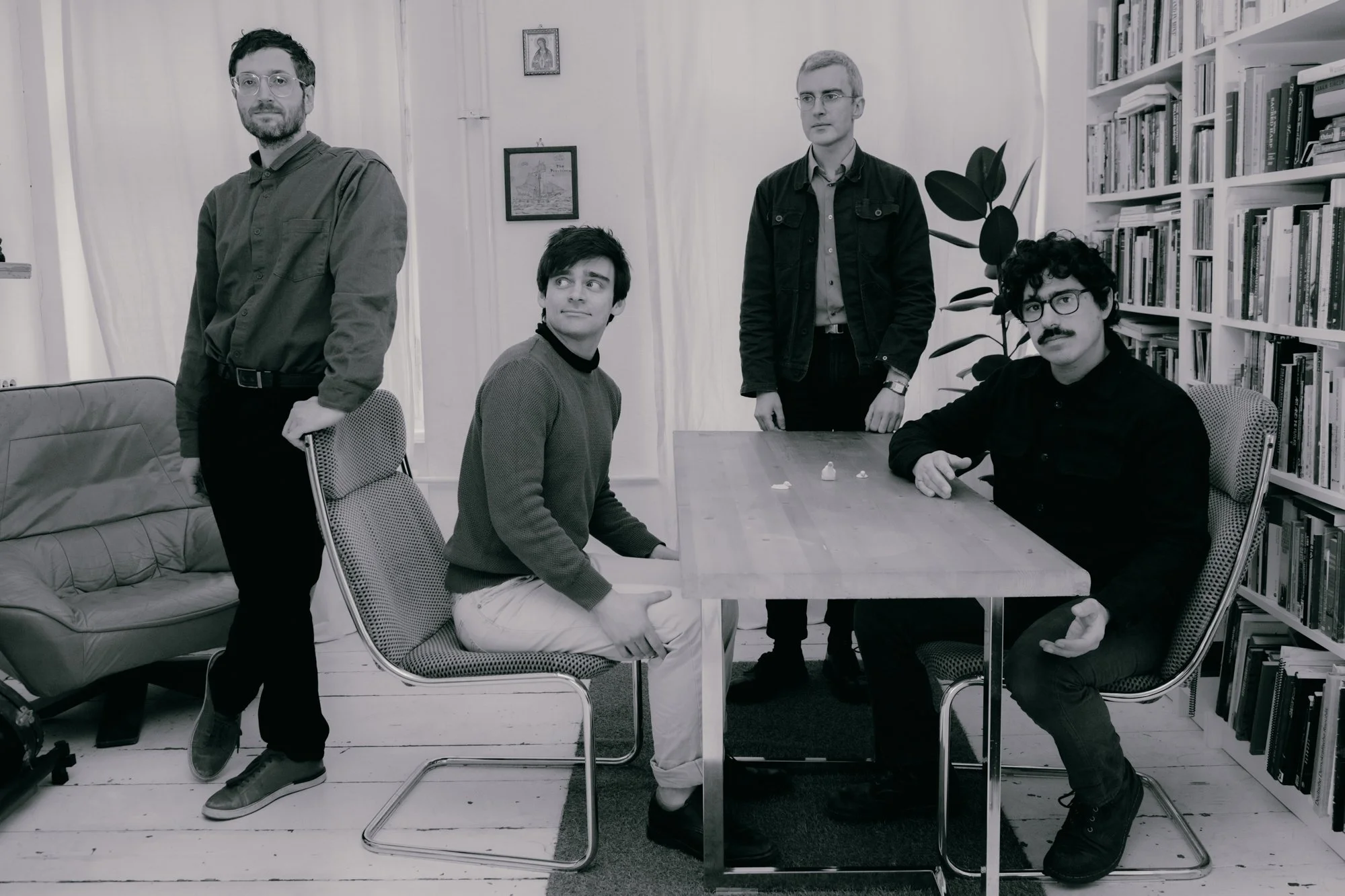
Horse Lords by Kasia Zacharko
Khagan Aslanov: One of the biggest questions on everyone’s mind, I think, is that on this album, you’re incorporating vocals into your pieces. Tell us about Sacred Harp and the decision to use shape note singing, and how you actually wove it into your writing.
Andrew Bernstein: The vocal patterns were taken from a Sacred Harp hymn, which is performed almost in full at the outset of the record. And then that material was repurposed and rearranged throughout. So it's a rotating arrangement of this piece. And we had that in mind from the beginning, when we started writing the record. We wanted this hymn to act as the keystone, with everything turning around it.
The singers, Nina Guo and Evelyn Saylor, are friends of ours. They’re trained opera singers, and are familiar with our music and with modern composition and experimental music. And so these odd meters and polyrhythmic aspects were not unfamiliar to them.
Owen Gardner: I've been involved with shape note singing for a long time, for much more time than I've been in Horse Lords. It should have been a fairly natural thing to fold into our sound, but for whatever reason, they felt separate for a long time. Maybe we just didn't have a convincing enough idea for it. Or maybe the problem was with the text of singing. I think it's always been a struggle for us in the past to deal with language. We’ve spent so long communicating without language. It’s an interesting sort of problem to have. It’s not a hindrance, but rather a productive, stimulating thing.
The particular text we ended up using on “Eureka” is from an archaic version of the shape note tradition that’s practiced in Hoboken, Georgia. Basically, it’s a transcription of men singing, which is then transposed to women’s voices. Then there’s Just Intonation and auto-tune. So in the end, the sound is obviously different. It’s a simple rhythm, but because it’s so slow and elaborate and ornamented, as you play it and hear it, you end up getting this effect – a floating feeling.
AB: At its heart, Sacred Harp is amateur music. It's meant for all people. The practice of drawing and singing the shapes is something that was designed to be accessible to anyone. It’s not a pretentious art form. And I think we approach our music in a similar way. I mean, we have our pretensions, of course. We like to consider what we do art music. But the way it’s presented is meant to communicate with any audience.
KA: The second biggest change on this album is the introduction of acoustic instruments, bass clarinet and trombone. This is a very expansive record, and it breaks quite radically from the much more insular way you composed before. How was it, making all these microtonal adjustments to get these instruments to lock into your frequencies?
AB: The players on the record, Weston Olencki and Madison Greenstone, are both top-notch contemporary concert players and composers in their own right. They have a deft microtonal vocabulary. So there were no modifications needed for the instruments, I think. I mean, trombone is pretty flexible as far as pitch is concerned. But they understood what we wanted, and they knew what to do with it. Their involvement, at least in part, came about from being in Berlin, and being part of this new community, and wanting to bring people into the mix. It’s not the first time we’ve written for orchestral instruments, we did a piece for the Peabody Conservatory in Baltimore.
OG: There were some adjustments to the clarinet, but I couldn’t tell you what those mechanics were. There are ways to use false fingerings where you can get a huge number of different pitches. And Madison is an absolute expert at their instrument. It's barely even extended technique, just sort of different kinds of non-standard standard techniques, if that makes sense.
KA: Well, just practically speaking, what did those recording sessions look like? Did the singers and players do several variations and you picked the ones you preferred? Was there anything left on the cutting room floor?
OG: Not really. We did a few takes, but it was all very similar. With the brass and bass clarinet, there was a huge amount of material that didn’t make it. They were incorporated in a very speculative way. We had a few specific ideas, and a lot of non-specific ideas that we presented to them. Both Weston and Madison are incredibly creative people. So we would tell them to play something for two minutes, and then switch it to something else – maybe play a drone next, or a particular articulation. So there was a huge amount of leftover material. What you hear on “Eureka” is also leftovers from another session. But having sopranos sing this yields these fairly strong difference tones. So the trombone and bass clarinet were placed in there to emphasize them.
The thing is, almost every bit of the whole album was recorded separately. The singers were together, and the guest musicians were together. But everything else was made without anyone being in a room together. It took a lot of doing to put it all together well. It was kind of a nightmare, frankly.
KA: The move to Berlin. Was the reason for it because the European experimental scene was more amenable to your general aesthetics?
AB: In part, but that's not the whole story. The opportunity came about in 2021. The previous year, all of our lives were upended by the pandemic. My wife got an opportunity to work here, we live in Southern Germany. And the band had been playing around Europe quite a bit in the years leading up to the move. It seemed like both a good idea and a fun adventure. It’s become a very open-ended change in our lives. Then Owen and Max (Eilbacher) moved to Berlin.
And I think the other reason, like you said, is that there's a great scene here for contemporary music and for experimental music. And we sort of slipped into it really, really nicely. It felt really simpatico with our aesthetic. We’ve made a lot of good friends and colleagues here.
KA: You’ve cited minimalist composers like Maryanne Amacher and Tom Johnson as inspirations for this album. But you’ve also mentioned concepts like Islamic geometric patterning as structural influences. I think there's sort of a mythology that has spun out around your band that when you sit down to notate music you actually write out prime number grids or permutations. It this something that actually happens? And if so, how does the process of mapping a non-linear, two-dimensional spatial grid work when you try to place it into the linear timeline of musical measures and beats?
AB: Well, it’s less direct mapping. I don't think we've mapped specific geometric designs onto our sound. It’s just a level of inspiration, how tessellating Islamic patterns interact. A scaffold, a feeling, you know?
OG: As far as writing formulas, it has maybe happened once. I mean, none of us are math whizzes or have advanced capacities, aside from Andrew with programming maybe. But it's helpful to have mapped tables sometimes, to figure out pitch or rhythm. We try not to get involved in that too much, and mostly focus on the sound itself. There are times when there is a right or wrong answer for the sound you have in mind, and sometimes you can get there intuitively or by using very simple math.
I mean these are things we think about. A lot of it is us struggling against our own ignorance. There’s another aspect with Islamic geometry, aside from figuring out how something is structured, and that aspect is that you’re encountering something sublime. And so it’s interesting to stay in that state in a real way, where you’re aware that you don’t understand it, but you’re wading through trying to figure it out, and you’re enjoying it. There’s a feeling within it that it’s intuitively understandable. I hope that’s not a disappointing answer (laughs).
KA: Lastly, I wanted to ask each of you how your path towards the avant-garde was shaped. How did you get here in your listening and playing?
AB: For me, it was a long time before the forming of Horse Lords. Max, Owen, and I played in a group together in the late 2000’s. It was more of an improvisational noise band in the late 2000s. Owen was playing cello at the time, and that introduced the idea of Just Intonation to me. We became enamored with the music of LaMonte Younge and Tony Conrad, as well as minimalist composers like Steve Reich, Philip Glass, the forebears. Then, Arnold Dreyblatt, who we got a chance to record with and play the past few years. The seed of our interest in the avant-garde was always there.
OG: For me, it was never really a shift, but sort of two parallel paths. I got into shape note quite young, maybe 12 or 13. And I got into through my parents. At first, my interest wasn’t very strong, because I was listening to artists like Frank Zappa. The folk music my parents were listening to struck me as simplistic maybe.
But fortunately, something changed. I was able to synthesize these ideas, or see that there's another way of thinking about folk music, about its potential complexity. Not that things have to be complex to be interesting or worthwhile. But once that change happened, it wasn’t a challenge to reconcile these things, that I had to do traditional music or experimental.
I found the sounds of avant-garde music appealing, and I also wanted to know not just how people do it, but why. It took a while to understand what was happening there.
Demand to Be Taken to Heaven Alive! is out now via RVNG. Intl.