
by Pat Pilch (@apg_gomets)
Shareholders rejoice; Seattle startup Telehealth have optimized, revitalized, and re-recommodified the Pacific Northwest punk scene. Fast and convenient, Green World Image arrives on doorsteps tomorrow, boasting the woes of San Francisco arriving in Seattle—today! COVID-born and partly inspired by neoliberal hell, Telehealth’s no-bullshit punk comes with a lot of tongue-in-cheek.
On a rainy evening before their Chicago show in April, Telehealth chatted with Post-Trash about the state of Seattle, food delivery robots, quitting the American dream to chase your own.
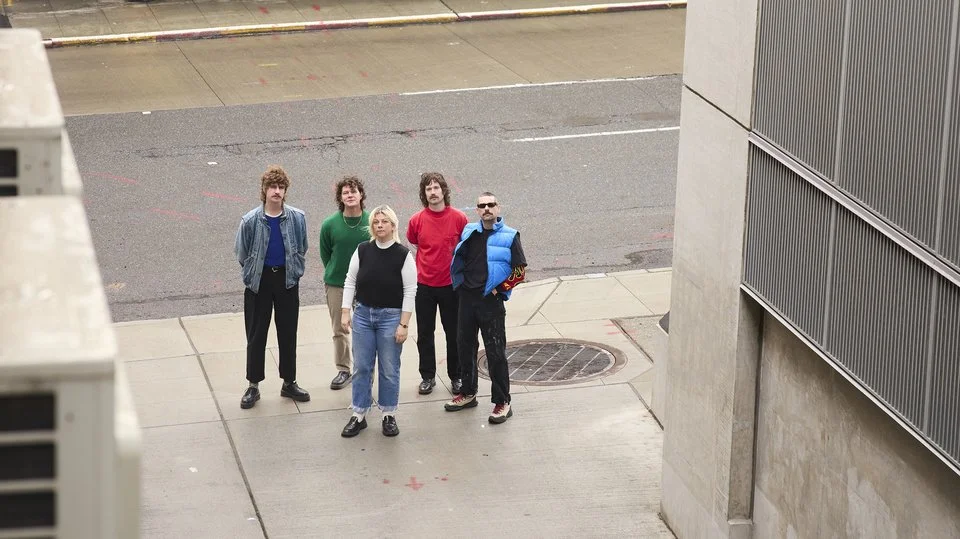
Telehealth by Eleanor Petry
This interview has been edited for length and clarity.
Post-Trash: How do you like in Chicago so far?
Alexander Attitude: It's the best, dude. Every time we come here, seriously, we go home, we're like, “should we do it? Should we move to Chicago?” I've never been on a tour where this wasn't the highlight of the show. Telehealth never played here. I played in another band called J.R.C.G. that played here a year or two ago.
PT: What projects are you in, Kendra?
Kendra Cox: Just Telehealth for now, but we both have been in and out of a lot of different bands. I've played around the Chicago area, but I never have played a Chicago show. So this is my first one.
PT: Have you seen the delivery robots yet?
KC: No, we didn't run into any, but I do hear they're out here and I hear they're a menace.
AA: Do you guys call them clunkers?
PT: I call them clankers. The first time I saw one, I got so angry.
AA: Yeah, I hear they're truly a nightmare on the sidewalk. I feel like my algorithm is mostly just people throwing Molotov cocktails and shit at those on the streets.
KC: I also have like a weird thing with these robots. First and foremost, I hate them. I think they’re stupid. But I have a sensitive heart where I'm also like, that's so sad. It's just out here all alone delivering your Thai food. You made this little fucking guy go out in the rain to deliver your food and it’s struggling to get over curbs. Go get your own Thai food. I have a weird emotional attachment to inanimate objects who are doing a task for a human. They're stupid though. I hate them. We don't have them in Seattle.
AA: Yeah, it's bizarre. You’d think a place like Seattle is rampant with those. It's a matter of time.
KC: Everything starts on the east and comes west.
AA: Whatever happens in San Francisco in two years, you see the exact same thing happen in Seattle. You saw condos for the first time downtown in like 2010? They're showing up two years later in Seattle.
KC: Follow the money, baby.
PT: Are you guys from Seattle?
KC: I'm from the area. A little town just outside.
AA: I grew up in Phoenix and I moved to Seattle when I was 18 and just stuck around.
KC: Alex and I met in 2013. We’ve been playing music together since then with all different folks. When we finished the first record, Alex was like, “what do we do with this now?” And we decided to hit up our best homies and say, “do you want to play in this band?” And that's how that happened. We've been playing off and on in different projects with this group of people for about 12 years.
AA: Telehealth is a new project. We had our first show in 2023. Telehealth was a COVID project. We started learning synthesizers during COVID, just fucking around and writing songs. We wrote a record and we finished it with a friend of ours. By the time it was done, people were starting to go to shows and there was this really sick new punk venue that felt really exciting.
KC: We played it and it shut down like two weeks later. Shout out to Cherry Pit.
PT: Tell me a little bit more, like just to go back to Seattle.
KC: It’s been an interesting little journey. I've lived there since I was 18 and I'm 36. So the majority of my life. I love Seattle, but it's changed so much, which every city does. I never want to dig my heels in the ground because it's just going to happen. A city is going to change.
So a lot of this record is about our reckoning with Seattle changing, and understanding and trying to relearn why we love this city, and why we still love the place that we live.
AA: I love Seattle so much, but I also fucking hate it. There's just a lot of stuff you see on the road, and you realize Seattle is very insular. It’s kind of a monoculture there. I think very much for me personally, Telehealth is what I want to show Seattle is like. I want to start talking about these subjects. I want it to be electronic. Like, why are we doing grunge? We're not a grunge city. We really never have been a grunge city.
KC: Alex does the majority of the songwriting. It’ll start there and then once a good demo is done, he'll bring it to me and we'll talk about structure and lyrics and melody and then we'll bring it to the band.
But these first two records have really been about trying to narrow out a place in the music community in Seattle and say or do what's missing or what gets us excited.
And honestly, it's actually been sick too, because there are a lot of bands in Seattle who are doing really cool work. Once we allowed ourselves to be interested in that mindset, we've opened up the door to a lot of other cool people who are doing cool shit too. So it's happening and things are shifting and changing, but the the Seattle price point is high and it makes making art in that city really fucking difficult.
AA: A lot of people moved during COVID. They were like, “I'm out of here.” Yeah, it's too expensive to live here. I can't do anything cool. I have no art space. I have no music community. So I'm going to move to a city and work remotely and make Seattle money in New Orleans. I'm going to make Seattle money remotely in New York and pay the same price in rent, but live in New York. Totally.
You know what I mean? Yeah. It's, that's, that's what this album is about. It's like reckoning with like, why, why are we here? Right.
And it's a question, but it's not, we're not talking shit really.
KC: It's not even a drag. It's us reckoning with the idea of what it looks like if we stick it out.
AA: It's not just this city. What we realized through touring more is this is a universal experience. We talked about the robots. It's every major city we're encountering. A lot of our lyrics are hyperlocal conversations, but they're universal topics that we're realizing more people are encountering.
But it's the same, same fundamental issues of like neoliberal politics and global capitalism of deeply affecting. Totally. Our lives.
We wrote this song, like “Things I Killed,” which is about the irony of being a millennial, moving into a city and feeling excited about it, but also knowing you're like completely complicit in killing that thing. But also being tired of being blamed for killing stupid shit all the time.
We’re writing about how it sucks that we suck. But also the situation we are put in really sucks. Ultimately no one feels good about any of it, so how can we have some fun and poke fun at ourselves about it, but also acknowledge it. And let's maybe try to do better.
PT: You had mentioned being iced out by the monoculture. Are you just talking about the neoliberal agenda at large?
AA: Yeah. I mean, without trying to sound too scathing, there's a cult in Seattle of who runs art and who doesn't run art. In Seattle, there's politic involved of who can play a show? When can they can play a show? What's their draw? In Seattle, it feels you need to be vouched by a very well known or wealthy person before you can step foot in there.
Venues do their best, let's be clear. Venues are not the problem, but it’s fucking expensive. And most of the venues in Seattle now are nightclubs first and foremost. And then they also just so happen to maybe have a show every once in a while too. Dance nights.
KC: There's a Dance Yourself Clean Indie Sleaze dance night every fucking night. You want to go to Seattle and find a small local show, you're going to have to hunt it down. So the barrier to entry becomes really, really narrow.
When we both started playing music, and maybe this is a generational thing, but we were playing house shows and DIY venues. We were playing all of these small spaces and I feel like they're becoming less and less prevalent. Now it's like, are the kids all right? Are the kids playing house shows? I hope so.
AA: Like it's, how do you build culture and community when everything around you is driven by money? And that maybe it's just like the overarching capitalist agenda.
PT: Those like indie sleaze nights make me depressed. It feels like an effect of fascism too.
KC: Oh, 100 percent, because again, follow the money. People are so willing to invest in that stuff, but will not show to a local band. They'd rather stream Spotify. People won't go out.
I'm a bartender, so is Alex. I see the culture shifting from behind the bar. When I see the culture shifting from behind the bar, I'm like, oh, we're fucked.
I do think your argument of fascism is really interesting, where it's like, under a more and more fascist regime, people want to lean more into safety, familiarity, and feeling good. We are leaning more into this hope-core kind of thing, too. We have to be very cautious of that.
We also have to push art forward. It just can't be feel good all the time. I think you're doing a good job if you're kind of low-key pissing somebody off. I think the art works best when it makes somebody feel a little bit attacked.
PT: I've talked about this with other bands, but I read somewhere that COVID parallels 9/11 in that there was this collective “what the fuck” moment that more or less became an impetus for a new generation of bands.
AA: I was working in architecture and I quit. Straight I was like, “I don't want to do this anymore.” I wanted to go back and do music full-time. I was in grad school and then I was like, “If the world is truly falling apart right now, I'm just gonna go back and play music with my best friends.”
With the pandemic, I think we saw the fabric of the culture being ripped apart. Like, nothing really matters anymore. If that's the case, I’m gonna do what I would really love to do with my friends and try my best to make that happen.
KC: Telehealth is very much like a post-COVID reflection. I think for both of us too it a little bit like opened up the door i think the sort of like ripping away of the world as we knew it especially both of us i mean at the time again you were in grad school but before that you've always been hospitality and as i buy pretty much and like it it took that away from us yeah for the first time in a long time and i think that like kind of shook everybody right. I think that made the two of us at least be like “well fuck it.” I quit two jobs from 2021 to 2023 because I got to the point where I was just going to make enough money to make the art and buy some beers on the weekend.
AA: I think we both lost our minds at heart. I’ll quit any job at this point. I just don't care. As long as the people make me feel cared for and respected and it's reciprocal, I’m down as long as I’m making enough money. But I’m not doing the grind set career. We work our asses off for this band. If I’m helping a friend, yeah I’ll work my ass off to do that, but I’m not doing nine to five anymore.
KC: You get one sack of skin to live in, you might as well live in it. The world's literally falling apart before our eyes, and it’s not like we’re the first generation that's felt this way. I think a lot of that is just living in America and is just the human condition right now. But I truly think COVID was a big old wake up call. Let's just stop trying to live the American dream and let's figure out what the fuck our dream is
AA: We reprioritized our happiness and thought less about external standards of what it means to be successful in your mid-30s. What's the dumbest thing you can do? Music. But I don't feel stupid for trying. And yeah it's brutal out there. It sucks touring and it’s not easy. We work very hard to do what we're doing and sometimes it feels like you get so little in return, but we love it.
KC: I’d be on the road 300 days a year if I could.
AA: We've been beat down so much, especially in Seattle. We’ve been rejected so often yeah i worked nine to five felt so out of place yeah yeah we tried to buy a house that was a fucking it was a nightmare. Just stay healthy, play music, live your life. Have fun, don't do weird things to each other, and try to grow internally.
Green World Image is out tomorrow May 15 on Sub Pop Records.