
by Khagan Aslanov (@virgilcrude)
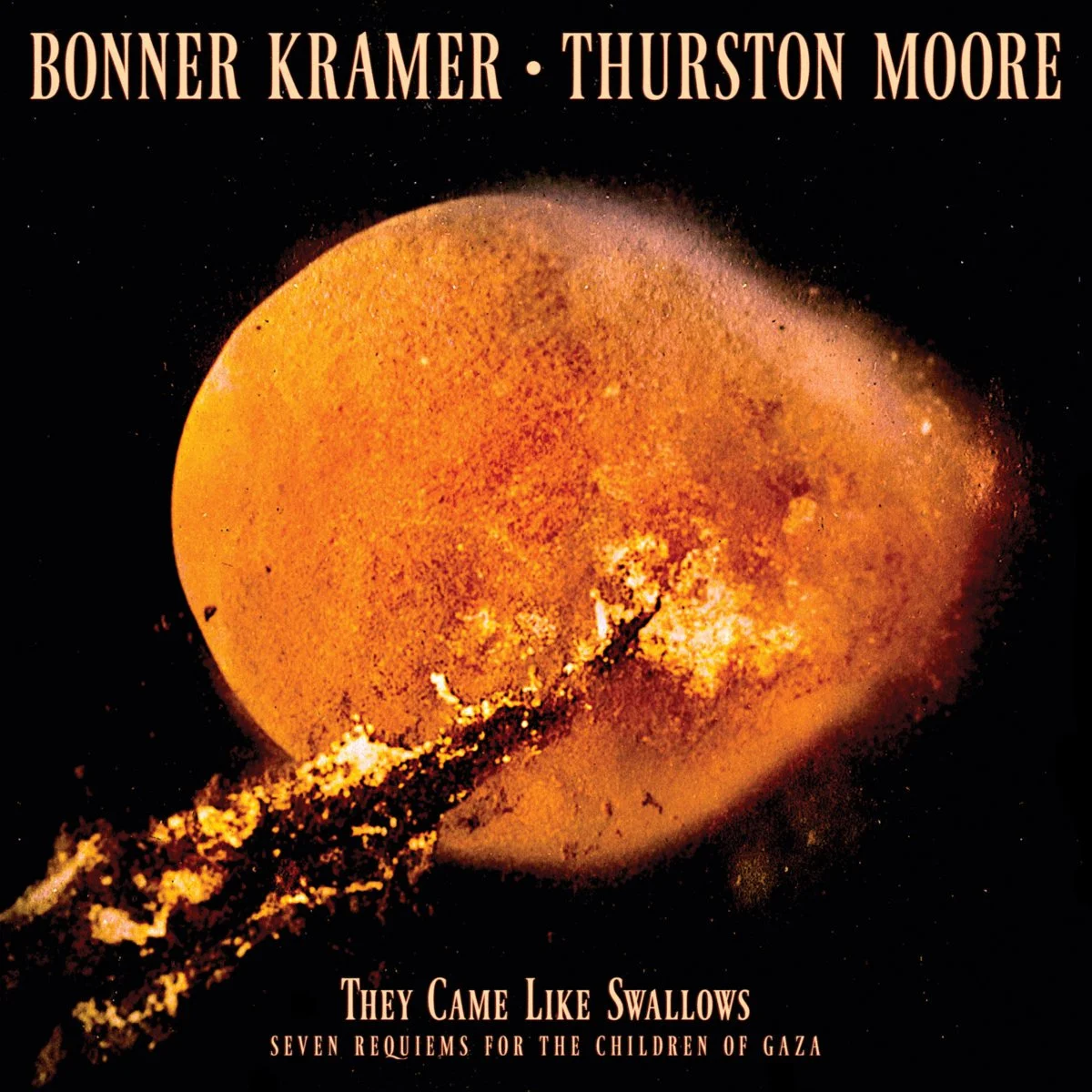
According to Bonner Kramer and Thurston Moore, the two have spent years circling around each other, waiting for some overlap of free time to open up in their calendars to get together and cut a record. Since the early 80’s, the two rock titans have charted somewhat similar paths, relentlessly carving some avant-garde breathing room into the general constraints of a genre that has come to be broadly called alternative rock. With They Came Like Swallows: Seven Requiems for the Children of Gaza, the duo finally convened in Southern Florida, to not only fulfill a decades-long dream of collaborating, but to pen a devastating lament for the thousands killed and displaced in the burning Levant.
To those familiar with Bonner Kramer’s resume, there is plenty of expected things to love here. He has always had a Midas ear for downbeat, patient songs that were both sweetly sentimental and quietly devastating. Over the course of his production career for Galaxie 500, Will Oldham, Low and scores of others, he has helped usher in some of the most enduring records of subtly haunted and highly personal music out there.
On the other hand, fans of Moore who are expecting a manifest of his inextinguishable hunger for squalling frequencies at devastating volumes have another thing coming. The noise maestro plays it close to the chest here, willingly plaiting into Kramer’s melancholically cresting draperies. The contrast he provides isn’t a usurping force, but amelioration, small buzzing bursts to let you know there is still life beneath the mourning.
In some grotesque way, it makes perfect sense that in that stifling, swampy, reactionary Florida heat, Kramer and Moore were able to forge something so poignant, so shatteringly humane. As Moore’s textured fretwork scrapes gouges and prods at the bedrock of Kramer’s organ and strings soundscapes, They Came Like Swallows becomes something more than a dream collaboration or a simple elegy, but a liturgical dissection of unrelenting grief.
For all the nuance the pair sink into the album, it feels oddly lean and graceful. On “The Redness in the West,” Kramer mounts an elegant push-and-pull between the viola and cello, while Moore uses high-strung sustain, and taps out a beatific pointillist plateau. On the title track, Kramer’s organ enters a vertiginous, concentric swirl of psychedelia.
The penultimate requiem, “The Oceans are Crying,” is a wonder, and perhaps the finest track here. Mirroring the patterns of opener “Urn Burial,” Kramer brews a sequence of slowly seething drones that feel as if they’re dissolving from the outside in. Moore leans into dense, complex timbres and deconstructive signals, punctuating rather than merging. In that mounting wave of high frequency feedback and low end oscillation, the tragedy and loss Kramer and Moore attempt to project comes to life in full force.
And then there is “Insight.” The cover has already been making the rounds, and if anyone was ever in doubt that they needed an ambient noise rework of the Joy Division ode to reaching a state of artful nihil, “Insight” should put their trepidations at rest. Peter Hook’s bassline is pushed to the very front, dwarfing the synths and ticking percussion, and where the original revelled in its cavernous minimalism, here, it enwraps the listener into a thick, warm swaddle. As Kramer and Moore softly intone “I’m not afraid anymore” as a desperate mantra, the guitar briefly squeals to life, and then, just like that, it’s done.
Beyond the colossal level of technical skill, improvisational brio and the searing activist frustration that anchors the record thematically, what Moore and Kramer create here is also something that is just starkly beautiful. And in that sense alone, They Came Like Swallows is already a triumph – a ragged, exhausted exhale on all our behalf.