
by Benji Heywood (@benjiheywood.bsky.social)
It’s hard to know what to make of the world around us. Is the world ending? Or is this just another turn in the dialectics of history, where moments of beauty and terror appear in equal measure?
The music of deary exists in a similarly liminal space. The London-based dream-poppers can be at once blissed-out and barb-wired, making music that would feel at home on a mix with both Cocteau Twins and Massive Attack. The band’s debut album, Birding (out now on Bella Union, no less), is at first blush a love letter to the waves of guitar and reverb from decades past. But the trio of guitarist Ben Easton, vocalist Dottie Cockram, and drummer Harry Catchpole are after something more.
We sat down with the band to talk about their formation, authenticity versus nostalgia, and how the tremendous power of the natural world can be at once mesmerizing and savage.
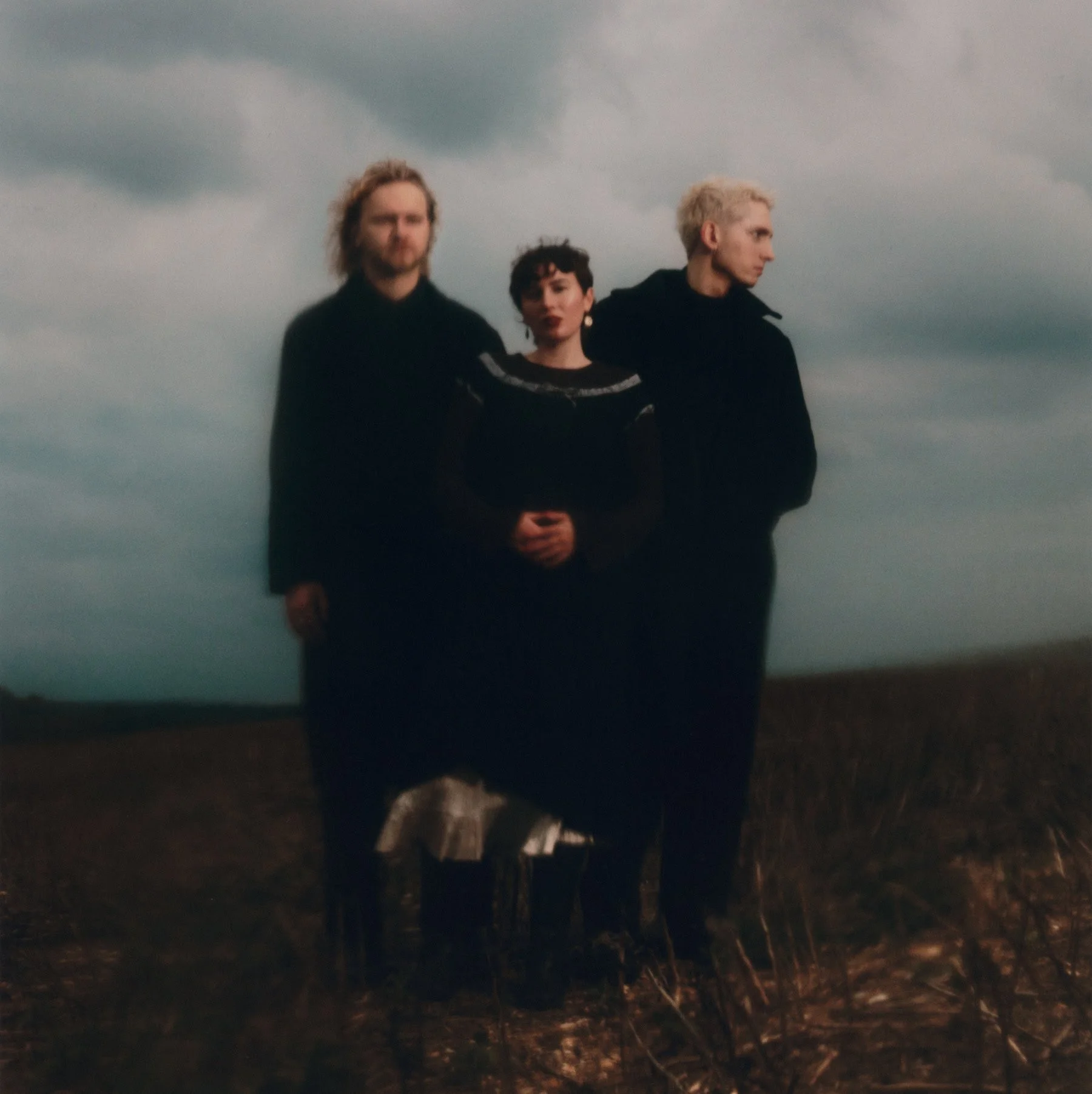
deary by Josh Hight
This conversation has been lightly edited for length and clarity.
Post-Trash: I heard you met at a pub, is that right?
Ben Easton: Yeah, was it the Royal Albert in New Cross, South London?
Dottie Cockram: Yeah.
Ben: It sort of half felt like a weird first date…
Dottie: All we talked about was music.
Ben: An hour in and we were already best mates. It all felt very natural. When we went our separate ways, it felt very exciting.
PT: Had it been set up as a date? Or was the meet-up always meant to be about music?
Dottie: Music! (laughs)
Ben: We met up with the intention of working together. Well, and Dottie was making sure I wasn’t a weirdo. (laughs)
PT: Where was your creative headspace at the time?
Ben: I needed some sort of music goal. Lockdown had just finished and I found myself at home. I bought a new guitar, bought some new pedals, with the view that I really wanted to make a lost 80s indie band thing. I started writing some demos, and then after a while, realized that, oh, actually, I need someone to sing over top of it. And it took about a year of messaging people to find someone who was going to work. Dottie and I were introduced by a mutual friend. When we first realized that we were both massive fans of Elizabeth Fraser and MBV, we just knew this is actually going to work really well.
PT: Dottie, were you singing in a band previously?
Dottie: I’d been making music for a while, but I’m kind of a scatter brain. I’m not very good at releasing music. It’s all on a hard drive somewhere. But, yeah, I met Ben and thought it was a really good opportunity for me to not have to necessarily think about everything, because when you're a solo artist, you have to think about absolutely everything. With Ben, he already had a set of demos. It was more fun, a bit more explorative. I could just write and sing over (the demos) and have a bit like less pressure, because I had someone I could bounce ideas off.
PT: Harry, how did you get involved?
Harry: I was living in Manchester and putting videos of my (drumming) online. I had plans to move to London already and I did a cover of—was it Beach House “Levitation”?
Ben: Yeah that one was cool.
Harry: And then I did another one…
Ben: The one that really stuck out to me was your cover of Caroline Polachek’s “Spring Is Coming with a Strawberry In Its Mouth.” I was like, this guy is fucking amazing.
Harry: Their reaching out happened to coincide with me moving to London. I was looking for a project like (deary) to join. I’ve been obsessed with this kind of music for a long, long time, both from my parent’s record collection and my own, so joining was an absolute dream.
PT: The first thing that struck me about the band are the drums on “Seabird.” As someone who is old enough to remember the first wave of dream pop bands, the rhythm sections weren’t always as prevalent, or as groove-oriented as deary. Harry, what was in your mind stylistically rhythm-wise that you thought would be cool to add to the band?
Harry: That’s a good question. The band brings real ethereal moments but there’s a lot of trip hop elements as well, which is really drummy. I knew I had to be very precise about my note choice to leave room for melody but also, like, play the shit of it. I wanted to make my mark.
PT: There are several moments on this album that are reminiscent of Massive Attack’s “Mezzanine.” It’s like a dream pop version of that album. How do y’all go about putting together an album?
Ben: Usually everything starts with me and an idea and I'll send it to the guys. Nine times out of 10, they've got a million notes. All of us have a say in the songwriting. But with Birding, a lot of it had already been floating around for quite a long time. We were kind of knocking around these demos, and then each of us had to put our own stamp on it our own way.
PT: And all the songs on the album came about that way?
Ben: Not all. There's a track called “Terra Fable,” which was something that Harry and I had been jamming in soundchecks. That was one of the last tunes that we finished, and it came out of absolutely nothing.
PT: Dottie, how do you think about performing in a studio environment versus performing live?
Dottie: Recording in a studio I find is quite difficult, because you're constantly aware of every little note that comes out of your mouth. You want everything to be perfect, but that can kind of ruin everything. You want to be authentic, you want these magical moments, little trills of the voice that are kind of heartbreaking, mistakes where Ben will say, like, do that again! Whereas live, because everything is kind of right there – we can be quite loud – my vocals aren’t necessarily the pivotal point so I can feel a little bit less intense about every note, which is the beauty of live music.
PT: You’ve mentioned Liz Fraser is an influence. Where does her influence guide you and where do you separate from it?
Dottie: I love how playful she is with her melodies. When we're writing for the band, we want different melodies to pop up and be this kind of magical experience – and Liz does that quite a lot with very different melodies. Then there’s Adrianne Lenker, who uses repetition in her melodies and there’s a meditative quality to that I really love. I try and bring a little bit of both.
PT: deary straddles a liminal space between paying homage to the dream pop and trip hop greats and forging somewhere new. What is the role of nostalgia in your writing?
Ben: During the – let's call them the wilderness years, the 10 years of sort of trying to make it in a band – there was a lot of pressure on authenticity and being completely different to whatever else is out there. And you can't really be.
PT: How so?
Ben: We were just in Rough Trade West in West London doing a little promo thing and we were looking at all these records on the wall by all these amazing artists, and we were like, there's, there's so much good music out there that you can only be authentic by being yourself.
PT: I read that you said the first deary recordings were you trying to sound like deary, but this album, Birding, is you sounding like yourselves.
Ben: Yeah. It's not that you can't be authentic. But there's so much that's gone before us that it's hard not to be inspired. You listen to a record and wonder, how did they do that? Since I was 15, I've been trying to figure out how MBV made Loveless. It comes more from a place of curiosity rather than nostalgia.
PT: The sound of this record makes me think of how starlings form these amazing, syncopated shapes in the sky that seem to breathe and morph on their own.
Dottie: Murmurations!
PT: Yes! Murmurations.
Dottie: I live in Brighton. Murmurations are a well-known thing in Brighton. At a certain time of the year, everyone flocks to the seafront about four to five pm and you can see all these birds swimming around in these shapes in the sky. It's just amazing. And it’s absolutely nothing to do with humans. You just stand there in awe of this amazing thing.
Ben: When we were doing the record, we recorded in a studio that was on the seafront in Brighton. Me and our producer, Iggy, would go and stay with Simon and Abby Raymond, who run the label, and we would drive to the studio along the seafront, and then back. And the weather would either be really terrible or really lovely, day by day. And I remember going back and forth along the seafront. And when it was sunny, the sea was calm, and then that day's recording would be positive. Some days it was shit, and the sea was really aggressive, and I would feel super anxious. And I don't know why, but I think that influenced what we were doing. A lot of it is about how insignificant you feel as a human being because of nature, both in its beauty and its savageness as well.
Harry: Thinking like that, the insignificance, it can be a really calming state of mind.
Ben: Exactly. I think that's where the album finds its middle ground. Some of the tracks on the album are dealing with really, really horrible stuff, and some of the tracks either deal with or sonically represent nice things as well. So, there's a dynamism that we were really conscious about to make sure that the album’s not like, all hopeless, and it's not all lovey-dovey either. Somewhere there's a balance.
PT: I mean, that’s how life is. The good and the bad aren’t separate things. It’s all one thing.
Ben: We played a show in Paris on the 24th of February, 2025 and 25th of February was my birthday, so we spent my birthday in Paris and had a wonderful gig. It was a sold out show in Paris, an amazing experience for us. And on the way back from from the gig, I got three emails within the space of an hour – one from my freelancing client who said we can't pay you, one from my landlords that says your rent is due, and then one from the tax man that said you owe us tax. And I couldn't help but feel completely anxiety ridden, even though we just spent this lovely day in Paris. The day after that, I woke up and had a panic attack, total break down, crying on the floor. Just terrible. A day after that, I got some pills from my doctor, and they said it was going to take about three weeks for them to kick in, then exactly three weeks to the day I wrote “Baby's Breath” and “Gypsophila.” That definitely was a moment for me where I was like, oh, there's some kind of beauty in the in the horror of whatever was going on.
PT: Do y’all have a favorite bird in either in real life or folklore?
Harry: I find birds with mimic ability to be unbelievable. I've seen so many videos of perfect mimics, really creepy ones, making sounds of babies crying, and you literally cannot tell if it’s really a baby or not.
Ben: The Vultures in “Jungle Book,” because they’re characters for kids but also representatives of death. That same sort of dichotomy we’ve been talking about. Light and shade.
Dottie: There's a cool poem called “Woodpigeons” by Vicki Feaver that I found in this bird poetry book when we were writing the album. I always turn to poetry when I need a little bit of a push in the right direction. And this poem is talking about these army generals sat around a table, and they're discussing how women tend to be able to handle things more, because they keep so much of themselves back. And the commander's wife is there, and she's serving them dinner, and they're eating this woodpigeon, and they’re talking about how gristly the meat is. And so, she goes to get knives, and then the last line of the of the poem is her with these knives in her hand. And they’re described as a “bouquet of dangerous flowers.” And I just thought that was really cool.