by Pat Pilch (@apg_gomets)
In no particular order, Burlington’s Robber Robber would like to confuse, scare, and charm. Their new record, Two Wheels Move the Soul, hits all those marks and more. The band’s sonic chaos by way of four-piece rock band combines the best of experimental and pop, making Robber Robber’s music equally confounding, satisfying, and profound.
Like a horror movie or siren’s wail, Two Wheels Move the Soul’s cryptic beauty is the heart of its allure, and it is easily one of the best records of 2026. Last November, Post-Trash chatted with Nina Cates and Zack James about the Burlington scene, the best and worst of Red Hot Chili Peppers, and the creative groove they’ve settled into with their Fire Talk debut.
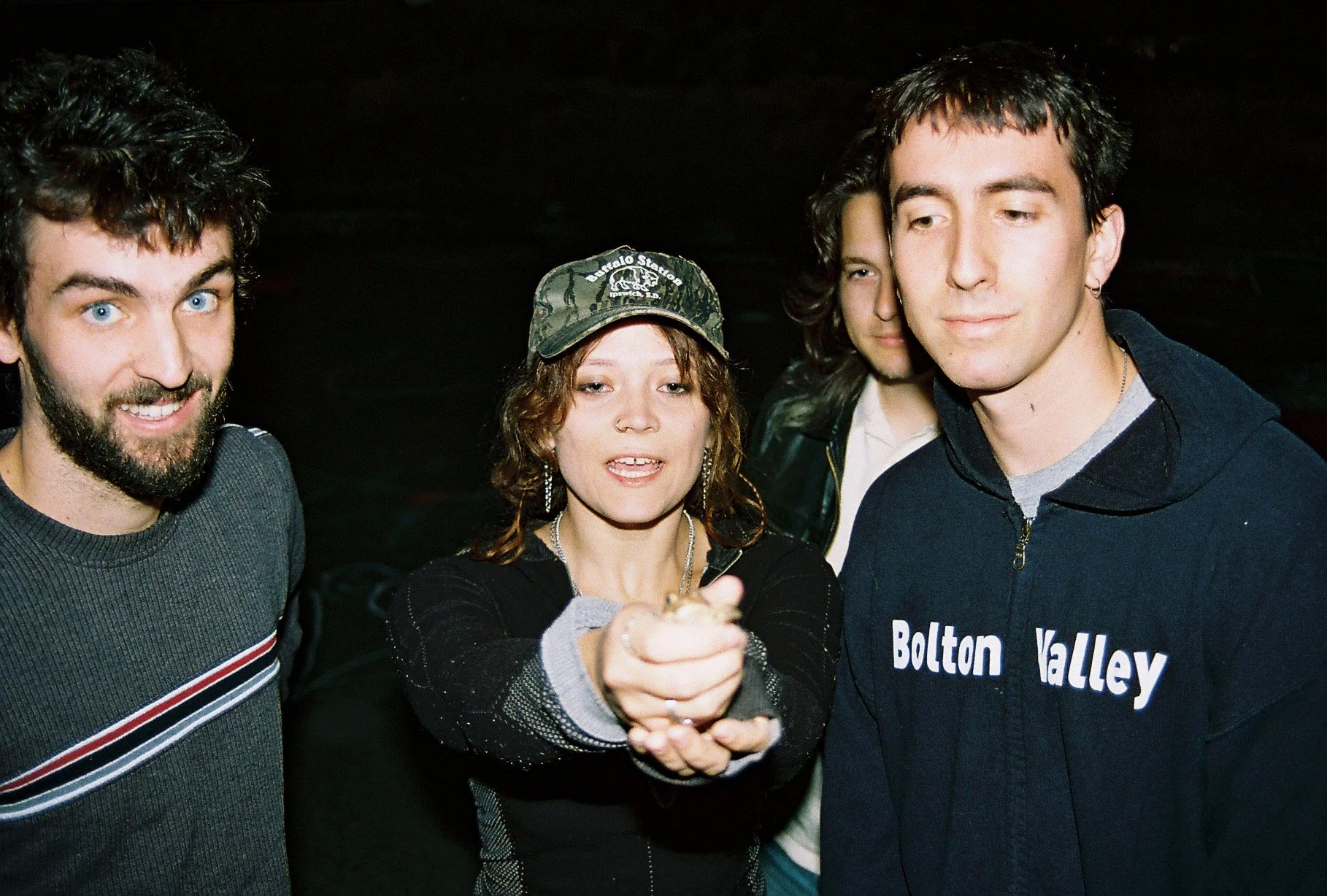
Robber Robber by Jackie Freeman
This interview has been edited for length and clarity. From November 2025.
Post-Trash: Robber Robber started back in 2017 when you moved to Burlington, right?
Nina Cates: Yeah, pretty much. We were writing songs as a duo back then, but we hadn't really figured out exactly what we wanted to do. The project had a different name. I partially feel like Robber Robber started when we changed the name and figured out the sound.
PT: What happened around that time when the sound started changing? What were the intentions set, if any?
Zack James: Just setting any intentions was a change. We wanted to approach the project with more intention and we wanted to make a debut album. We wanted the album to be something we could work really hard on, tour a lot on, and feel good about.
NC: At first, I felt like the project was like, “can we write together?” And it was just sort of testing the waters. And then it was like, “OK, we can. Now what do we want to write together.” You can see the progression a little bit through the first trial EPs. Then Wild Guess was when we were like, “OK, this is where we want to aim.” Now that we figured out how to tell each other what our creative ideas are.
It's easy to be friends with people and play music with them, but it's hard to tell them like, “I don't fuck with that idea.” And also to receive that feedback and then move forward in a productive way.
PT: Can you talk about how that happens between you two?
NC: I think we've both developed a slightly thicker skin about it. Coming off of Wild Guess when we were writing like a bunch of new stuff. So it's not like we’re building this world of Robber Robber out of nothing anymore. We have some points to fall back on for reference. We’ve both gotten better at not taking it personally too, when the ideas are just different. That said, it's still hard. We're no masters.
PT: There's a lot of imagery involved in your music. I'm curious about what your creative backgrounds are in tandem with music and how that may influence, if at all, the music that you make?
NC: We're both very visually creative people too. I went to to UVM for studio art and psychology. Zack didn't study art, but he has a very artistic background. He does most of the graphic design for us too.
ZJ: We have pretty different tastes, in terms of what we grew up listening to and what our interests have been in the past. That initially felt like a challenge, but we've leaned into that.
Coming up in the same scene as kid, we also share a fundamental understanding of one another. I think having that baseline, like a deep seated connection makes it a lot easier to smash together those surface level differences.
NC: As far as visual elements go, I think that's one of the things I really fuck with about like being in a band. There are little side quests like making music videos and designing merch. There's always something else to try and wrap your head around and figure out how that fits into the world of the band. We all came up in DIY, so there's no team helping with visuals or anything, you just have to figure it out.
PT: Can you tell me about your surface level differences?
ZJ: We both had our formative artistic awakenings around very different art. I definitely grew up listening to a lot more rap music.
NC: I was listening to a lot of Destiny's Child and disco. Zack's dad is a musician and his granddad was too. My family are music appreciators, but they've always been incredibly supportive.
I think we started playing in bands when we were around 13. Zack's upbringing by musicians was definitely influential to me also in how to think what about a song I appreciate.
I was writing songs when I was a teenager for years that I hated. And I was like, well, I'm writing songs. I'm not really proud of them. It took a while to be like, “What do I really fuck with about a song? And like, how can I bring that into the songs that I'm making?”
ZJ: As is the case with anyone, you can be looking at the same thing or listening to the same thing and be interpreting it totally differently. That definitely happens with us a lot, but that's great. Instead of letting that get in our way, that's kind of where the magic happens.
It's cool to collaborate with people who are exactly the same page. But then having no idea can be just as surprising. You can really push the boundaries of your own taste as much.
NC: I would say that on the first two EPs there was more of a point of tension. It definitely still happens.
ZJ: At this point, we're pretty locked in.
PT: Nina, as a listener, what parts of songs would you lock into?
NC: Growing up, I would really lock into the vocals of a song a lot. I was definitely very lyric and melody focused. Then I started playing bass. That was like my first instrument when I was in fourth grade.
Zack would point out things about songs that I would never have considered, like textural elements and a unique song structure I hadn't initially thought about. Now I've really leaned into that. We both will listen to literally almost anything.
ZJ: We both really put emphasis on trying to enjoy things that we didn't previously enjoy. A big part of the Robber Robber thing is embracing things that you're surprised by liking.
PT: What are you listening to right now?
NC: Our listening habits devolved over our recent tour with Dari Bay. But one that totally knocked me out of the water this year was that Nourished by Time record, The Passionate Ones. That shit was so good. That new Tobias Jessup Jr. single too, “I Love You.” That was amazing.
ZJ: We listened to that new Smerz remix album the other day. That was really good. Dem Franchise Boys. I like the new xaviersobased EP that just came out.
NC: We were on tour with Graham Hunt, and I've been so obsessed with his set.
PT: One of my favorite parts about Robber Robber's music is the transitions. How do you approach taking the next steps in a songwriting process?
NC: We think a lot about it being natural. Sometimes it’s cool, but I have a pretty negative reaction when I'm like, “this was just two different song ideas that they taped together.” That'll ruin a song for me.
We had a CD of By The Way by Red Hot Chili Peppers. No shade on the Chili Peppers. They’re amazing. But that record has a lot of moments where I'm like, “that was just two song ideas that came together.”
PT: Yes, they do that all the time.
NC: It can ruin the vibe of the song. Like “Zephyr Song.” It is so cooked. The verse, for me, is so sick. Maybe it's just the fact that I don't like the chorus of that song very much.
I appreciate physical media so much. A couple years ago, when my Spotify wrapped came out, I got the badge that was like, “you like to listen to songs front to back or albums front to back.” And I was proud of that. But By the Way is a tough listen front to back.
PT: “Can't Stop,” which is a good song, is two songs.
ZJ: I agree. I think “By the Way,” the title track, is like two songs also. I think that's like a top 10 really good song. It's one of my favorites. They just don't overthink it either, you know? They just do whatever they want. And Rick Rubin's like, whatever. Just be you. Be yourself.
NC: I appreciate that so much about them. I guess in the end, there is nothing truly negative about doing that. It's just something that I tend away from. And I think it raises a red flag for me when a song feels too much like that.
ZJ: It's risky and it's weird, which is kind of fire. I don't think the parts we tape together are something that we wrote last week combined with a voice memo from two years ago. It usually all comes out at the same time, even if the parts sound really different.
NC: We're never like, “here's three different song ideas I had.” And then they become one song. We start writing the song and then build the other parts off of the prior part, even if they're mad different.
PT: Can you talk about how the Burlington scene has influenced Robber Robber? I spied Lily Seabird among a couple other musicians in the “How We Ball” video. I know Greg Freeman directed the “Sea of War” video as well.
NC: Yeah, Greg was in the “How We Ball” video too. So was Merce [Lemon], actually. We all went to school, but none of us, not Lily or Greg or any of the members of Dari Bay or Robber Robber, went to school for music. It took us kind of a second to be like, “yeah, music is actually truly what we want to do.”
We were all musicians for many years. Playing music together with those guys inspired us to start this band in the first place. I think we've all been sort of emboldened by each other a bit. Seeing Lily book that first DIY tour, we were like, “Oh, I didn't know you could tour if you didn't have any help like that.” It made us all want to start pursuing that in a more real way.
ZJ: Seeing your homies book a tour and make an album, you're basically starting to create a music scene together.
NC: And we would all go on tour together, too. The first ever Lily Seabird tour was also the first ever Dari Bay tour. Then I joined Lily Seabird, and we would all tour together with that.
There was no guidebook for how to start a band and how to try and build a band, especially in Burlington, Vermont. For years when we were going to shows in school, it was all basement shows. There's so much shit about how the music industry works that takes a really long time to learn, and doing it all together as friends was really enlightening and made us all believe in it a little bit more.
There's this tendency that happens in college towns where people will start bands and then when they graduate, they're like, “okay, we're done with that. That was a college thing.” For the most part, we didn't get cranking on the bands until we all graduated.
ZJ: During school, we were getting ready, putting some of the pieces together, playing some shows and touring. Once we were all done, we were like, “Oh, awesome, now we can really do more band stuff for a sec here.”
Also, sadly, I think a lot of aspiring musicians probably find themselves in a situation where for some reason it feels lame to take it seriously or take yourself too seriously. It feels naive or whatever for wanting it. But that was so not the case for us. We made it very normal.
NC: Also, obviously, Lily and Greg are both amazing songwriters. I think everyone together has been upping the ante for what will fly. None of us are letting ourselves release anything that we don't fully stand behind. I think that's led by the example of our friends.
ZJ: The second that someone was like, “Oh, Burlington, Vermont has a cool music scene,” and they were talking about us and our friends; that was the coolest shit ever. Never thought anyone would ever say that.
NC: It's such a weird, obscure little town. I feel like it was earlier than we thought where people were like, “Yeah, these guys are doing something unique.” Which, who knows? It's not even that unique. There's a bunch of cool scenes around the country.
PT: Burlington's pretty cool.
NC: It is cool.
ZJ: Yeah, we fuck with Burlington heavy. Yeah. We love Vermont.
PT: Tell me about working with Benny Yerko at Little Jamaica.
ZJ: Benny's awesome. That's our boy. We're about to go eat burgers with him right after this interview. He's such a creative guy. He doesn't freak out about the technicalities of engineering and stuff. He's a very music-forward engineer. He's just got such good taste in gear and vibes. His studio is such a down to earth pro studio. He's just got really nice old preamps that he drives pretty hard. You hear the playback of your take that you just did. It already sounds very good and very warm.
NC: We had been hanging out at the studio because we were buddies with him and also because Lily was doing some recording there. We already felt pretty comfy when we started recording Wild Guess there.
ZJ: He wants you to make the most messed up sounding thing possible, which is cool. Your worst fear in the studio is that you'll want to try something crazy and the engineer will roll his eyes at you.
NC: He's very much the opposite. There was this one moment on one of the newer songs that we recorded where something weird happened when Carney hit the bass pedal off and it sounded like the speaker tore in half. It sounded like a crazy paper shredding noise.
And Benny paused it and he was just cackling. He was like, “This is so sick.” And we kept it. It's the weirdest, happy accidents that are totally welcome. He's got this tiny little battery-powered Fender reverb amp. Some of the guitar leads were doubled on Wild Guess off of that.
It's a really beautiful balance between very experimental and also a very nice, awesome, totally solid professional studio. We were so lucky to have it in town as a resource.
PT: What do you hope people take away from Two Wheels Move the Soul?
NC: I feel like it's what we were trying to do with Wild Guess. We’re going off in a lot of different directions, but also trying to make it nice and cohesive, and with more practice. I feel like my lyricism has gotten a lot stronger. I'm a lot more proud of the lyrics, looking back.
Having Wild Guess as a launching off point emboldened us to go a little further with some of the experimental shit. But we’re always trying to make accessible-ass rock music, too. We still want it to be immediate.
A couple of the songs we wrote were based off of jams with the whole band. Some of them started with a jam at practice and then we took it home and Zack and I distilled it and arranged it.
ZJ: We've decided that we really love the four-piece rock band thing. But we also love the laptop music thing.
NC: I fell in love with this dinky little Silvertone practice amp that was actually Lily’s. Lily had this one and I tried to buy it off of her a bunch of times and she said it's special to her. So I found the same one but it's got this cunty leopard print on it. A lot of the guitar leads were either doubled or recorded on one of these little guys.
ZJ: Another piece of gear that we use a lot is Benny ordered this mic off of Temu. It was just the worst sounding mic we had ever heard. And we were like, “Wow, this is a truly, truly awful microphone. Unusable. We should use this on every song.” We used it really heavily.
NC: It's really more fun that way, I think. It’s a little bit more surprising. The surprise within the process is good. Also, Zack mixed Two Wheels Move the Soul by himself, which is different.
ZJ: Yeah, I mixed it when I had the flu.
PT: You and Michael Jordan.
ZJ: Exactly, this album is my flu game.
Two Wheels Move the Soul is out now via Fire Talk Records.