
by Jade Marantz (@jade.marantz)
Julianna Barwick and Mary Lattimore take the listener to a parallel universe with Tragic Magic. The duo, in collaboration with the Philharmonie de Paris and French record label InFiné, used historical instruments from the Philharmonie’s Musée de la Musique to create an album of experimental tapestries of sound. Recorded in Paris over nine days, the album is composed of improvisational, yet still highly focused blends of soaring 80s synth patches, soothing vocals, and an intriguing array of historical harp textures hand-picked by Lattimore from the archival collections of the Musée.
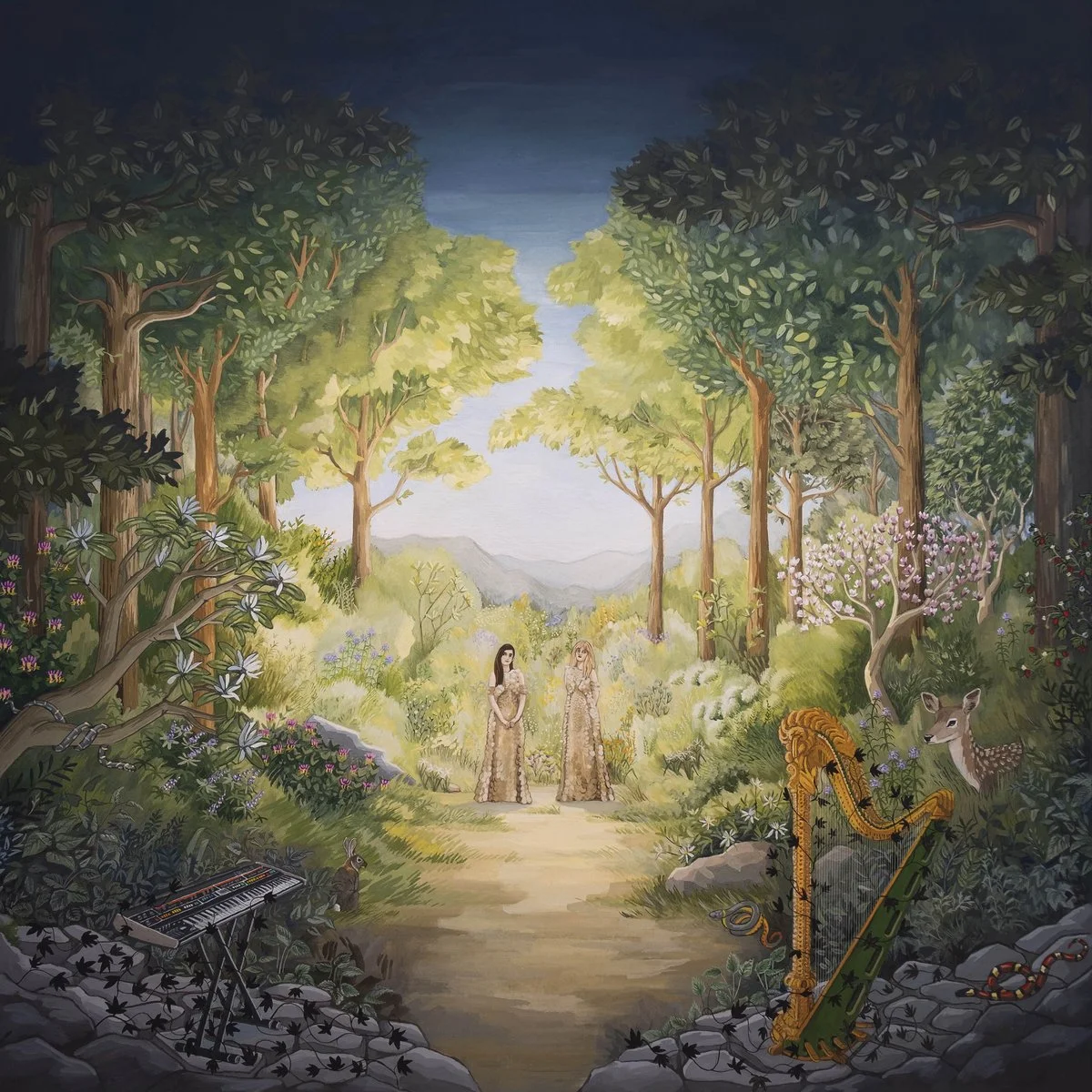
The album art, illustrated by multi-disciplinary artist Cat Solen, is the perfect visual complement to the sonic fairy world within. As I look at the album cover and listen to the opening track “Perpetual Adoration,” I can’t help but be transported to my childhood summers spent in the local garden store, which had a plentiful selection of soothing new age playing over the speakers, while I dutifully searched for supplies for my fairy gardens. The otherworldly, organic quality of this album will appeal to those who enjoy indulging in fantasy worlds, and may invoke a nostalgic feeling for those that, like myself, spent significant portions of their childhood pretending to be a woodland sprite. This sense of play and imagination may lend itself to the long-term friendship of Barwick and Lattimore, who had known each other for over a decade before this project. As much of the album was built from the duo’s improvisatory experiments, this relationship no doubt added a unique emotional depth to the finished product.
Each of the seven tracks, while remaining distinct from one another, are connected by a gentle insistence of their respective textures, motifs, and messages. A patient aesthetic emerges, one that does not force itself upon the listener but rather warmly invites them into the sound world of the album. The combination of antique harp textures (the oldest instrument on the album being a German Hӧchbrucher harp from 1728) alongside celestial 1980s synth patches creates a parallel universe outside of our average sense of time. In a conversation with Barwick for Talkhouse, Lattimore discusses the task of making a record with archival instruments: “I think in my mind…it was like, ‘OK, because these instruments are so old, we want to make something that sounds timeless.’ You don’t want it to sound like a 2025, 2026 record. Not too modern, like, ‘Let’s mess around with the computer.’ We didn’t really fuck around with the computer. We wanted to really showcase the instruments and have the record stand out of time a little bit.” The music itself often plays with a pseudo-Renaissance feel in its polyphonic texture and modal cadences, heard, for instance, in “Temple of the Winds,” composed by Roger Eno. Other tracks, such as “Stardust,” feature the synthesizers chosen by Barwick from the Philharmonie’s collection: a 1982 Roland Jupiter, a 1970s Sequential Circuits Prophet-5, and a 1980 Korg Vocoder VC-10. “Stardust” additionally stands out as the only track to feature a synthesized drum beat, fading into the texture about two thirds of the way through the song.
A large facet of both Lattimore and Barwick’s solo careers is their use of pedaled effects, particularly looping, to enhance their acoustic instruments (harp and voice, respectively). Barwick compares the experience of performing Tragic Magic with her previous work: “I used to position my station when playing live so that a curtain of hair fell between my face and the audience, and then my music kind of was the same thing — loops and layers and wordless and a fog of sound. And this record is definitely an exercise in feeling very exposed. Which, I think when we made the record, that was kind of wanting to give homage to the sanctity of the experience in a way.” Rather than blurring or confusing the sound, the effects on the album serve to expand and deepen the world of the duo’s performance. As Barwick alludes to here, the album feels intimate in its presentation.
The two Los Angeles-based composers have discussed the challenges of recording this album in the midst of the devastating wildfires last year; although they were physically removed from the situation while recording in Paris, the sadness and worry they felt at the time is cited as a component of their creative process. The patience, openness, and lucidity of the album allow ample space for the interpretation of both the composer/performers and the listener; as motifs repeat and slowly develop and build upon one another, one is immersed in a world of feeling. Although the album is mostly wordless, its texture gentle and calm, this does not make sentimental connection to the listener’s ears any less effective. The album Tragic Magic is not only a fascinating product of electro-acoustic composition, but also a story of friendly collaboration and the fruits that can grow from institutional support of open-minded experimentation. This project is impossible to box into one genre, making it a refreshing listen and a unique addition to the collections of those who appreciate music history, electro-acoustic innovation, and improvisational performance.