
by Myles Tiessen
“Looking out across the tracks at the late summer trees which now grow even more darkish-green in the twilight, I longed for my train to back then,” writes William T. Vollmann in Riding Towards Everywhere. The experiential American author and essayist, in the midst of his slowly crumbling marriage, was catching out in the boxcars that rode the steel tracks cutting through his home nation. Vollmann recounts a self-deprecating hollowness he finds within himself on the rails. This emptiness is intertwined with his longing for a promised land in people and places, where oblivion gives way to a new light, shining brighter than ever before—a place he calls Everywhere.
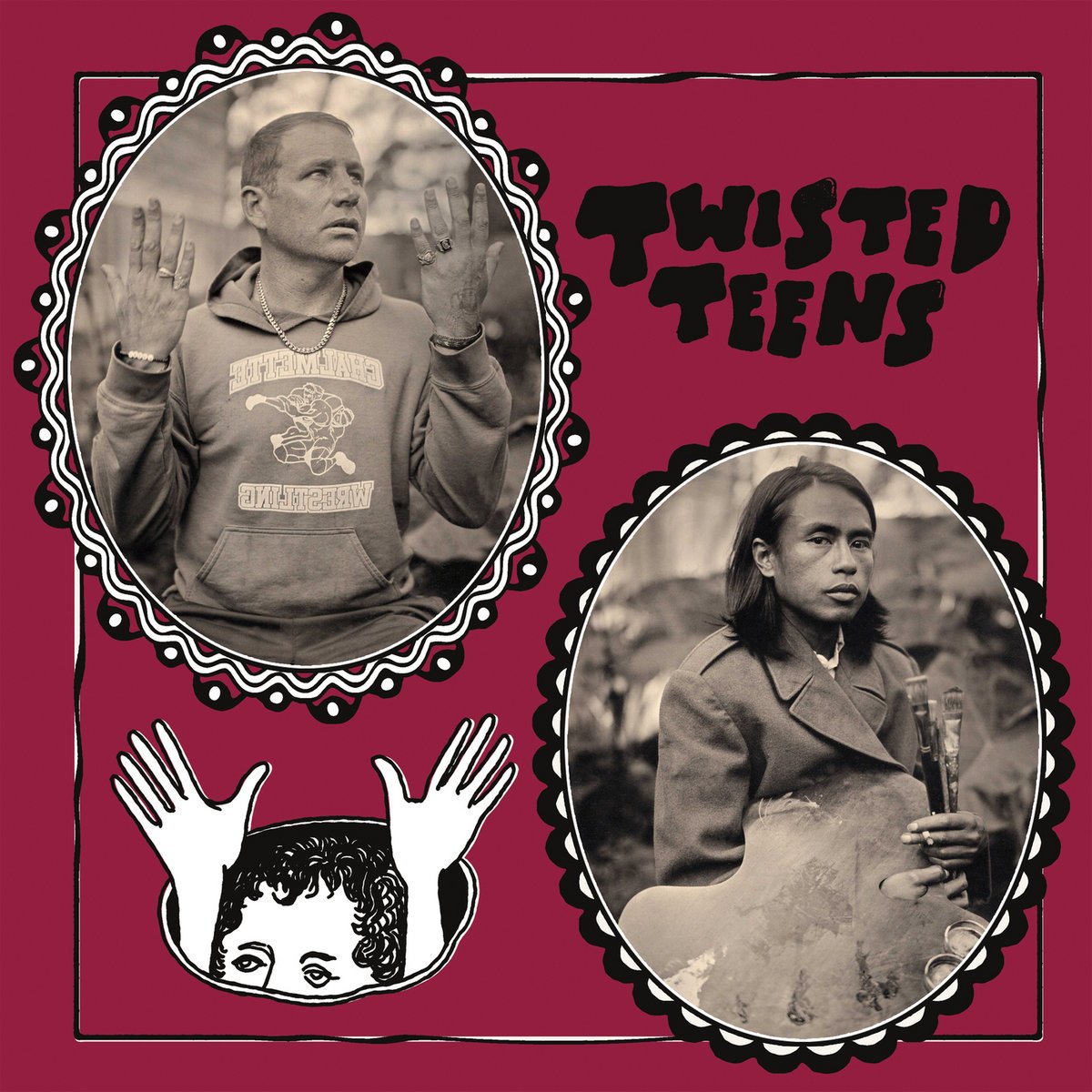
In many ways, Twisted Teens’ latest album, The Holy Cross Tigers, rides in the same desperate, empty boxcar towards Everywhere. Written in the aftermath of a breakup, Twisted Teens’ fourth album is a cynical examination of romance. In it, frontman Caspian Hollywell analyzes and often judges his actions and mistakes, speaking in cryptic yet accessible plainspoken verse. Backed by the phantom tones of RJ “Razor” Santos’ pedal steel, Hollywell circles through pain and recycles thematic concepts with a deadpan mania that feels particularly high-concept and effortless.
This blending of highly attuned sapience with a pragmatic embrace of playful imperfections seems to be the Teens’ modus operandi these days. Their ability to balance sincerity, intelligent self-examination and lackluster simplicity in their songs has shot them through the stratosphere, with a recent signing to Sub Pop Records, international tours, and an expansive new audience. The Holy Cross Tigers marks three full albums in 2026 alone and it’s hard to see the productivity ever dipping soon. The Teens’ formula, whatever it may be, is essentially a hit-making factory.
Throughout Tigers, the Teens’ sound is on the verge of glorious collapse. Their ceaseless drum machine and nuclear-fried rhythm guitar play leapfrog, each one continually feeling like it’s trying to catch up with the other. Santos seems to operate in his own universe on each track; his pedal steel continually screams over Hollywell's vocals, exhibiting his sneakily splashy style.
The thirteen fuzzed-out alternative punk, swamp-rock and country tracks are supposedly inspired by the notoriously emotionally heavy album Blood on the Tracks by Bob Dylan. Following in the shadow of that record, Tigers makes space for a similar emotional clairvoyance. Rather than tracing a relationship's downfall through mythic poetic epics like Dylan, Hollywell’s insistence on grounded realism helps Tigers feel relatable, honest and in many ways hopelessly harsh.
Hollywell’s open-heart diary writing is at its best when it synthesizes his general malaise and melancholy into hyper-specific moments of heartbreak. There is a brief, forlorn recollection of happiness in the George Jones-wino-infused lyrics of “When We First Met,” where Hollywell mourns the loss of confluence during the mundane moments with a partner. “Working on the bottle until the bottle was through/ Then I started thinking about all that we did together/ When we first met.”
On “Figure It Out,” Hollywell repeats the track’s name over and over, creating a mantra of confusion rather than enlightenment. His voice slowly dissolves while he repeats the phrase and as the desperation increases, so too does he lyrically spiral into incoherence. “And I’m better without/ Without and out/ And you’ll figure it out/ With him/ With out/ And you’ll figure it out/ Without me having to tell you.”
As the album closes, the hypnotic “Darker The Night Is The Brighter I See” finds the Teens willingly embracing the abattoir. The dark, psychedelic, unholy place that Hollywell sings of on this track is also the most transformative. It’s a place where destruction and its subsequent darkness become a new kind of light.
Maybe as crust-punk rail-riding hobos themselves, the Teens have a special understanding of the relationship between compulsion and longing. Maybe what makes The Holy Cross Tigers so tactile, so palpably real, is the transient experience. The Teens find oblivion and resurrection in these dusty tracks and perhaps, as the album closes, Hollywell and co. find Everywhere.
“It’s darker now than it used to be/ That’s the brighter I see.”