
by B.Snapp (@snappstare.bsky.social)
After a solid foundation of singles and EPs going back to 2023, Starcleaner Reunion have outdone themselves with their luminous debut LP, Umbrella. Their indie-pop/motorik infusion balances retro-futuristic nostalgia with Euro-chamber pop arrangements, easily summoning the likes of Stereolab and Broadcast, with hints of the band listening to Sing-Sing, Cocteau Twins, and maybe even Pizzicato Five, or other French-pop-inspired acts like them. So of course I wanted to know more about the band’s roots.
In the 1979 illustrated children’s book, The Starcleaner Reunion by Cooper Edens, there’s a call to action that’s fitting for the band who found their name there: “The time has come, my friend, for a reunion to recall the great deeds we began before there were years at all, or memories.” This group of friends, by all accounts, grew up in New Jersey, connected with each other through the love of sharing music, played in bands together in different configurations, and eventually gravitated north to New York City. They have since culminated their combined talents and passions into daydream-inducing music that transcends time.
There is a timelessness in their songs. Kinetic trance, reverie, and mesmerism begin to describe the music. Some of it oscillates, like My Bloody Valentine or Lush, and they incorporate suspension to increase the depth, like the krauty Harmonia and resonant chamber-pop of The High Llamas. On the record, Starcleaner Reunion layers a profusion of backing instruments to support and levitate the lead melodies. There’s the eloquent clarity of the vocals by frontwoman and lyricist Jo Roman. The arrangements feature guileless guitars and keys from Pat Drummond and Neil Torman accompanied by interwoven bass lines from Adam Kenter. It’s interesting to note that Torman and Kenter split drumming duties evenly across the album's tracks. These are the core four, who have had others join them to play live drums and make other sounds, so Roman can focus on singing and shaking a tambourine and the guys can play their multiple instruments.
Other guests on the record include Sarah-Louise Barbett, Talullah Calderwood, Drew Mullins, and Gary Olson. From clarinet, trumpet and banjo, to Philicorda, keyboards/synths, and aluminum cello, there is a tapestry of sound woven throughout, all mixed by Ruben Radlauer (Model/Actriz, Dirt Buyer). His father, Dan Radlauer was enlisted to stitch MIDI violin lines into “Never Odd or Even” and “Headlamp Hiker” — two songs that operate at the opposite ends of the metronome, to use a visual metaphor for the range of tempos the band employs. In fact, the latter is well-timed two-thirds of the way through, a sleeper giving a breather before the last three songs bring it home.
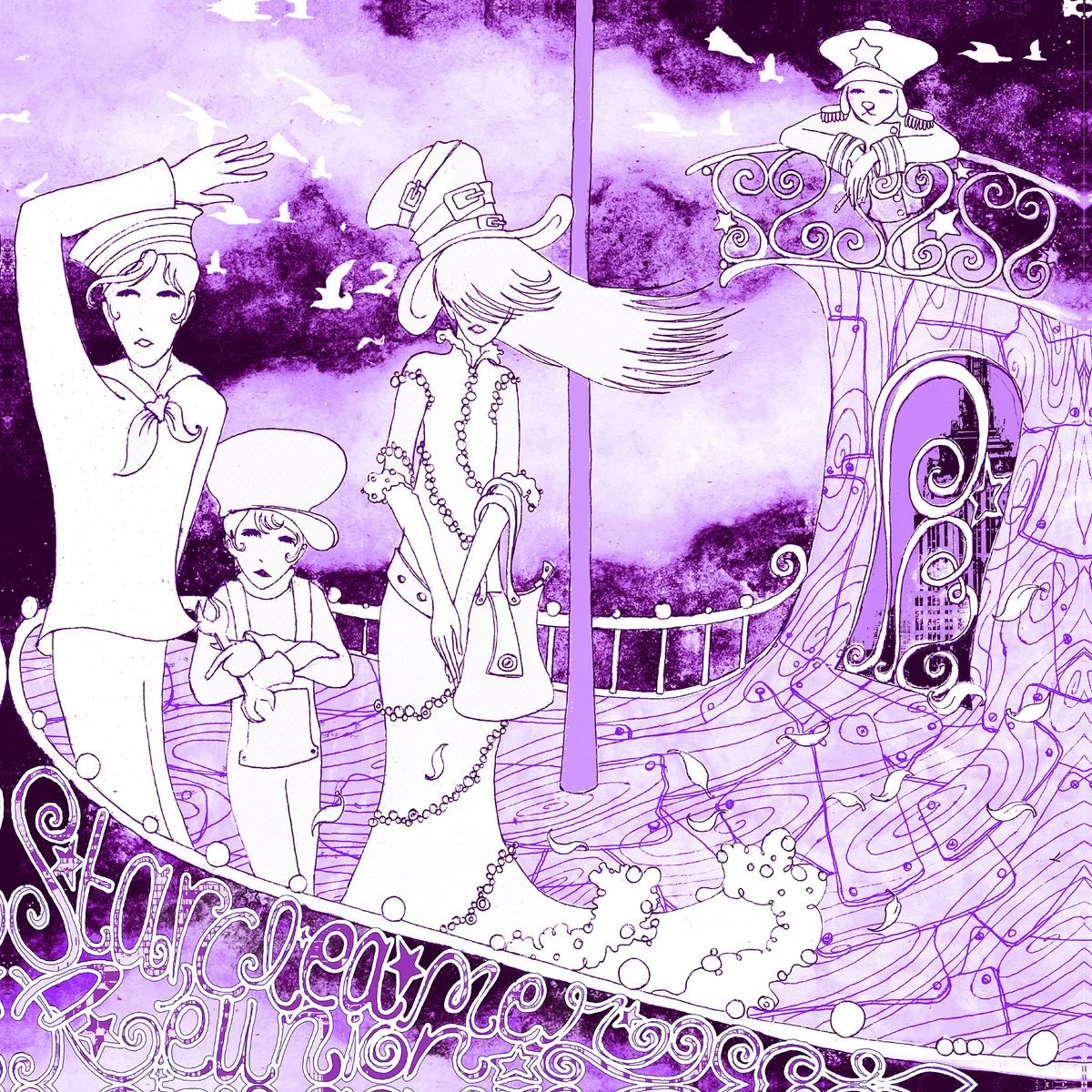
The band themselves take credit for engineering and producing the album. The sequencing of the songs provides a solid, connected journey — and if you look closely at the cover of the album, you’ll see the Empire State Building through a window of what appears to be the bow of an astral-nautical ship, indicating the journey begins and/or ends in the band’s new hometown, New York City. My own interpretation of the album’s title is threefold: an umbrella is a shield from unpredictable elements, a vessel for magical transportation (think Mary Poppins), and a conceptual canopy that envelops all that fits underneath. Whatever the intent, there is indeed an umbrella sound across the universe of songs.
“Theme” opens the album, setting up the expectation that you’ll love listening to these songs as much as finding your new favorite song on the radio. As good radio jingles go, they stick in your head as earworms. The song title “Maschine Mockup” refers to the process of drafting the MIDI layout for the tracks on a sampling workstation, fitting for a repeated flange sound that echoes the techniques of Cocteau Twins and MBV. “Weather Instrument” sounds like it could’ve sampled a halo of a Pizzicato Five riff for the intro, maybe it’s the horns. “Eating the Alphabet” has a recurring banjo addition, a lick casting a shadow across the whirring underpinnings to get lost in, that daydream feeling kicking in again.
“Tea Drops Park” is the track that awoke, hooked, and grabbed me when I first heard the album. It hits so many sweet spots — fuzzy, switched on, upbeat, curve-bending — put it on heavy rotation and add it to the monthly mixtape immediately. Like the theme song predicted, I found my song, and “I’d like you to sing along, this is my favorite song, I repeat it! on and on and on...” The lyrics of “Tea Drops Park” are wistful, a longing to have someone come over and just be, drink some tea, lie around, do the crossword, “watch tv with me in my house”... an unexpected narrative on this album and a plot twist. After examining the liner notes, that person may not be coming over after all. Maybe this is an expression of a want for normalcy, wrapped up in the most eclectic, unconventional-sounding orchestration on the record so far. It’s easy to forget everything else while listening, and just bask in the freshly cleaned starlight. Care for a parasol, anyone?