
by Rohan Press (@burnsoutatmidnight)
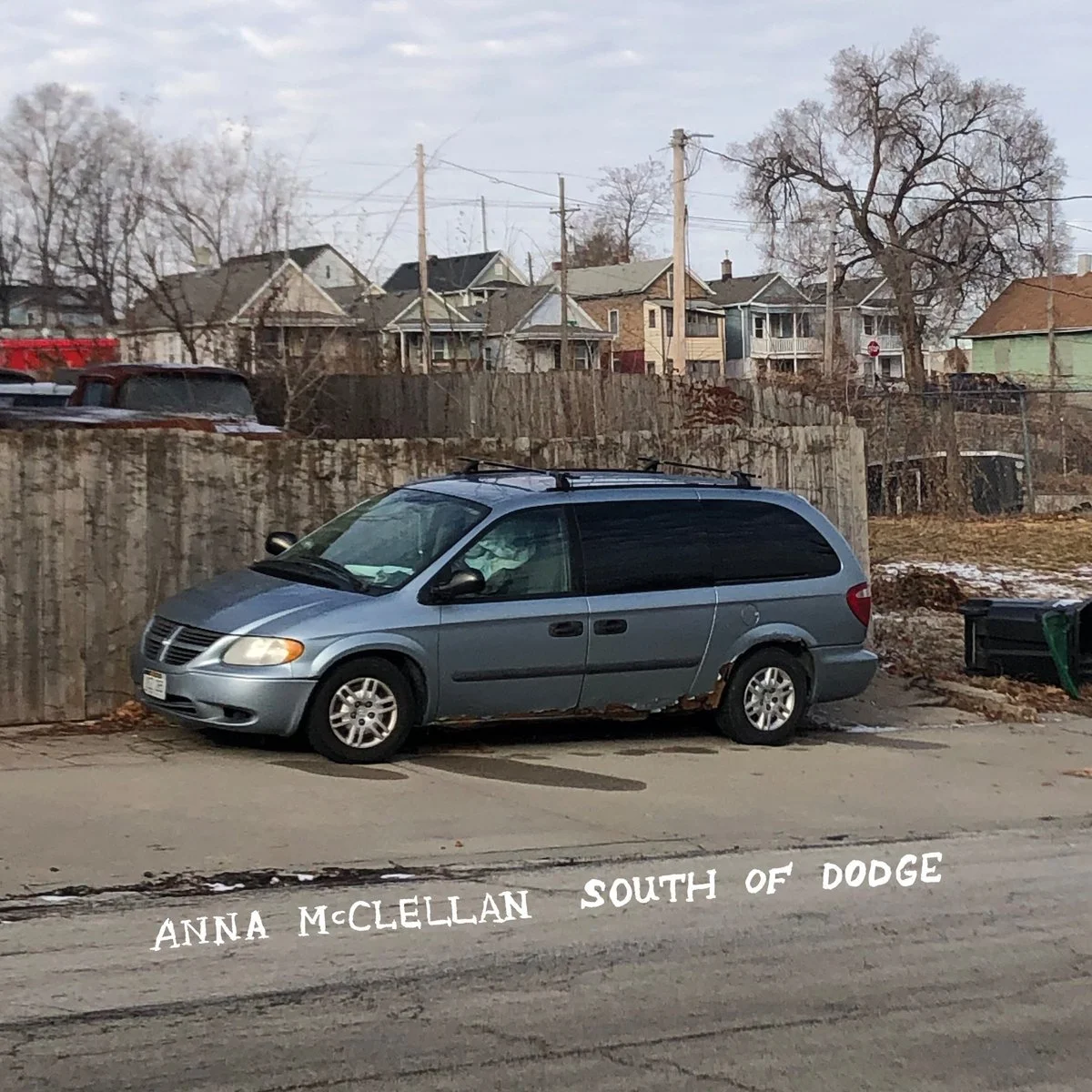
Anna McClellan is on her way home. “Can’t imagine being anywhere else,” her voice whisks atop the restless glitch of “Anywhere,” holding it all down. “And if the weather sucks, will you hold my hand? I don’t wanna feel like I don’t know where I am.” It’s that desire to be ultimately oriented, by both landscape and love, that connects most deeply to the singer-songwriter’s newest EP, South of Dodge. That title references Dodge Street, coextensive with US Highway 6, a significant east-west arterial bisecting McClellan’s hometown of Omaha and defining its cultural landscape. For McClellan, being south of that line marks something important about her orientation and groundedness in the Omaha scene that nurtured her musically, emotionally, and geographically.
Nebraska has always had a powerful musical lineage—Bright Eyes, Cursive, and (my favorite) Josh Rouse, to name a few—and McClellan carries the spirit of that place with care and complex attachment. The six songs that comprise South of Dodge were all written before 2023, while McClellan was still living in Omaha. Since then, she’s moved west and back east, ultimately landing in New York City. It took until now for McClellan to feel ready to record and finish the material, to give it a new home and to accept the old home from which it came. As expressed beautifully in Danielle Dietze’s album bio, these songs are “a way of looking backward without quite being able to return. [Omaha] shaped her, and it always will; this record allows it to become history. You can love something and let it go.”
In that way, these songs return to a primordial root, and acknowledge that it still gives life, while also accepting and owning up to the miles walked since, the growth-rings. It’s a difficult truth: that home can be a place you allow yourself to leave. When I reflect on this EP, I think about how I’ve also left behind my home, in Oregon, in some restless pursuit of self here in New England. I wonder often about what the American West still sustains in me. Again, I return to that line: “Can’t imagine being anywhere else.” In being re-recorded now, that sentiment comes to encompass both Omaha and New York. It also, perhaps most literally, means: finding a home, anywhere (as the song is titled), in the person you love, simply by holding their hand.
In fact, most of the songs on the EP are love songs, sometimes desperate, sometimes wistful, sometimes looking to run away, sometimes looking to run back. On their own, without any other narrative context, I hear a pervading spirit of restlessness in the material. “Keep on wanting all the things I know I can’t have,” she repines on “Drank Earlier,” stumbling desire intermingled with existential unmooring. Likewise on “A Spark / In Vain”: “I don’t know if anything that I do / matters even a lick or two.” The chords are almost always simple, while McClellan’s voice is strained and wobbly, sincere and pained. On “Nobody Wants Me,” a Robert Lester Folsom cover, she commits fully to her own self-pity and sounds strangely “classic” in the process. My favorite, though, is the bracing “Do You Want Me Like This”—balanced between thick, distorted guitar below and McClellan’s voice above, almost seemingly hoarse, as she tries to piece together intimacy and bewilderment:
to be honest i am teetering
in between things
way in my dreams
do you want me
do you want me like this?
All these songs, each three or four years old now, surely display a different Anna McClellan, caught up in younger anxieties and yearnings. But these are still songs that McClellan believes in voicing, for though she knows she’s come a long way emotionally, she also knows that change hides its own form of persistence. Reflecting on these songs now, I remember leaving Oregon on my eastbound drive across the country, which took me right through Nebraska, the point where the West yields to the East, the point where I knew I was really leaving home. South of Dodge allows me to hope I’m still carrying it.
Buttressed by their context here, at this moment and on this EP, that general question or spirit of restlessness becomes also a spirit of groundedness. Leaving and owning up become parallel gestures. What connects them, of course, is love—lost, battered, strained, sentimental, disappointed, anxious, absent, and yet right there, reaching and rising in McClellan’s voice.