
by Benji Heywood (@benjiheywood)
There’s a moment in the meta-documentary You Can See Everything when co-director Nathan Fielder shows the film’s subject, Elizabeth Holmes, a famous comedy sketch. It’ s a test of whether Holmes, an eccentric headed to prison for fraud, understands language beyond the objectively literal. As the sketch ends, Fielder asks her why it’s funny. An awkward exchange makes it clear that while Holmes knows she should find it funny, she can’t really explain why. Sitting in the theater, I recalled the title of the new gash album, at least you know what you’re laughing at. I’d been thinking about the Eau Claire band’s album a lot, and this odd exchange in the film made me wonder what the connection was.
As a collage of VHS-audio clips soundtracked by cut-and-paste rhythms and tangled guitars, at least you know what you’re laughing at is as much a conceptual artwork as it is a musical composition. It’s a shapeshifting album that’s by turns both beautiful and terrifying. How had the band, which until now had put out a couple of EPs, made such a (dare I say) Lynchian leap? To find out, I called the band’s founder and lead conceptualist, Logan Nyberg, who, alongside vocalist Breckelle Bathke, guitarist Mitchell Smuhl, drummer Eric Simmons, and bassist Ricky Christensen, has conjured one of the year’s stranger and more cinematic albums.
This interview has been lightly edited for length and clarity.
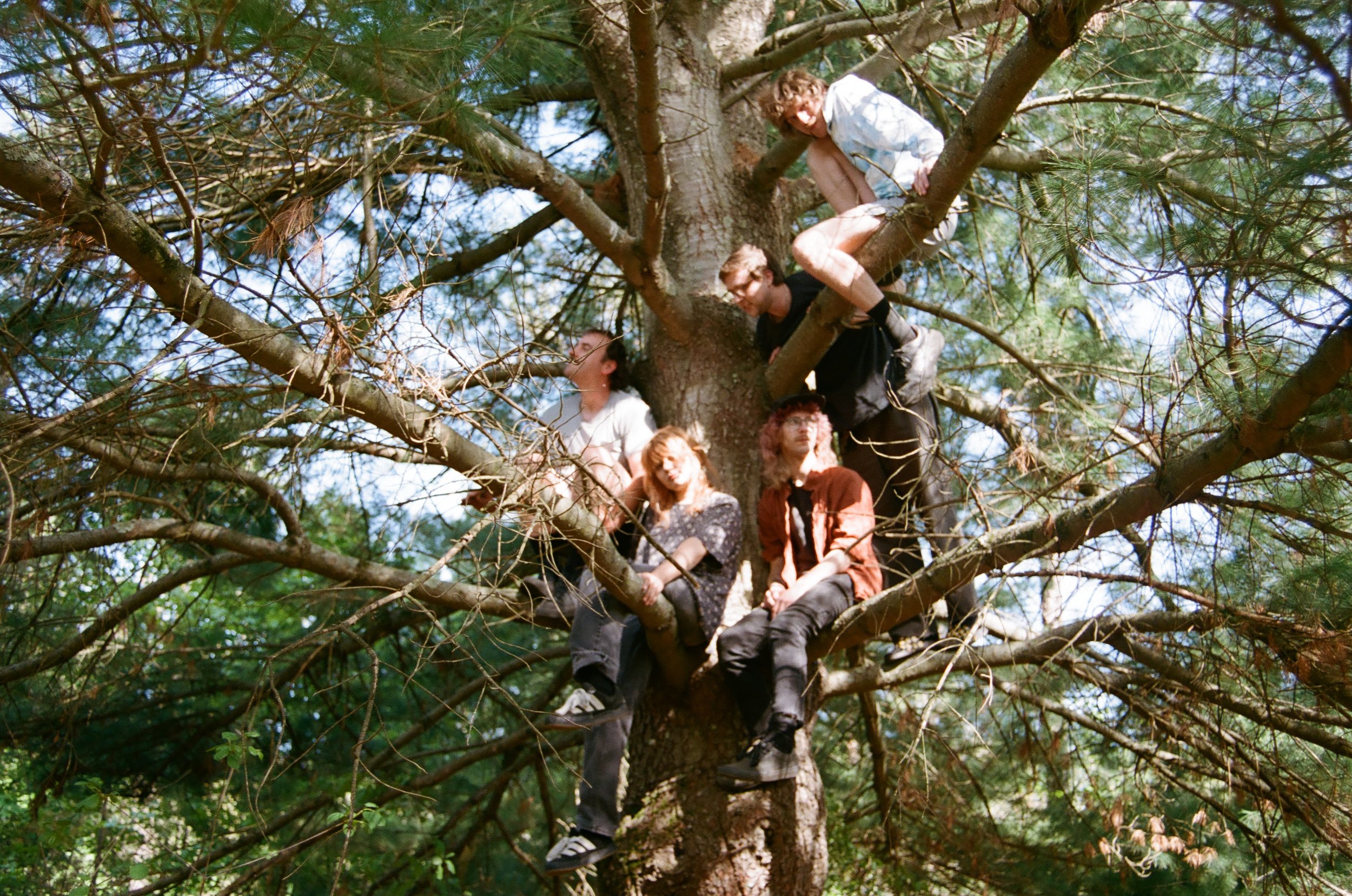
photo credit: Troy Hoyt
Post-Trash: How did playing [Bon Iver’s] Eaux Claires festival go?
Logan Nyberg: That was excellent! I think what really helped is we went on tour for ten days about a week before, and we got our set really dialed in. We played to amazing young crowds, and we played to terrible, sparse, older crowds, so we had a taste of everything in terms of playing our set. We were ready for whatever.
PT: I know y’all have been an integral part of Eau Claire’s DIY scene. Are you still hosting shows?
LN: Yeah, we just did Rash Fest on Saturday.
PT: What’s Rash Fest all about?
LN: We do it at a Masonic temple here in Eau Claire — I know the owner of it. I guess a lot of the Freemasons are just a bunch of old white guys, and they’re all dying, so they need to do good PR to get new members. A way for them to do that is to host events and get the public inside the building.
PT: Masonic temples tend to be pretty trippy, aesthetically.
LN: It’s a cool, old building downtown, but it’s always been creepy and cryptic, because no one ever goes inside or knows what goes on in there. They’ve got a big, beautiful ballroom in the basement that they let us do shows in. We do two stages, back-and-forth music the whole time. We did a rough count, and I think there were upwards of 300 people there this year. It was pretty crazy.
PT: Well, I love the new album. The press release I received mentioned the album contains audio from video clips that you digitized. What’s the story there?
LN: My grandpa had a VHS camcorder when I was growing up. He’d bring it out during family events or whatnot, and I remember they had all these tapes just sitting in a box. I was like, “Well, I should digitize them,” because otherwise they’d probably just sit there and no one would ever do anything with them. Since they degrade over time, I thought, better do it now before they get too fucked up.
PT: What was that experience like? Unearthing these early moments from your life?
LN: It was kind of cool looking back through it — nostalgic, and all the feelings you’d assume you’d get looking at camcorder footage of family events from when you were a child. But there were some human moments that felt universal that I really clung to. Those are some of the things I tried to use in the album.
PT: Can you describe one of those moments?
LN: At the end of the album, there’s a part taken from — I think it was my little sister’s birthday. She must have been turning one or two, and she was watching Teletubbies, and my grandma was cheering her on as she crawled on the ground: “Go, Brianna, go, go!” With the Teletubbies in the background, and my aunt there, I could just feel that place again. And I felt like other people could feel that too, if I posed it the right way in the music.
PT: Were you in the video?
LN: I think so. I think I might have been there — I can’t remember.
PT: It’s crazy, because what these songs feel like to me are snippets of memory that fade in and out. I feel like I’m coming in in the middle of them, and then they leave before I know what’s happening. Does that make any sense?
LN: Yeah, totally. I kind of got that. Have you ever heard of The Caretaker?
PT: Big time. Once a year my friend and I have “Caretaker Day” where we listen to the whole Everywhere at the End of Time cycle, which, for those who may not have heard of it, is an audio representation of losing your memory to Alzheimer’s.
LN: Exactly. So, I work at an assisted living and memory care facility. There’s nothing really like it. I’d say some of that kind of seeps into the music a little bit.
PT: Can you tell me a little bit about how that idea came to you? To use loops and field recordings and old VHS audio in the songs?
LN: I was interested in seeing how far you can push audio into the visual realm without actually using visual stuff, which I’d say started with our last record [304/62]. I’ve always kind of liked putting audio of something in with music. I remember in high school using GarageBand on my phone, recording a TV show on my phone, and then putting that into an instrumental. It makes [the music] weirdly more emotive in certain ways. But last year I got — there’s this band called Heavy Vegetable — and they’ve got this acoustic B-sides CD called Mondo Aqua Kitty. The last song on it seems like one long amalgamation of weird found footage: audio of people hanging out, a bootleg of a live song of theirs, and then very intimate acoustic performances. It’s all these things in one song that just go by, and I was like, “That’s really cool.” It literally sounds like a VHS tape, but it’s audio.
PT: We have film, we have music, and we have memory, and these seem to be the three themes I kept returning to when I was listening to the new record. How do those three things interact for you?
LN: That’s what I was trying to figure out with this record. I think it’s a really good [start] — but I’m not done exploring these [themes]. I don’t think I’ve completed my goal yet.
PT: Is it that something feels unfinished? Or is it just that the idea is still interesting to you?
LN: Both, yeah. The idea is still very much interesting to me. Sometimes it doesn’t even need to be musical to be interesting — there can be segues of non-musical stuff in a song, and that’s something I’d like to explore a little more and figure out how you’d do that with the live band or something. There’s still stuff to explore.
I’m starting to get an idea for our next record, and I was explaining it to everyone: I bought this nice boom mic, and I’d like to experiment with recording some of our instruments outside in certain places, just to see how it interacts with the environment, or if we could capture anything spontaneous. Instead of going to a studio for a week, we could spend the whole year doing impromptu recording sessions in different places that we like.
PT: Would you say you’re interested in figuring out where the boundary is between recorded music and capturing a moment that’s happening in real time? What I mean is: when you go to a show, you’re witnessing it, experiencing it; it’s happening right then. When you listen to an album, you’re experiencing something that happened at a different time. When I hear you describe what you’re trying to do, it sounds like you’re trying to figure out how to collapse those two different ways of experiencing into one.
LN: Right, totally. Because we record all our own music, it’s tough to say when something’s done, or if it’s done right the first time. That’s a problem we’ve had recording at studios before: you only have X amount of time to do it, and when it’s done, it’s done. How you did it then is how it’s gonna be forever. The music is time-stamped. That works for a lot of people, and it has worked for us in the past, too. But I think it’s more interesting to try to make something a little more timeless. Sometimes it’s more interesting for us to spend a longer period on a song and see how it can develop in different ways.
PT: At the risk of dulling the magic, maybe give us a look into how this album was made.
LN: Well, we added a new member, Breckelle Bathke, my girlfriend. She’s doing vocals and samples; she’s kind of a multi-instrumentalist in the band. But she doesn’t really have any formal music experience, so making this record was sort of our invitation to her to figure out where she shines within the music. And the easiest way for us to do that was — I had all these demos on my computer, and usually what we’d do is learn the demo, completely reconstruct it, and it’d be a completely different thing by the end. But this time, I tried to make a point of having all the songs stay in demo form. We didn’t try to learn anything; I would just play what I had, and everyone would come up with their parts over that.
PT: Can you walk us through a specific example of how this worked? Say, with “good and bad”?
LN: That was the first song we did for this record — we didn’t really know it was gonna be for this record, either. It was just a song we were working on. I started out wanting to make an obscure drum beat. I have a lot of recordings of our drummer, Eric, playing to a metronome at different BPMs, so I took a recording of his drums and slowly started layering stuff on top. It was very simple — just the drum beat you hear and the one guitar part. We went on tour, came back and listened to it, and Breck did a spoken word over the top of it. That was her first take. She just read this poem she had in her phone into the microphone, and I was like, “Oh, this is a different vibe.”
I think “good and bad” is the song where I started thinking about how I wanted everything to sound like a demo, because it wasn’t finished until everything else was finished. It was the first song we started and the last song we finished. There’s a version of it that’s like seven minutes long that’s gonna be on the cassette version — that was the original version. It’s got this long drone at the end. But yeah, it mostly started with me doing drums, looping them, and playing this guitar part, and then having Breck come on. Then I showed everybody else in the band, and Eric redid his drums and made them more for the song, and Ricky did his bass. It was pretty simple. Then at the end, there’s a sample of Breck saying that she’s the Joker.
PT: And then, the scream. It’s the stuff of nightmares, man. Or at least for me. I love a song or a piece of music where you can remember exactly where you were the first time you heard it, and I know exactly where I was the first time I heard this, because it scared the fucking shit out of me.
LN: (laughs) That’s great news, man. Glad to hear it. We were just chilling in my car one time, and she had a moment where she needed to scream, and she wanted me to record it. That was one of the early moments, too, where I was like, “I want more of these human moments to be captured.”
PT: Do you like horror films?
LN: Yeah, I do. Love horror movies. I’m a big movie guy. What inspired the new idea, where I want to record outside, is I’ve been watching a lot of the Werner Herzog documentaries. He’s always putting himself in very strange positions — where he’s either going to fail miserably, or it’s going to be an insane triumph that he pulled it off. And I’m kind of interested in seeing how we can put ourselves in similar positions when we record music.
PT: Before I let you go, do you have any movie recs for me?
LN: I saw a couple recently that were really good. There’s this Korean movie, Memories of Murder. I don’t think it was Bong Joon Ho, the guy who made Parasite — it might have been him [it was], but it’s got some of the same actors. It’s very much noir, detective, but it’s got some really good funny parts in it. I usually don’t like it when horror movies are funny, but they throw it in there amazingly.
PT: Last question. If you could soundtrack any director’s work, who would it be?
LN: That is a phenomenal question. Thank you for asking. I think it would be Werner Herzog, because I’d honestly just like to talk to him and pick his brain. He uses music in a lot of interesting ways in his documentaries and movies, and I’d be interested to talk to him about that very same thing — how movies and music work.
PT: He seems like the type of guy who, if you could get him in the right mood, would probably just talk to anyone. You never know!
LN: I know, yeah. I listened to his autobiography not too long ago, and he’s definitely someone I’d love to just chitchat with for a long time.
at least you know what you’re laughing at is out now on Angel Tapes.