
by Christopher J. Lee (@haijoondontbesad)
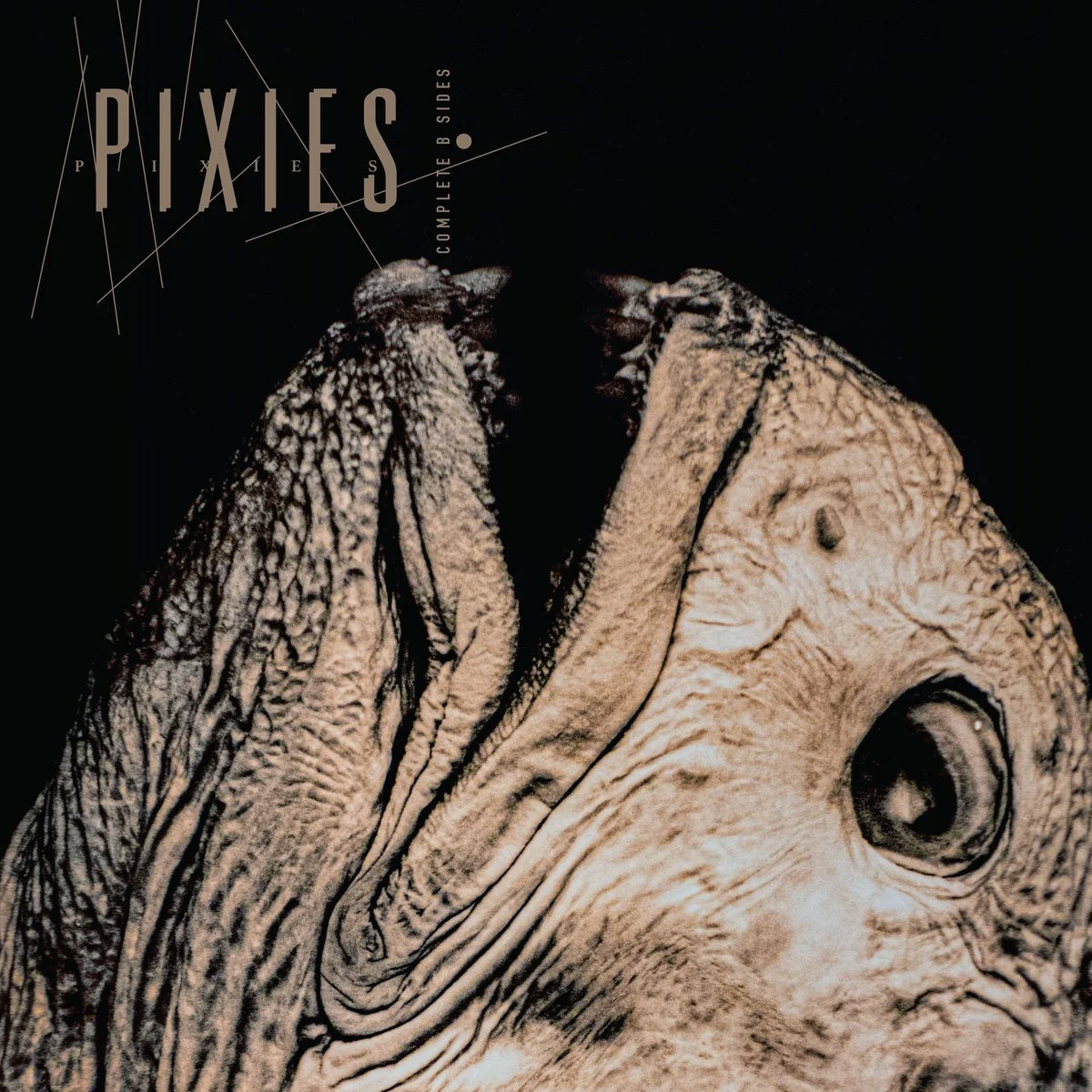
Qu’est-ce que c’est? The cover of Complete B Sides: 1988-97 has what looks to be a coelacanth, a prehistoric, bottom feeding fish once thought to be extinct but rediscovered alive in 1938. It’s a good joke. Compilations of this kind are often easy cash grabs for legacy acts, the Facebook Marketplace of LPs that make pay day by cleaning out what’s in storage. That said, Complete B Sides escapes this one-dimensional assessment by returning listeners to a lost world. It is a well-justified act of self-canonization. Call it the Jurassic period of indie rock or what have you, but Complete B Sides recalls a different time when the Pixies briefly ruled like no other band, before the meteorite of corporate alternative rock destroyed that era.
Though the Pixies are still touring and recording occasionally, the period of 1988 to 1993 (give or take) is the era when the band was unimpeachable. Their first three LPs from 1987’s Come On Pilgrim (a “mini-LP”) to 1989’s Doolittle sounded odd, exuberant, frenetic, and often on the brink of implosion. Sandwiched in between, Surfer Rosa is arguably their peak moment—an effort famously disparaged by its own producer/engineer Steve Albini (“a patchwork pinch loaf from a band who at their top dollar best are blandly entertaining college rock”), which would seem like a calculated move of reverse psychology if Albini wasn’t already acknowledged as being unapologetically direct and often caustically so. Albini aside, Surfer Rosa created its own blast radius that affected every band that came after. The warm jangle pop of R.E.M. and the barroom Americana of the Replacements that dominated college radio at the time seemed instantly dated.
Harnessing the speed and volume of Hüsker Dü with the angular art punk of Gang of Four, Black Francis, Kim Deal, Joey Santiago, and David Lovering became known for a loud-quiet-loud approach that grounded their charisma. Perhaps too much so. While this characterization is not untrue, it might be more accurate to say that they were skilled at musical arrangement. Listening to Complete B Sides does not reveal any obvious or recurrent formula in relation to volume (it’s all loud much of the time) but instead a band that mastered instrumental restraint or excess depending on the mood or task at hand. Take the opening track as an example: “River Euphrates” (from the Surfer Rosa sessions) which starts like gangbusters and then pulls back almost immediately only to lurch forward again, all in the space of its first minute. With incoherent, if melodic, backing vocals from Deal and animalistic shrieks from Francis abetted by the queasy guitarwork of Santiago, it is a disorienting start that captures the teetering chaos that the Pixies could conjure in a matter of seconds. Only Lovering’s percussion provides a throughline of structure and apparent sanity through the song’s three-minute mayhem.
The remainder of Complete B Sides further elaborates this argument across its twenty-five tracks, eighteen of which are previously released B-sides plus seven concert recordings. Tracks like “Into the White,” which unambiguously foregrounds Lovering’s drums and Deal’s bass line for a solid thirty seconds followed by Deal’s vocals and then, finally, guitars by Francis and Santiago, is a prime illustration. It’s as if you can hear the song being constructed in real time, whether as a reflection of deconstructionist intention or a young band still learning to reach their full musical potential. Probably both. Yet, other features also come into the foreground. To wit, there is an unusual debt to early rock and roll on tracks like “The Thing,” “Manta Ray,” and its sibling, “Dancing the Manta Ray,” both of which impart a 1950s sock hop vibe, albeit with greater weirdness and much less innocence. Debts are paid to Neil Young (“I’ve Been Waiting for You” and “Winterlong”), the David Lynch film Eraserhead (“In Heaven (Lady in the Radiator Song)”), and the 80s video game Narc (“Theme from Narc”), providing an eccentric Rosetta Stone of cultural influences.
A standout feature of Complete B Sides, however, are the vocals of Black Francis, namely his frequently unhinged delivery that equivocates between deranged and borderline frightening depending on the track. He’s a total beast on many songs with their live version of “Tame” (from Doolittle) arguably being the defining track of this compilation. Alternating between screaming and hyperventilating, Francis unleashes a schizophrenic energy of psychopathic delusion and terror. It’s a gripping kind of dark charisma, and it makes retroactive sense that the head-trip single “Where is My Mind?” from Surfer Rosa has ended up being their signature hit. Kim Deal’s edgy voice provided a feminine contrast that equally defined the Pixies, but her pivotal contributions (with the exception of “Into the White”) are mostly absent on this release.
Stage personas are hard to sustain and, for the most part, exceedingly rare. David Bowie, Lou Reed, and David Byrne come to mind with varying degrees of success. Complete B Sides implies that the unstable, psycho-killer aspect of Black Francis’ stage presence may have been taken for granted. Unheralded or not, the vocal chemistry between him and Deal certainly contributed to the mythos of the early Pixies, a dynamic that genuflected more to Bonnie and Clyde than, say, Fleetwood Mac. Intentionally or not, it suited an era defined by Lynch’s Wild at Heart and Quentin Tarantino’s first films. Yet even madness has its limit. The Pixies did not so much decline as become gradually and quietly sane.